One of the best tools for healing is reading. Scripture calls us to be “transformed by the renewal of your mind” (Romans 12:2), and for most of the men and women we counsel, a steady reading habit is one of the most practical means of that renewal. A good book lets you sit with a wise guide for hours at a time, on your schedule, for the price of a lunch.
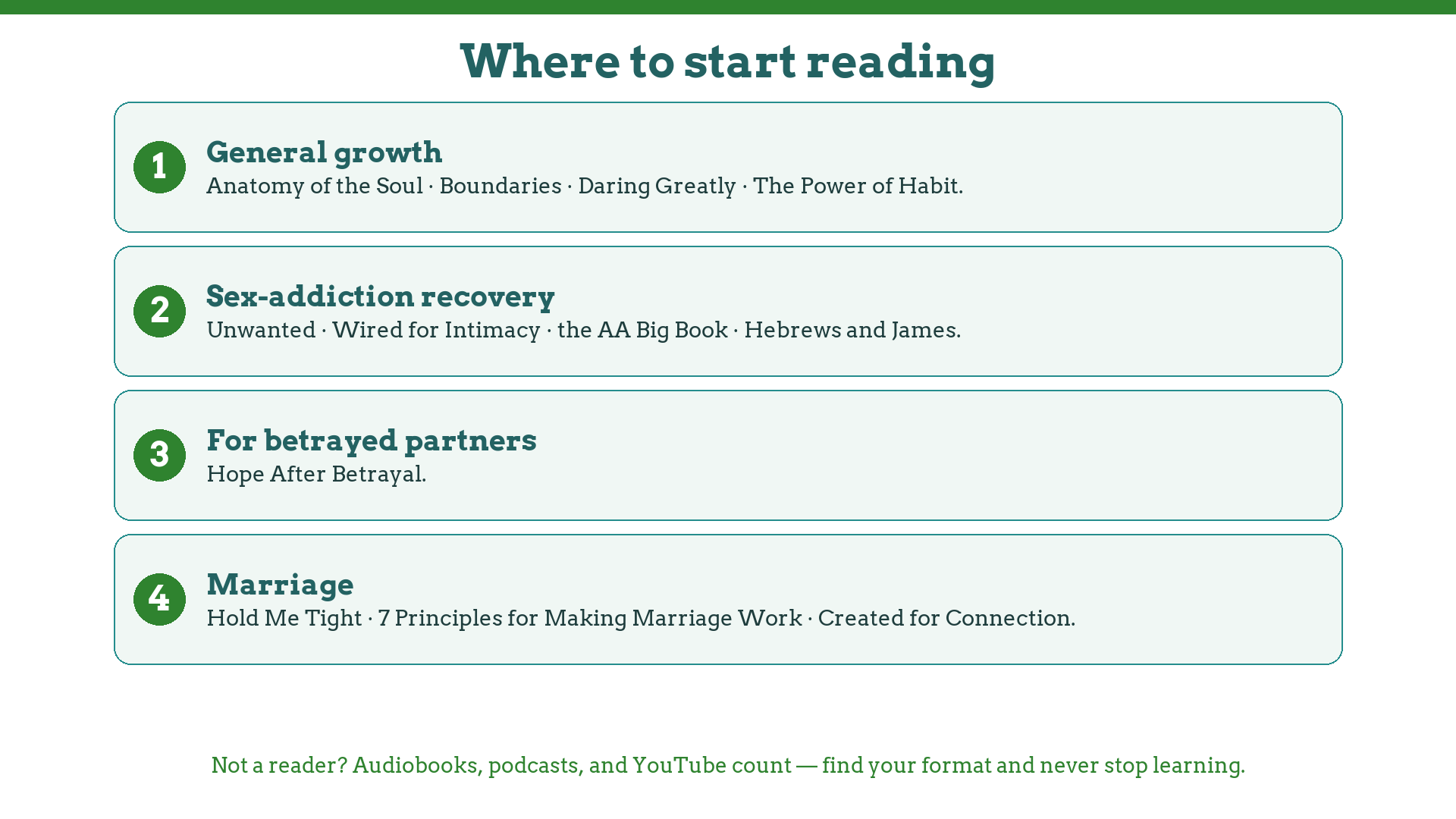
If you’re not a “reader,” don’t let that scare you away. Nearly every book below is available as an audiobook, and many of the authors also teach through podcasts or YouTube channels. The format doesn’t matter; the steady diet does. Pick one book from the section that fits your season, put it where you’ll see it, and give it fifteen minutes a day. If you’re working with one of our counselors, tell them what you’re reading: they will gladly connect it to what you’re doing in session.
Disclaimer: many links below are Amazon affiliate links. If you follow one and make a purchase, Restored Life receives a 4-6% commission.
General reading

We recommend these to many of our clients, even when addiction or marriage issues are not the main concern. They cover the foundations: how God designed your mind and body, how shame works, how habits form, and how to order a life.
- Anatomy of the Soul, by Curt Thompson. A Christian psychiatrist on how relationships rewire the brain, and why being truly known is central to healing
- The Soul of Shame, by Curt Thompson. Where shame comes from, what it does to you, and how the gospel answers it
- You Are What You Love, by James K. A. Smith. Why your habits and loves shape you more than your ideas do; the book behind much of how we think about formation
- The Body Keeps the Score, by Bessel van der Kolk. The standard work on how trauma lives in the body. Written from a secular frame, so read it with discernment, but the clinical insight is unmatched
- The Practice of the Presence of God, by Brother Lawrence. A short classic on walking with God through ordinary work; centuries old and still disarming
- The Divine Conspiracy, by Dallas Willard. A serious, joyful vision of discipleship as apprenticeship to Jesus in everyday life
- Daring Greatly, by Brené Brown. Vulnerability research that pairs well with The Soul of Shame
- Boundaries, by Henry Cloud and John Townsend. The classic on where you end and others begin; essential for people-pleasers and the chronically over-committed
- Emotionally Healthy Spirituality, by Peter Scazzero. Why you can’t be spiritually mature while remaining emotionally immature
- The Power of Habit, by Charles Duhigg. How habit loops work; useful groundwork for any recovery plan
- The Miracle Morning, by Hal Elrod. A simple morning-routine framework many of our clients use to anchor their day
- Deep Work, by Cal Newport. Focus as a discipline; surprisingly relevant to recovery from compulsive scrolling
- Grit, by Angela Duckworth. Perseverance research for the long middle of change, when novelty has worn off
Reading for sex addiction recovery

These are the books we hand to men and women fighting for sexual integrity. Start with Unwanted; it asks the question the others build on: not just “how do I stop” but “why do I want this in the first place?” For the theology of desire underneath the fight, add Keller and Luther.
- Unwanted, by Jay Stringer. Why your struggle follows the pattern it does, and what your story has to do with it. The first book we assign
- Wired for Intimacy, by William Struthers. A neuroscientist on what pornography does to the male brain, and how God designed intimacy to work instead
- Counterfeit Gods, by Timothy Keller. Idolatry as the engine under addiction: what you’re really reaching for when you reach for the counterfeit
- Sex Addiction 101, by Robert Weiss. A plain-language orientation to compulsive sexual behavior and recovery
- Alcoholics Anonymous Big Book. The original recovery text; the honesty and structure translate directly
- Sex Addicts Anonymous Green Book. The SAA basic text, if you’re working a twelve-step program alongside counseling
- Talking to Your Kids About Sex, by Mark Laaser. For parents who want their children’s story to start better than theirs did
- The Bondage of the Will, by Martin Luther. For the theologically hungry: why willpower alone was never going to be enough, from the Reformer who knew
- Bible reading: Hebrews and James. Perseverance, temptation, confession, and endurance, straight from the source
Reading for partners and betrayed spouses

If your husband or wife has betrayed you, the right book can put language to what you’re carrying and prove you are not crazy and not alone. These are written for the betrayed partner, not the addict. Read them in whatever order matches where you are; and if formal disclosure is ahead of you, our disclosure guide walks through that process in depth.
- Hope After Betrayal, by Meg Wilson. A Christian voice for wives in the aftermath of sexual betrayal
- Your Sexually Addicted Spouse, by Barbara Steffens and Marsha Means. The book that reframed partners as trauma survivors rather than co-addicts; validating and clinically sound
- Facing Heartbreak, by Stefanie Carnes. A structured workbook for partners walking through discovery and early stabilization
- Mending a Shattered Heart, edited by Stefanie Carnes. Answers to the questions partners actually ask: disclosure, the children, whether to stay
- Disclosing Secrets, by M. Deborah Corley and Jennifer Schneider. For couples preparing for formal disclosure: what to share, how, and with what support
Marriage books

Recovery that stops at sobriety leaves a marriage half-rebuilt. These books are for the rebuilding: attachment, communication, and a vision of marriage sturdy enough to carry two sinners for a lifetime.
- Hold Me Tight, by Sue Johnson. The accessible introduction to attachment in marriage, from the founder of Emotionally Focused Therapy; the frame behind much of our couples work
- Created for Connection, by Sue Johnson and Kenneth Sanderfer. Hold Me Tight rewritten for Christian couples
- 7 Principles for Making Marriage Work, by John Gottman and Nan Silver. Forty years of marriage research turned into practical habits
- The Meaning of Marriage, by Timothy Keller. The best single theology of marriage we know; read it together
- Love & Respect, by Emerson Eggerichs. A widely used framework for the ways husbands and wives miss each other
- The 5 Love Languages, by Gary Chapman. Useful vocabulary, with a caveat: knowing each other’s love language won’t save your marriage by itself
Save and share
Pin or share these — someone you love may need them today.