AI Use Disclaimer: This article was developed through a collaborative process utilizing advanced AI research tools to aggregate clinical data, theological insights, and consumer trends. While artificial intelligence assisted in structuring the outline and synthesizing research, the final content has been written, reviewed, and deeply refined by human experts to ensure accuracy and alignment with our values. Additionally, all citations in the bibliography have been manually verified by our team against the original source material.
Introduction – The Crisis of Fragmentation
The Core Thesis: Recovery is not merely the cessation of a behavior (sobriety) but the commencement of a new life (flourishing). True porn addiction recovery requires the rigorous integration of neurobiology and theology, treating the human person not as a broken machine or a disembodied spirit, but as an embodied soul designed for glory.
Beyond “White Knuckling:” A New Path for Porn Addiction Recovery
You have likely been here before, desperately seeking answers for porn addiction recovery. It is 2:00 AM, and the glow of the screen has just faded, leaving you in the dark with a familiar, crushing weight in your chest. Perhaps you made promises or installed the filters. Furthermore, you may have prayed with genuine tears on Sunday morning, telling yourself that “this time would be different.” Yet, here you are again, staring at the ceiling, wondering if you are simply too broken to be fixed.
Digital communities often refer to this cycle as “white knuckling.” It is the exhausting effort of fighting a nuclear war with a water pistol. Essentially, you are trying to use willpower to fight a neurochemical flood, and you are losing.
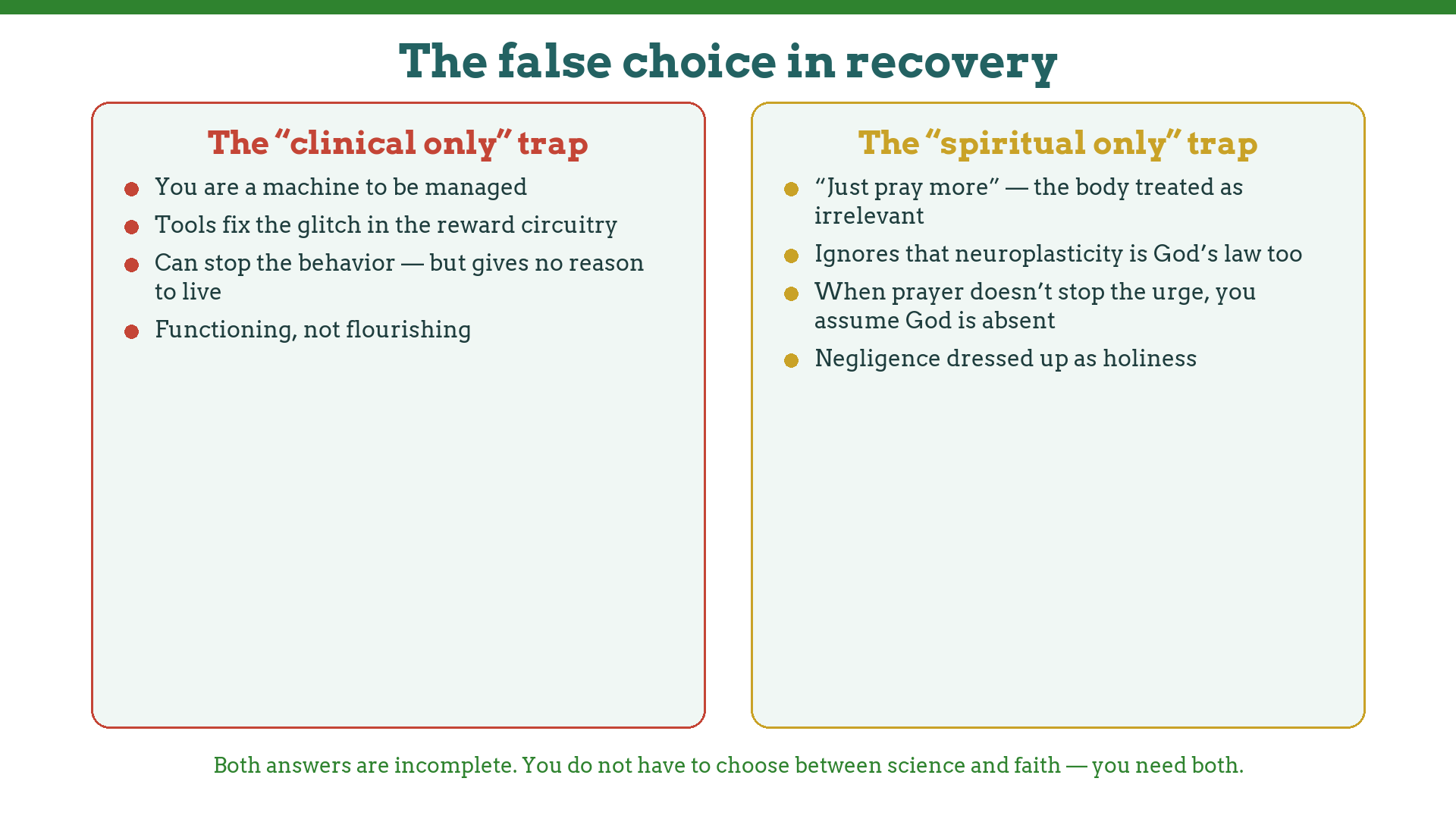
In the chaotic landscape of porn addiction recovery, you are often presented with a false dichotomy. On one side, the secular world tells you that you have a “brain disease” that requires management. On the other side, the church often implies you have a “faith problem” that requires more prayer. Both answers feel incomplete because, fundamentally, they are.
If you are local to the Phoenix area,Restored Life Counseling| 623-267-5849 | 17230 N 59th Ave Room 108, Glendale, AZ 85308 exists to bridge this gap. We operate on a different premise: You do not have to choose between science and faith. You need both. Effective porn addiction recovery demands that we treat the hardware of your brain with clinical precision while simultaneously reordering the loves of your heart with theological depth.
The False Choice in Porn Addiction Recovery
The modern recovery market is fragmented. It forces you to treat your body or your soul, but rarely both at once. This fragmentation is not just inconvenient; it is the primary reason for chronic relapse in porn addiction recovery.
The “Clinical Only” Trap
The clinical world offers a “mechanistic reductionism.” It views you primarily as a biological machine seeking homeostasis. In this model, addiction is a hijacking of the mesolimbic dopamine system. Consequently, the cure offered is often a set of cognitive tools, behavioral modifications, or pharmacological interventions designed to fix the “glitch” in your reward circuitry.
Although this is scientifically accurate, it is spiritually hollow. As noted in the medical literature [1], we understand how the brain is hijacked, but as the theological data clarifies [2], this does not explain why the heart was hungry enough to take the bait. A clinical-only approach can help you stop the behavior, but it cannot give you a reason to live. It addresses the bios (biological life) but ignores the zoe (spiritual vitality). You become a well-managed machine, functioning but not flourishing.
The “Spiritual Only” Trap
Conversely, the church often falls into the trap of “Functional Atheism” or Gnosticism. This view treats the body as irrelevant, assuming that spiritual disciplines alone should override biological realities. You are told to “just pray more” or “read your Bible,” as if these spiritual acts will magically dissolve the neural pathways etched by years of dopamine abuse.
This leads to a “God of the Gaps” mentality. When prayer doesn’t instantly stop the urge, you assume God is absent or that you are unforgivable. However, this approach ignores the doctrine of Creation. It fails to recognize that the laws of neuroplasticity are God’s laws, and that “renewing the mind” (Romans 12:2) is a biological event as much as a spiritual one [3]. Ignoring the body in the name of faith is not holiness; it is negligence.
Chapter 1: The Neurobiology of Enslavement (The “Fall” in the Brain)

Defining the Struggle: Addiction is not merely a weakness of character; it is a physiological entrapment of the brain’s survival machinery. It is the biological manifestation of the “Fall”—a corruption of the very faculties designed for connection and life.
The Anatomy of the Brain in Porn Addiction Recovery
You often ask yourself, “Why do I do this when I hate it?” The answer lies not in your lack of sincerity, but in the mechanics of your neurology. The doctrine of Total Depravity teaches that sin impacts every faculty of the human person—mind, will, and affections. Modern neuroscience confirms this theological truth with terrifying precision. Your brain has been hijacked.
The addiction you face is not a simple habit; it is a structural remodeling of your reward system. To fight it, you must understand the weapon that has been formed against you.
The “Supernormal Stimulus” in Porn Addiction Recovery
Historically, the human brain was designed to function in an environment of scarcity. Food, safety, and reproductive opportunities were rare and required significant effort to obtain. Today, however, you live in an environment of engineered abundance that your brain was never designed to handle.
Tinbergen’s Eggs: Preferring the Fake
In the mid-20th century, ethologist Niko Tinbergen discovered a strange phenomenon. He found that birds would ignore their own pale, speckled eggs to sit on giant, brightly colored plaster eggs he placed in their nests. The artificial egg was a “Supernormal Stimulus”—a fake version of reality that was more stimulating than the real thing [4].
Consequently, internet pornography functions as this giant plaster egg. It is a hyper-sexualized, pixelated illusion that is brighter, louder, and more accessible than any real-world partner could ever be. Your brain, acting on innate survival drives, mistakes this high-contrast input for a massive reproductive opportunity. It chooses the fake over the real because the fake “feels” more essential for survival. This is not just a bad choice; it is a biological trick.
The “Triple A” Engine
This supernormal stimulus is delivered via a delivery system known as the “Triple A” Engine: Accessibility, Affordability, and Anonymity [5]. In the past, consuming pornography required physical effort, social risk, and financial cost. Today, it requires only a thumb swipe.
Moreover, this removal of friction is catastrophic for the brain. There is no “cooling off” period between the urge and the act. The supply is infinite, meaning your brain never receives the signal to stop. You are drinking from a firehose of dopamine that was meant to be sipped, and your neurology is drowning.
Dopamine Dysregulation in Porn Addiction Recovery
Crucially, the primary currency of this hijacking is dopamine. Contrary to popular belief, dopamine is not the “pleasure molecule;” it is the “pursuit molecule.” It drives you to seek, hunt, and acquire.
The Coolidge Effect: Weaponizing Novelty
Why can you spend hours clicking from one video to another, even when you are physically exhausted? This is the “Coolidge Effect.” In biology, a male animal that has lost interest in a female partner will immediately regain sexual potency if a new female is introduced. Novelty overrides satiety.
In this context, digital pornography weaponizes this mechanism. By offering endless variety—different genres, bodies, and acts—it tricks your brain into resetting its refractory period over and over again. You are not “high libido;” you are chemically manipulated. This leads to binge sessions that deplete your neurochemistry, leaving you in a state of profound exhaustion and emptiness.
DeltaFosB: The Molecular Switch
While dopamine drives the immediate behavior, a protein called DeltaFosB locks you in the cage. Unlike other proteins that dissolve quickly, DeltaFosB accumulates in the brain’s reward center (the Nucleus Accumbens) with chronic use [6].
Think of DeltaFosB as a “molecular switch.” Once it flips, it changes the gene expression of your brain cells. It physically builds new neural pathways—like thickening cables—that link stress or boredom directly to pornography. This is why you can be sober for weeks and suddenly feel an overwhelming physical urge. The “flesh” (Romans 7) has literally built a structure in your brain to ensure its own survival.
The “Wanting” vs. “Liking” Paradox
Perhaps the most confusing aspect of porn addiction recovery is the loss of pleasure. You may find yourself frantically searching for content, desperate to watch it, yet feeling numbness or even disgust while you do.
Incentive Sensitization
Neuroscience calls this “Incentive Sensitization” [7]. Over time, the addiction decouples the brain’s “Wanting” system (craving) from its “Liking” system (enjoyment).
Specifically, the “Wanting” system becomes hypersensitive. A simple cue—a lonely apartment, a stressful email—triggers a massive spike in dopamine anticipation. You feel you must act. However, because your receptors are burnt out (downregulation), the “Liking” system offers no reward. You are left in the tragic state of craving something you no longer enjoy. This is the physiological definition of slavery: you are compelled to obey a master who pays you no wages.
The Tragedy of “Anhedonia”
The cost of this flooding is “Anhedonia”—the inability to feel joy. Because your baseline for stimulation is set so high by the supernormal stimulus, ordinary life feels gray. A sunset, a meal with friends, or intimacy with a spouse cannot compete with the high-voltage input of the screen.
As a result, you feel bored, flat, and lifeless. This is not just depression; it is a dopamine deficit. The theological tragedy here is profound. You lose the ability to enjoy the simple, good gifts of God’s creation. The idol has not only failed to deliver heaven; it has stolen the earth. But take heart: this state is reversible. The brain is plastic, and what has been bent can be bent back.
Chapter 2: The Executive Erosion & The “Flatline” (Symptoms of the Fall)

The Diagnosis: Addiction is not just a gas pedal stuck to the floor; it is a brake line that has been cut. “Hypofrontality” is the physical erosion of your willpower, and the “Flatline” is the terrifying—but temporary—silence that follows the storm.
Losing the “Brakes”: Hypofrontality
Many men have likely stared at yourself in the mirror after a relapse and asked, “What is wrong with me? I promised I wouldn’t do this.” You feel like a passenger in your own body, watching your hands type the URL even as your mind screams “No.”
However, this is not just a spiritual crisis; it is a physical malfunction known as Hypofrontality. Your brain has two primary drivers: the Limbic System (the accelerator) which handles survival drives, and the Prefrontal Cortex (the brakes) which handles logic, morality, and future planning. In a healthy brain, the brakes are strong enough to stop the car. In an addicted brain, the brakes have withered away.
The Atrophy of the Will
The Reformer Martin Luther wrote famously of the “Bondage of the Will” [8]. He argued that while we are free to do what we want, we are not free to choose what we want. The theological reality of ‘Incurvatus In Se’ [8] manifests biologically as ‘Hypofrontality’—the erosion of the brain’s executive control [9].
Cortical Thinning in the dlPFC
Research using MRI scans has shown that individuals with compulsive sexual behavior exhibit “cortical thinning” in the Dorsolateral Prefrontal Cortex (dlPFC) [9]. This is the specific region of the brain responsible for executive control and willpower.
For instance, when you say, “I will just use willpower next time,” you are relying on the very part of your brain that has been damaged by the addiction. It is like trying to lift a heavy weight with a broken arm. This explains why “Just Say No” is a failed strategy. You cannot out-think a broken circuit. You must rebuild it through time, nutrition, and the “Means of Grace” that allow for neurogenesis.
Delay Discounting: The Death of the Future
This erosion leads to a cognitive error called “Delay Discounting.” A healthy brain can weigh a small, immediate reward (pornography) against a large, future reward (a happy marriage, a clear conscience). The addicted brain cannot.
Consequently, the hypofrontal brain becomes “future-blind.” The future reward, no matter how immense, feels abstract and distant. The immediate reward, no matter how destructive, feels concrete and urgent. You trade your birthright for a bowl of stew not because you don’t value the birthright, but because in that moment, your brain can only see the stew.
Decoding Symptoms During Porn Addiction Recovery
If Hypofrontality is the mechanics of the disease, how does it feel to live inside it? The lived experience of the addict is often terrifying, defined by symptoms that feel permanent but are actually signs of withdrawal.
“Brain Fog”: The Cloud of Confusion
Frequently, you may feel perpetually “slow.” You struggle to find words in conversation. You walk into a room and forget why you are there. The online recovery community calls this “Brain Fog,” and it is a direct result of executive erosion [10].
Importantly, this is not early-onset dementia. It is a brain that is exhausted. Your dopamine system is so over-taxed by the supernormal stimulus that it has nothing left for daily cognitive tasks. You are running a marathon every night and wondering why you can’t walk to the mailbox in the morning. The good news is that clarity returns. As you starve the addiction, the fog lifts, and the sharp edge of your mind comes back.
“The Flatline”: Reframing the Silence
Additionally, perhaps the most terrifying symptom of early recovery is the “Flatline” [11]. After the initial struggle of withdrawal, you may hit a period where your libido vanishes completely. Your sexual drive, which once felt uncontrollable, is suddenly dead. You feel asexual, numb, and physically broken.
Rest assured, this is not permanent damage. It is a necessary recalibration. Your brain has downregulated its receptors to survive the flood of dopamine. Now that the flood has stopped, the remaining receptors are too few to pick up normal signals [11]. You are in a “dopamine depression.”
Chapter 3: The Somatic Toll: PIED & Autonomic Dysregulation
The Somatic Toll in Porn Addiction Recovery: Porn addiction recovery is not merely a spiritual reset; it is the physiological rehabilitation of a body that has kept the score of every click, every binge, and every collapse.
For many men, the most humiliating aspect of this struggle is not the guilt of the soul, but the failure of the body. You find yourself in bed with a spouse—someone you love, cherish, and desire—and your body refuses to respond. The shame is crushing. You assume you are broken. You assume you have destroyed your virility. But the clinical and theological reality is more complex: your body is not broken; it is bored.
To understand this, we must look beyond the spirit and examine the bios. The Apostle Paul writes that sin dwells in the “members” of the body (Romans 7:23). Modern neuroscience confirms this: your nervous system has been conditioned to require a supernormal stimulus to function. Recovery, therefore, requires a precise understanding of the somatic toll.
The Mechanism of PIED in Porn Addiction Recovery
Pornography-Induced Erectile Dysfunction (PIED) is a distinct clinical entity from organic erectile dysfunction. Organic ED is typically a vascular issue—a failure of blood flow often related to age or diabetes. PIED is a neurological issue—a failure of signaling.
The Threshold of Arousal
Over years of consumption, your brain has been trained to require a “Supernormal” level of stimulation to trigger arousal. The “Triple A” engine of internet pornography (Accessibility, Affordability, Anonymity) provides shock, variety, and high-speed novelty that no human being can replicate [12]. Consequently, this raises your arousal threshold to stratospheric levels.
When you are with a real partner, the stimulation is “normal.” It is intimate, slow, and singular. To a desensitized brain, this feels like a “low signal” input. The dopamine surge required to initiate the parasympathetic cascade of an erection simply does not occur. It is not that you do not love your partner; it is that your brain is waiting for the circus, and you are giving it a quiet dinner.
The “NPT” Litmus Test
How do you determine if your struggle is PIED or organic damage? The answer lies in the Nocturnal Penile Tumescence (NPT) test [13]. Healthy males experience erections during REM sleep (3-5 times per night) independent of their psychological state.
Therefore, if you wake up with erections or experience them during sleep, your hardware is intact. The blood flow is sufficient. The nerves are functional. The problem is not in your groin; it is in your head. This distinction is vital because it proves the condition is reversible. You do not need surgery; you need a reboot. You need to starve the supernormal stimulus so that the quiet beauty of reality becomes exciting again.
Autonomic Dysregulation: The Nervous System Loop
However, addiction is not just about sexual function; it is about the regulation of your entire nervous system. You use the screen to manage your internal state, oscillating between two dangerous extremes that prevent you from experiencing true peace.
The Ladder of States
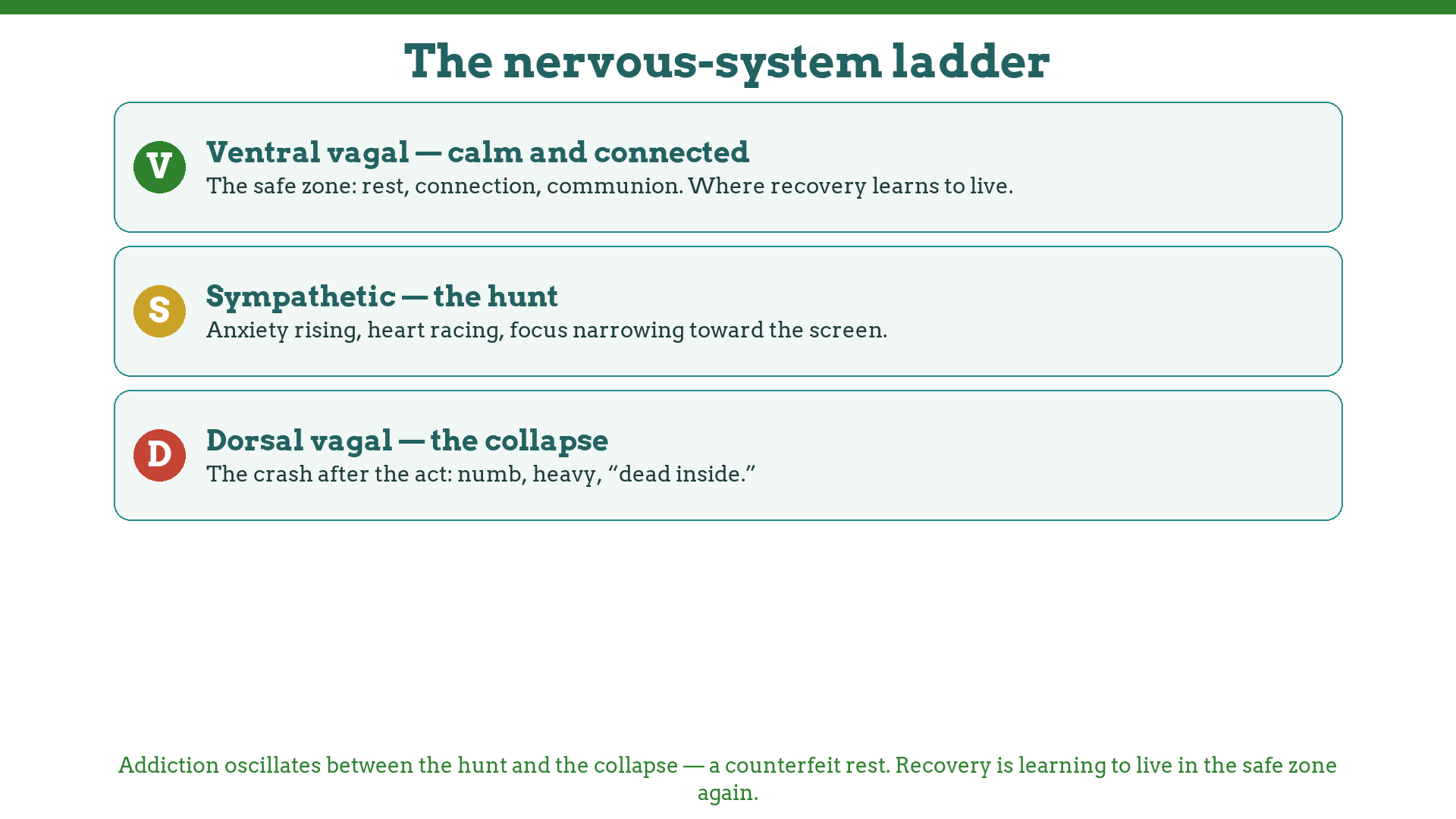
According to models of Autonomic Regulation, often popularized as Polyvagal Theory [14], your nervous system operates on a “ladder” of states. While the specific evolutionary timeline of this theory is debated, the physiological reality of these states is essential for recovery. A healthy person lives in the “Ventral Vagal” state—calm, connected, and safe. Addiction traps you in the lower rungs.
- Sympathetic Hyperarousal (The Hunt): Initially, you enter the Sympathetic state. This is the anxiety leading up to the act. Your heart rates rises. Your focus narrows. You are mobilizing metabolic energy to “hunt” for the perfect video.
- Dorsal Vagal Shutdown (The Collapse): Immediately after the act, you crash. This is the “shutdown” response. You feel numb, heavy, and “dead inside.”
The Theological Implication
Theologically, this oscillation is a counterfeit rest. You use porn to spike yourself up (Sympathetic) or numb yourself out (Dorsal), but you never truly rest in the “Ventral” safety of communion with God. Porn addiction recovery is the process of learning to live in the safe zone again, without the chemical crutch.
“Gooning” and “Edging”: The Dissociative Trance
This dysregulation explains specific, escalating behaviors often found in the “Deep Research” of addiction, such as “Edging” and “Gooning.”
Beyond Sexual Gratification: “Edging” involves masturbating for extended periods without reaching orgasm. “Gooning” takes this further, describing a state of dissociative trance where the user enters a hypnotic, zombie-like state [15].
Critically, these are not sexual acts in the traditional sense; they are dissociative acts. The user is not seeking libido release; they are seeking to escape the self. They are attempting to anesthetize the pain of the Incurvatus In Se (the heart curved inward) by erasing consciousness entirely.
The Clinical Warning: If you engage in these behaviors, you are likely not dealing with a simple “high sex drive.” You are dealing with a profound need for emotional regulation. You are using the screen to turn your brain off because reality feels too heavy to bear. Recovery, then, is not just about “stopping the sex;” it is about learning to tolerate the weight of being alive.
Chapter 4: The Theology of Design: Homo Adorans in Recovery

The Human Telos: You are not a survival machine fueled by instinct; you are a worshipping creature (Homo Adorans) designed for Covenantal Intimacy. Your addiction is not merely a biological error; it is a disordered search for the One who can truly know you.
What is a Human Being?
To effectively fix a thing, you must first know what it was designed to do. If you try to use a violin as a hammer, you will break it, not because the violin is bad, but because you have misunderstood its purpose.
On one hand, modern psychology often tells you that you are a “sophisticated ape”—a biological machine driven by the evolutionary need to survive and reproduce. Gnostic spirituality tells you that you are a “ghost in a machine”—a spirit trapped in a dirty body. Both are lies. You are an Embodied Soul. You are dust and breath woven together for glory. Until you understand this design, your porn addiction recovery will only be behavior modification, not restoration.
Imago Dei as Organism & Covenant
You were created in the Imago Dei—the Image of God. But this image is not just a static stamp; it is a dynamic function.
Mikrotheos & Mikrokosmos
Specifically, the Dutch theologian Herman Bavinck described the human being as Mikrotheos (Micro-God) and Mikrokosmos (Micro-Cosmos) [16]. You are a “Micro-God” because your spirit reflects the Creator’s ability to reason, love, and rule. You are a “Micro-Cosmos” because your body sums up the physical universe—you are made of the same carbon and water as the stars and the soil.
This distinction is crucial for recovery. Your body is not a cage to be escaped or a tool to be used for pleasure; it is the bridge between heaven and earth. When you use pornography, you are taking this cosmic bridge and turning it into a dead-end street. You are using the dignity of the Mikrokosmos to worship a pixel.
Lovers First, Thinkers Second
Frequently, we think that if we just “know” the right things, we will stop sinning. But as St. Augustine argued, and James K.A. Smith reminds us, we are primarily “Lovers,” not “Thinkers” [17]. You do what you love, not what you know.
Augustine famously prayed, “You have made us for yourself, O Lord, and our heart is restless until it rests in you” [18]. Thus, your addiction is not a result of not knowing that porn is bad. It is a result of loving the relief it promises. You are a Homo Adorans—a worshipping man. You cannot stop worshipping; you can only change what you worship. The goal of porn addiction recovery is not to kill your desire, but to heal your love.
The Nuptial Meaning of the Body in Porn Addiction Recovery
Furthermore, if you are a worshipping creature, then your sexuality is not just a biological function like digestion. It is a theological language.
Sexuality as Language
In essence, your body speaks. In the act of sex, the body says, “I belong completely, exclusively, and permanently to you.” This is the “Nuptial Meaning of the Body” [19]. Sex was designed by God to be a covenant-renewal ceremony—a physical way to say what the heart has promised.
However, pornography is a lie spoken with the body. It allows you to speak the language of intimacy (“I see you,” “I want you”) without the reality of the covenant. It is a monologue masquerading as a dialogue. You are shouting into a void, and the echo is deafening.
Yada: The Hunger to Be Known
In Genesis 2:25, Adam and Eve were “naked and not ashamed.” The Hebrew word for this intimacy is Yada—to know and be known. This is the deepest hunger of the human heart. You do not just want to see nakedness; you want to be naked—fully exposed, fully vulnerable—and yet fully accepted.
Tragically, pornography offers a demonic inversion of Yada. It offers you the ability to see (voyeurism) without being seen (vulnerability). It promises the thrill of intimacy without the risk of rejection. But this is a trap. It gives you the “fruit” of knowledge without the “tree” of life. You end up knowing everything about bodies, but nothing about people. You end up with a library of images, but a heart that is starving for a face.
Chapter 5: The Diagnosis of Desire: Incurvatus In Se and Recovery
The Spiritual Root: Your addiction is a “Worship Disorder.” It is the state of being Incurvatus In Se—curved inward on yourself—seeking to extract life from created things rather than the Creator.
The Geometry of Sin
Culturally, we often define sin as “breaking the rules.” But the Reformer Martin Luther offered a more penetrating definition, one that explains the mechanics of addiction perfectly. He called sin Homo Incurvatus In Se—man curved in on himself [20].
Centripetal vs. Centrifugal Love
By design, your heart was created to be Centrifugal—moving outward to love God and neighbor. Addiction creates a Centripetal force—collapsing the universe into the self.
Consequently, in this state, other people cease to be image-bearers with their own needs and dignity. They become “Instrumental.” You view the woman on the screen not as a person, but as a utility—a tool for your gratification. The world becomes a resource to be consumed rather than a garden to be tended. This curvature is the essence of isolation. The more you feed the self, the smaller your world becomes, until you are trapped in a hall of mirrors where you see only your own hunger.
Gnostic Fracture: Knowledge Without Commitment
Inevitably, this inward curve leads to a “Gnostic” way of relating to the world. You seek “Knowledge without Commitment” [21]. You want the knowledge of intimacy (seeing nakedness) without the commitment of a relationship (sacrifice).
Fundamentally, this is a theft. You are trying to steal the benefits of marriage—comfort, pleasure, relief—without paying the cost of love. But intimacy without cost is cheap, and cheap things do not satisfy the human soul. You are left with a “disincarnate spirituality,” floating above reality, disconnected from the messy, beautiful work of loving real people.
Diagnosing Desire in Porn Addiction Recovery
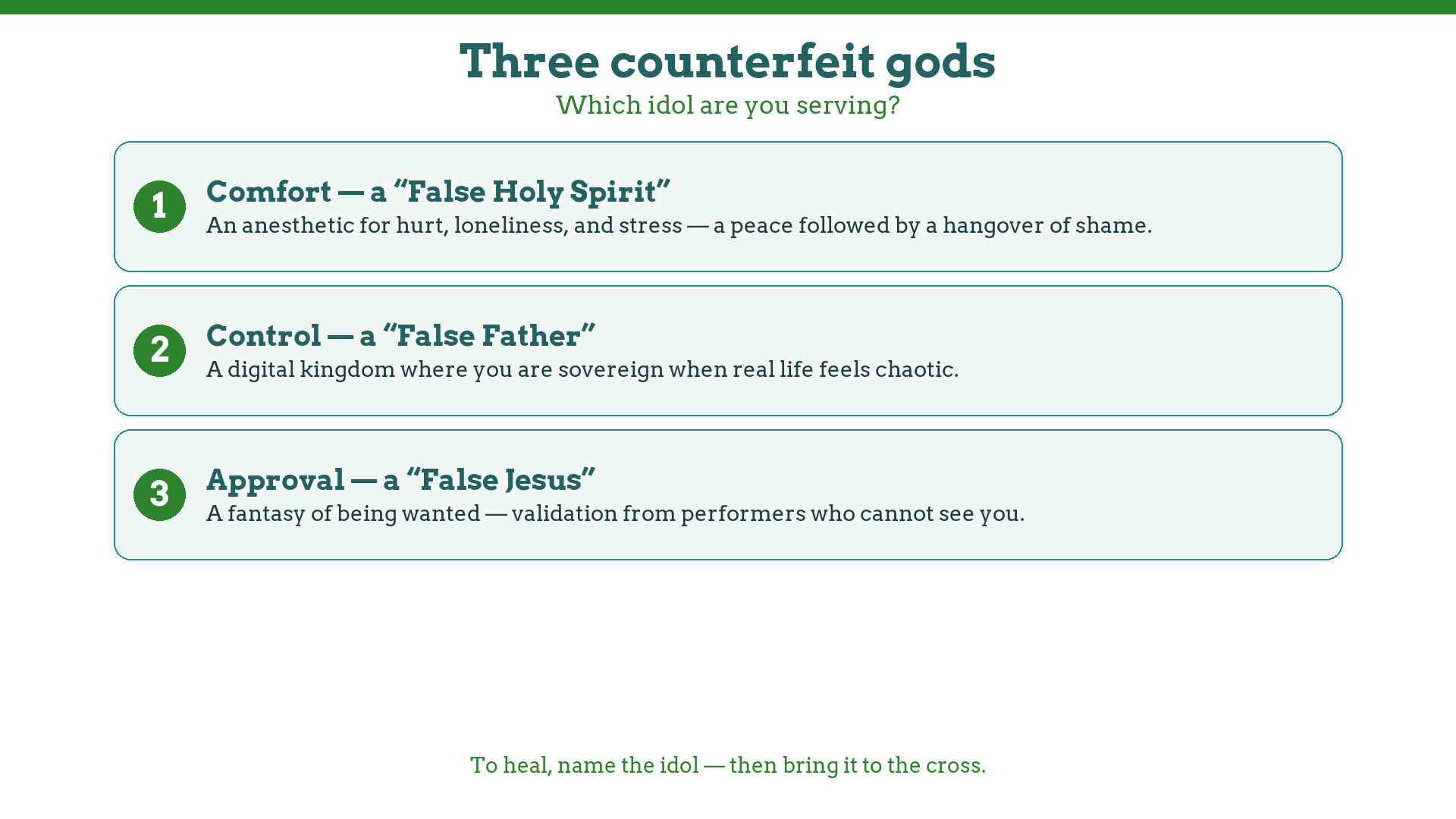
Since you are a worshipper, your addiction is an act of liturgy. You are going to the screen to get something you believe you need for life. Pastor Timothy Keller calls these “Counterfeit Gods” [22]. To heal, you must identify which idol you are serving.
The Function of False Gods
In our pursuit of healing, understanding the specific role these idols play is critical. They are not random; they are functional.
- Comfort Idols: The “False Holy Spirit”
For many individuals, pornography is an anesthetic. You use it when you are hurt, lonely, or stressed. You are seeking a Comforter. You want to be held, soothed, and told that everything will be okay. Functioning in this mode, pornography acts as a “False Holy Spirit.” It offers a temporary peace, a moment of numbness where the pain of the world fades away. But unlike the true Comforter, this peace is followed immediately by a hangover of shame. - Control Idols: The “False Father”
In contrast, real relationships are unpredictable. A spouse has moods, needs, and boundaries. They can reject you. Pornography is safe because it is controllable. You choose the video. You choose the timing. You are the sovereign of that digital world. In this scenario, pornography functions as a “False Father” or “False King.” It gives you a domain where you are in charge. If your life feels chaotic—your job is stressful, your finances are tight—you retreat to the screen to regain a sense of power. You are worshipping control. - Approval Idols: The “False Jesus”
Often, deep down, you may feel unworthy. You feel unnoticed or unattractive. Pornography offers a fantasy where you are the object of intense desire. The actors on the screen perform as if you are the most desirable person in the world. Theologically, this is a “False Jesus.” It offers you a form of Justification—”I am wanted; therefore, I matter.” But it is a hollow validation because you know, deep down, that they do not see you. They are performing for a lens, not for you. You are drinking salt water to quench a thirst for love.
Chapter 6: The Betrayal: Betrayal and Porn Addiction Recovery

The Partner’s Reality: The impact on a spouse is not “codependency;” it is Betrayal Trauma. It is a violation of the “One Flesh” covenant, functionally equivalent to adultery of the heart, requiring justice and safety before intimacy can be restored.
The Shattered Covenant
Perhaps you tell yourself, “It’s just images. I never touched anyone. It’s a victimless crime.” This is the deception of the Incurvatus mind. In a covenant marriage, there is no such thing as a private sin.
However, when you entered into marriage, you made a vow of exclusivity. You promised that your sexual energy, your gaze, and your intimacy would belong solely to your spouse. Pornography is not just a “bad habit”; it is a breach of contract. It is the siphoning of covenantal resources—your passion, your attention, your dopamine—away from the marriage and into a void. To your partner, this discovery is not a “struggle” you are having; it is an affair you are hiding.
Validating the “Trauma Model”
Historically, for decades, the psychological community labeled partners of addicts as “codependent,” implying they were part of the sickness. We reject this. The “Trauma Model” recognizes that the partner is a victim of a traumatic event, often displaying symptoms identical to PTSD [23].
“The Trophy Wife:” Pornography as a Rival
Frequently, partners describe pornography not as a substance, but as a person. They call it “The Other Woman,” “The Mistress,” or “The Trophy Wife” [24]. This metaphor is devastatingly accurate.
Specifically, the “Trophy Wife” on the screen is always available, always willing, and never demands anything in return. She has no bad days, no needs, and no flaws. She is a “Hyper-Real” rival that no real woman can compete with. When your partner looks at you, she wonders, “Is he comparing me to her?” This is not insecurity; it is a rational response to your betrayal. You have introduced a third party into the bed, stealing the gaze that belongs only to your wife.
Safety vs. Sobriety
Unfortunately, a common error in recovery is assuming that “stopping” (sobriety) is enough to heal the marriage. It is not. Your partner does not just need you to be sober; she needs you to be safe.
For example, a “Dry Drunk” is someone who stops drinking but remains angry, secretive, and defensive. For a partner, this is terrifying. She asks herself, “He isn’t watching it today, but is he thinking about it? Is he white-knuckling it?” Safety comes from transparency. It comes from you initiating the conversation about your triggers before she has to ask. Sobriety is what you do for yourself; Safety is what you do for her.
Chapter 7: Integrated Porn Addiction Recovery: The “Means of Grace” for the Brain

Define Integrated Practice: Integrated Practice is the refusal to separate the physical from the spiritual. It is using clinical tools like CBT and EMDR not as secular alternatives to God, but as “Means of Grace” to steward the body and renew the mind.
Dismantling “Functional Atheism”
Regrettably, a dangerous idea has taken root in many churches: the belief that if you use psychology, you are relying on “fleshly wisdom” instead of God. This creates a split in your soul. You pray for your heart, but you ignore your brain.
We term this “Functional Atheism.” It assumes that God is only present in the miraculous and absent in the mechanical. It assumes He works through prayer but not through neuroplasticity. This is false. The God who commanded “be transformed by the renewing of your mind” (Romans 12:2) is the same God who designed the synaptic clefts where that renewal happens. You do not have to choose between God and science; you must learn to see science as a description of God’s handiwork.
The Physiology of Sanctification in Recovery
Ideally, Sanctification—the process of becoming holy—is not just a spiritual abstraction. It is a biological event. When you change a habit, you are physically remodeling the architecture of your brain.
Neuroplasticity as Common Grace
Technically, neuroplasticity is the brain’s ability to rewire itself based on experience. “Neurons that fire together, wire together.” Every time you resisted an urge in the past, you weakened the addiction pathway (Depotentiation). Every time you chose a healthy behavior, you built a new pathway (Synaptic Genesis).
Theologians identify this as “Common Grace” [25]. It is a mercy built into the fabric of creation. God has given you a plastic brain that is capable of redemption. You are not “hardwired” for sin; you are “wired” for habit, and those wires can be moved. When you engage in therapy, you are not bypassing God; you are actively cooperating with His design for your restoration.
“Trying” vs. “Training”
Notably, the philosopher Dallas Willard made a critical distinction between “Trying” and “Training” [26]. “Trying” is what you do in the moment of crisis—gritting your teeth and hoping your willpower holds. “Training” is what you do when you are not tempted, to build the strength you will need later.
Simply put, you cannot “try” your way out of addiction any more than you can “try” to run a marathon without training. Spiritual disciplines and clinical tools are the training. They build the “muscle” of the Prefrontal Cortex so that when the urge hits, you have the neurological capacity to say no.
Somatic Tools as Spiritual Disciplines
If indeed the body is a temple, then clinical tools are the janitorial supplies. They help clear the clutter so worship can happen.
- EMDR: The “Sanctification of Memory”
Frequently, trauma gets stuck in the body. You may have memories of abuse or neglect that trigger deep shame, driving you to the screen for relief. “Eye Movement Desensitization and Reprocessing” (EMDR) is a therapy that helps the brain process these stuck memories [27]. You can think of EMDR as the “Sanctification of Memory.” It does not erase the past, but it removes the sting. In an integrated session, we might invite the presence of Christ into the traumatic memory. We allow His truth to rewrite the narrative of abandonment. This is not just psychological relief; it is the redemption of your personal history. - CBT: “Taking Thoughts Captive”
For instance, the Apostle Paul commands us to “take every thought captive to the obedience of Christ” (2 Corinthians 10:5). Cognitive Behavioral Therapy (CBT) is the practical “how-to” for this command. Specifically, CBT teaches you to catch “Automatic Negative Thoughts” (e.g., “I am a failure,” “I need porn to relax”). You identify the lie, stop it, and replace it with truth. This is not secular humanism; it is biblical wisdom operationalized. When you use CBT to dismantle a lie, you are engaging in spiritual warfare using the weapons of logic and truth that God gave you.
Chapter 8: Integrated Recovery II: Urge Surfing for Recovery
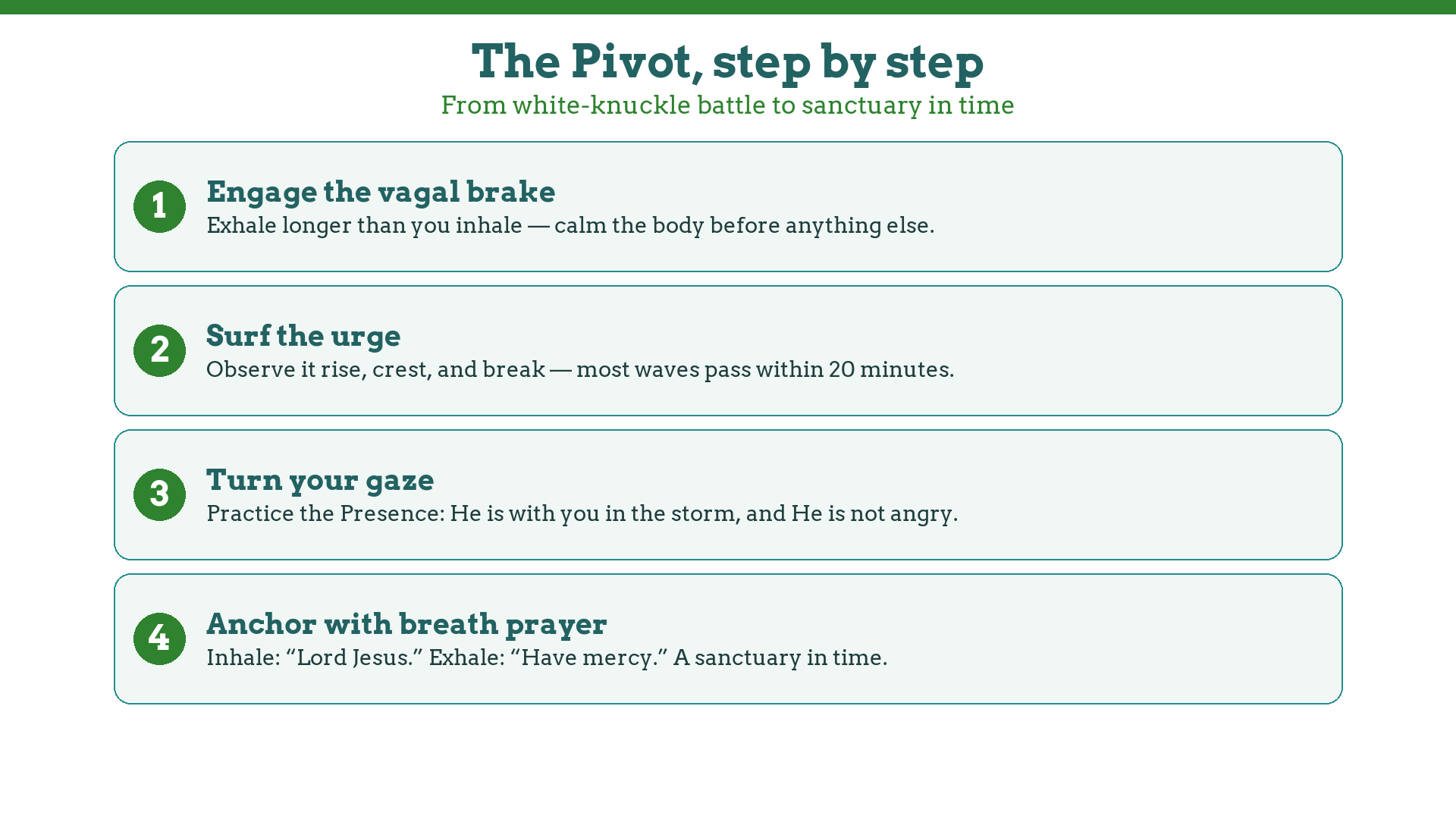
The Pivot: The most critical moment in recovery is the split-second decision when the urge hits. “The Pivot” transforms this moment from a white-knuckle battle against sin into a “Sanctuary in Time,” fusing the clinical technique of Urge Surfing with the spiritual discipline of Practicing the Presence.
The Liturgy of the Moment in Recovery
Ultimately, temptation is not just a test; it is a call to worship. When the urge strikes, your heart is being asked to bow down to a false god (Comfort, Control, or Pleasure). The goal of the Pivot is to redirect that bow.
Previously, in the past, you likely responded to temptation with panic (“I can’t do this”) or negotiation (“Just a little bit”). Both responses are “liturgies of the self.” They keep you focused on your own strength or your own desire. The Pivot invites you to step out of the self and into the presence of Another. It turns the trigger—which the enemy meant for evil—into a bell calling you to prayer.
Re-Toning the Vagal Brake
However, before you can pray effectively, you must regulate physically. You cannot meditate when your body is in “Fight or Flight.”
The Biology of the Pause
Physiologically, when a trigger hits, your Sympathetic Nervous System spikes. Your heart rate rises, your palms sweat, and your Prefrontal Cortex (the logical brain) goes offline. This is why “just praying” often fails in the moment—your brain is literally too agitated to focus on God.
Therefore, you must engage the “Vagal Brake” [14]. This is the function of the Vagus Nerve that slows your heart rate and signals safety to the brain. The quickest way to do this is through breath. A long, slow exhale (longer than the inhale) physically forces the Vagal Brake to engage. It is the biological “Pause” button. You are not fighting the sin yet; you are just calming the soldier so he can hear the Commander.
Urge Surfing in Porn Addiction Recovery
Clinically, the psychologist G. Alan Marlatt developed a technique called “Urge Surfing” [28]. He observed that cravings are like waves. They rise, crest, and eventually break.
Often, the mistake most men make is trying to stop the wave (Fighting) or drowning in it (giving in). Urge Surfing means you stand on the board. You acknowledge the physical sensation—the tightness in the chest, the heat in the face—without judging it. You say, “I am feeling an urge. It is strong, but it is temporary.” By observing the urge rather than fighting it, you detach yourself from its power. You ride it until it crashes on the shore, usually within 20 minutes.
Baptizing the Technique
While Urge Surfing is a powerful clinical tool, but for the believer in porn addiction recovery, it is incomplete. We do not just want to ride the wave; we want to ride it toward someone. We baptize the technique by adding the “Vertical Dimension.”
Brother Lawrence in the Brain
For example, the 17th-century monk Brother Lawrence famously practiced the “Presence of God” amidst the noise of a kitchen [29]. He learned to keep a “loving gaze” fixed on God regardless of his circumstances.
Thus, in the moment of the urge, while you are surfing the wave, you turn your internal gaze to Christ. You do not need to use many words. You simply acknowledge that He is with you in the storm. You practice “looking at God looking at you with love.” This changes the neurobiology of the moment. Instead of a shame-filled battle in the dark, it becomes a relational moment in the light. You are not alone in the room; the King is there, and He is not angry—He is helping you hold the line.
Breath Prayer: The Anchor
Next, to anchor this attention, we use the ancient practice of “Breath Prayer.” This combines the biological regulation of breathing with the theological power of the Word.
Specifically, as you inhale, you pray a name of God (e.g., “Lord Jesus”). As you exhale, you pray your need (e.g., “Have mercy”). This rhythm—Lord Jesus… Have mercy—occupies the mind, calms the body, and directs the heart. It is a “Sanctuary in Time.” You are literally breathing in grace and breathing out panic. By the time the wave passes, you have not just survived a temptation; you have spent ten minutes in prayer.
Chapter 9: Navigating the Landscape of Recovery Models

The Recovery Landscape: Successful porn addiction recovery rarely happens in a vacuum. It requires navigating a diverse ecosystem of support models—from 12-Step fellowships to Christ-centered groups—understanding that each offers unique strengths for your journey.
The Ecosystem of Support in Porn Addiction Recovery
You may find yourself overwhelmed by the sheer number of acronyms and organizations dedicated to recovery. Questions like “Is SA right for me?” or “What about Celebrate Recovery?” are common and valid. The reality is that there is no single “right” group for everyone; rather, there is an ecosystem of support that can be tailored to your specific needs.
Ultimately, we must move beyond a “one size fits all” mentality. Different models emphasize different aspects of healing. For example, some groups focus strictly on sobriety definition, while others prioritize holistic emotional healing. However, the common thread across all effective models is the provision of “Social Buffering”—the biological reality that connecting with safe people lowers cortisol and stabilizes the brain.
The 12-Step Tradition: SA & SAA
The 12-Step model, originating with Alcoholics Anonymous, has been adapted for sex addiction with profound success. Two of the most prominent fellowships are Sexaholics Anonymous (SA) and Sex Addicts Anonymous (SAA).
Sexaholics Anonymous (SA)
SA is known for its strict definition of sobriety. It defines sexual sobriety as having no form of sex with oneself or with anyone other than the spouse. For many men, this clear, black-and-white boundary is essential. It provides a hard line in the sand that helps break the cycle of rationalization and bargaining.
Specifically, SA emphasizes the concept of “lust” as the core problem. If you need a rigorous, no-nonsense approach to stop the bleeding, SA can be a powerful “emergency room” for your soul. The “White Chip” surrender represents a total admission of powerlessness, which is often the first step toward true freedom.
Sex Addicts Anonymous (SAA)
In contrast, SAA offers a more flexible approach through its “Three Circles” model. In this model, you work with a sponsor to define your own boundaries. The “Inner Circle” contains behaviors you want to stop (e.g., porn use), the “Middle Circle” contains slippery slopes, and the “Outer Circle” contains healthy behaviors.
This flexibility can be particularly helpful for those with complex trauma or unique situations where a rigid definition might be shaming or counterproductive. SAA allows for a more personalized definition of health, empowering you to take ownership of your recovery plan within a supportive community.
Christ-Centered Models: Celebrate Recovery & Regeneration
For the believer, integrating faith directly into the recovery process is often non-negotiable. Christ-centered programs offer a unique blend of clinical wisdom and biblical truth.
Celebrate Recovery (CR)
Celebrate Recovery is a massive, global movement that applies the 12 Steps within a distinctly Christian framework, linking them to the Beatitudes. Unlike SA or SAA, CR is a “large umbrella” program, welcoming people with all types of “hurts, hang-ups, and habits”—from chemical dependency to codependency to sexual struggles.
Moreover, the “Large Group / Small Group” dynamic allows for both communal worship and specific, gender-segregated sharing. This broader scope can be a strength, reducing the isolation of “only addicts go here,” but it can also be a weakness if you need the hyper-specificity of a room full of men dealing with the exact same struggle.
The “Restored Life” Integration
At Restored Life Counseling, we do not view these models as competitors to therapy, but as vital partners. We advocate for an “Integrated Approach” that utilizes the unique strengths of each.
Think of recovery groups as the “Gymnasium” and therapy as the “Hospital.” You need the deep, surgical work of therapy to address trauma, attachment wounds, and neurobiological dysregulation. But you also need the daily “exercise” of a recovery group to maintain your spiritual and emotional fitness. Therefore, we often recommend a “Both/And” approach. Use therapy to dig deep and heal the roots; use a recovery group to stay sober and build community.
Chapter 10: The Ecology of Healing: Community in Porn Addiction Recovery

Define Koinonia: Addiction is a disease of isolation; therefore, recovery must be an ecology of community. Koinonia is not just a coffee hour; it is deep, vulnerable fellowship that functions as “Neural Co-Regulation,” physically healing the brain’s attachment circuitry.
We Cannot Heal Alone
Unfortunately, one of the most persistent lies of porn addiction recovery is, “I can handle this myself.” You may believe that your struggle is private, and your recovery should be private. But the human brain is not a closed system; it is an open loop that requires other brains to stabilize it.
Fundamentally, we are social creatures. God said, “It is not good for man to be alone” (Genesis 2:18), not just because of loneliness, but because of function. In isolation, your brain loses its ability to regulate fear and shame. You need a “Thou” to become a “Self.”
Interpersonal Neurobiology (IPNB)
For instance, Dr. Daniel Siegel, a pioneer in Interpersonal Neurobiology (IPNB), argues that the brain is a social organ [30]. It is shaped and reshaped by relationships. This gives scientific weight to the biblical command to “confess your sins to one another” (James 5:16).
Specifically, when you are in the presence of a safe, non-judgmental person, your brain activates its “Resonance Circuitry.” You experience “feeling felt.” This connection releases oxytocin and dopamine—not the cheap, high-voltage dopamine of porn, but the warm, slow-release dopamine of bonding. Consequently, this biological connection soothes the amygdala (the fear center) more effectively than any drug. When you share your burden, you are not just venting; you are “Co-Regulating.” You are borrowing the calm nervous system of your friend to stabilize your own.
Confession as “Neural Repair”
Often, shame is the glue that holds addiction in place. Shame tells you, “If they knew the real me, they would leave.” This fear creates a “Shame Map” in the brain—a neural pathway that triggers hiding whenever you feel vulnerable.
However, confession breaks this map. When you tell the truth about your darkest secrets and are met not with rejection, but with grace (“Me too, brother”), the shame dissolves. The brain learns a new truth: “I can be known and still be loved.” This rewires the neural circuitry of attachment, healing the Incurvatus In Se by forcing you to turn outward and trust. If you are local, Restored Life Counseling| 623-267-5849 | 17230 N 59th Ave Room 108, Glendale, AZ 85308 offers group environments specifically designed to foster this kind of safe, neural repair.
Structural Accountability
Nevertheless, while organic fellowship is the goal, you also need structure. A vine needs a trellis to grow upward.
Beyond “Policing:” Encouragement, Not Surveillance
Commonly, many men view accountability as “policing”—having someone check their browser history to catch them in a lie. This is insufficient. Surveillance produces better criminals, not better men.
In contrast, true accountability is “Encouragement” (Hebrews 3:13). It is not just about catching you doing wrong; it is about reminding you of who you are. An accountability partner is not a cop; he is a corner man in the boxing ring. He sponges your face, reminds you of the game plan, and sends you back in to fight. He holds hope for you when you cannot hold it for yourself.
Chapter 11: The Teleology: Generational Building in Porn Addiction Recovery

The Goal: The purpose of recovery is not just sobriety (stopping a bad behavior); it is Generational Building (starting a new legacy). We reject “Lifeboat Psychology” in favor of a mission that transcends survival.
Beyond the “Lifeboat”
Consider a man who falls off a cruise ship. He is pulled into a lifeboat. He is safe, but he is shivering, wet, and terrified. He spends the rest of his life in that lifeboat, afraid to move, grateful just to be alive.
Sadly, this is how many Christians view porn addiction recovery. They see themselves as “saved wrecks.” They define their entire identity by what they aren’t doing (“I haven’t watched porn in 90 days”). While the lifeboat is necessary for survival, it is not a place to live. You were not made to survive; you were made to build.
Rejecting the “Forever Patient” Identity
Furthermore, a danger in the recovery community is the “Forever Patient” identity. This is the belief that you are permanently broken, fragile, and one mistake away from total ruin.
Lifeboat Psychology: The Scarcity Mindset
Specifically, this mindset, often called “Lifeboat Psychology,” is rooted in fear. It keeps you focused on the storm rather than the destination. It treats recovery as a defensive war where the only goal is not to lose.
However, the Gospel is not defensive; it is an offensive advance against the gates of hell. If your only goal is “not sinning,” you will eventually get bored and relapse. You need a “Superior Pleasure” and a “Greater Mission.” You need to move from “Sin Management” to “Kingdom Investment.”
The Call to Build
Ultimately, the antidote to addiction is not sobriety; it is Vocation. It is finding the work God has called you to do and doing it with all your might.
The “Cycle Breaker:” Absorbing Chaos
Perhaps you come from a line of broken men. Maybe your father was an addict, or his father before him. You have felt the weight of “Generational Trauma”—the patterns of anger, silence, and escape that have been handed down to you.
Thus, your recovery is an act of spiritual heroism. You are becoming a “Cycle Breaker.” When you choose to feel your pain rather than numb it, you are absorbing the chaos so that it does not pass to your children. You are saying, “The line ends here.” This is painful work, but it is the work of a patriarch. You are clearing the land so your children can build a city.
Chapter 12: The “High Desire” Myth vs. The Addiction Reality in Porn Addiction Recovery

The Critique: Skeptics argue that “porn addiction” is a misnomer for High Sexual Desire. We validate the drive but distinguish the direction: Addiction is not wanting sex too much; it is wanting a “Supernormal” relief that you no longer enjoy.
Is It Addiction or Just High Drive?
As you navigate the landscape of porn addiction recovery, you will inevitably encounter a counter-narrative. Critics like Dr. David Ley and Dr. Nicole Prause argue that “sex addiction” is a myth [31]. They posit that men who identify as addicts are simply individuals with High Sexual Desire (HSD) who feel shame about their usage due to social or religious pressure.
Therefore, you must ask: Am I really addicted, or do I just have a high drive? If it is just high drive, the solution is acceptance. If it is addiction, the solution is recovery. We must define the line.
The Litmus Test: Wanting vs. Liking in Recovery
The definitive test for porn addiction recovery is the “Wanting vs. Liking” distinction established by neuroscientists Berridge and Robinson [7].
Incentive Sensitization
True high libido involves liking what you get. You desire sex, you have sex, and you feel satisfied. Addiction involves wanting what you no longer enjoy. The “Incentive Salience” (the craving) remains sky-high, but the “Hedonic Impact” (the pleasure) crashes.
The Joyless Binge
This manifests as the “Joyless Binge.” You find yourself clicking through tabs for hours, searching for the perfect clip, yet feeling no arousal—only anxiety and a desperate need for relief. This “Zombie Mode” is not High Drive. It is a dysregulated reward system seeking dopamine to fix a deficit, not to express a surplus.
Conclusion: A Hunger for the Wrong Thing
Ultimately, we validate your drive. Your sexual energy is God-given. But addiction is a “hijacking” of that drive. In porn addiction recovery, we do not kill the drive; we retrain it to seek the satisfaction it was designed for: real intimacy, not digital relief.
Chapter 13: The Shame Paradox: Moral Incongruence or Conscience?

The Conflict: Does religion cause your pain? Critics argue that “Moral Incongruence” creates the distress. We argue that this distress is the Conscience signaling a breach of integrity, and the cure is not numbing the signal, but aligning the life.
Does Religion Cause the Pain?
A prominent theory in secular psychology, championed by researchers Joshua Grubbs and Samuel Perry, suggests that “porn addiction” is actually a problem of “Moral Incongruence” [32].
The Accusation
The theory states that your distress comes not from the porn itself, but from the conflict between your behavior and your religious values. Essentially, you feel bad because you believe you should feel bad. The implication is that if you simply stopped believing porn was sinful, your “addiction” symptoms would vanish.
The Biology of Dissonance in Porn Addiction Recovery
However, the “Moral Incongruence” theory fails to account for the biological reality. Even secular users who have no moral objection to pornography experience PIED, hypofrontality, and relationship decay [1]. The brain erodes regardless of your theology. If you touch fire, you get burned, whether you believe in fire safety or not. The distress is not just “Catholic Guilt;” it is the biological consequence of supernormal stimulation.
Integrity vs. Numbness
To fix incongruence, you have two options:
- Lower your standards: Sear the conscience, change your theology, and decide porn is “healthy.”
- Raise your behavior: Align your actions with your deepest values through porn addiction recovery.
We choose integrity. Numbing the conscience creates a fractured self. It requires you to kill a part of your soul to coexist with the addiction. Recovery is the reintegration of belief and behavior. The distress you feel is not “religious trauma.” It is the Imago Dei crying out for alignment. It is the Holy Spirit using “godly sorrow” to provoke a repentance that leads to life (2 Corinthians 7:10). We do not want to remove the signal; we want to fix the engine.
Chapter 14: Agency in the Age of Neuroscience: You Are Not a Robot

The Balance: Is it a disease or a choice? We reject the fatalism of “My brain made me do it.” Neuroscience explains the difficulty of the choice, but it does not erase the agency of the chooser.
Do You Have a Choice in Porn Addiction Recovery?
By emphasizing DeltaFosB and Hypofrontality, we run the risk of painting you as a helpless victim of your biology. Critics like Sally Satel argue that the “Brain Disease Model” undermines human agency, giving addicts a biological alibi [33].
The “Zombie” Defense
You may be tempted to say, “I can’t help it; my brain is hijacked.” This leads to passivity. You wait for the cravings to fade or for a miracle to happen. But porn addiction recovery requires active participation. We clarify that neurobiology influences the will—it makes the “No” harder to say—but it does not erase the will. You are “hindered,” not “dead.” The pilot (Prefrontal Cortex) is tired, but he is still in the cockpit.
Training vs. Trying (The Agency Solution)
So, how do we exert agency when the brain is compromised? We shift from “Trying” to “Training.”
“Graceful Control”
The theologian Martin Howe coined the term “Graceful Control” [34]. Agency is not exerted in the moment of temptation (when the hijacking is active), but in the preparation (training).
Stewardship of the Machine
You are the pilot of a plane with mechanical issues. You are responsible for the flight, which means you are responsible for the maintenance. You use the “Common Grace” tools of therapy, filters, and community to fix the mechanics so you can fly the mission. You are not a robot; you are a steward of a complex, broken, redeemable machine.
Conclusion – The Integrated Life: From Survival to Glory

The End State: The goal of porn addiction recovery is a heart so filled with the “Superior Pleasure” of Christ and the mission of the Kingdom that the plastic pixels of pornography simply lose their power.
The End of the “Lifeboat” Era
We began this journey by discussing the shadow—the dark, isolating weight of addiction that fragments the soul. We end it by stepping into the light. The promise of the Gospel is not just that the shadow will be managed, but that it will be expelled by a brighter sun.
The Hardware is Real
We have acknowledged that your brain is an organ, subject to the laws of neurobiology. By understanding the “Supernormal Stimulus” and “PIED,” you can stop shaming yourself for being broken and start doing the work of repair. We have answered the critics: we accept the biological reality of high drive and the pain of incongruence, but we refuse to let them define you.
The Heart is Sovereign
We have diagnosed the deeper issue: a “Worship Disorder.” You have seen how the Incurvatus In Se curvature of your heart led you to seek life in “Counterfeit Gods.” By identifying your idols—Comfort, Control, Approval—you can now bring them to the cross.
The “Expulsive Power” of the New Life
The door to the cage is open. The neurochemical chains are strong, but they are brittle. They will break under the consistent pressure of grace and discipline. Sobriety is boring; Building is an adventure. We reject the “Lifeboat Psychology” that keeps you huddling in fear. We invite you to the “Expulsive Power” of a new life—a life where the plastic pixels of the screen simply cannot compete with the glory of the reality you are building [35].
The “Generational Builder” Identity
You are not a “Recovering Porn Addict.” That is a description of your past, not your identity. Your identity is a Son of God, a Cycle Breaker, and a Generational Builder. The pain you feel today is the price of your children’s freedom. By absorbing the chaos of addiction and refusing to pass it on, you are changing the trajectory of your family line.
Building Together
You do not have to build alone. “Lone Wolf” recovery fails. You need a team, a plan, and a place to start. If you are ready to move from “White Knuckling” to “Generational Building,” and you are in the Phoenix area, Restored Life Counseling| 623-267-5849 | 17230 N 59th Ave Room 108, Glendale, AZ 85308 is your partner in this construction project. It is time to pick up your tools.
Save and share
Pin or share these — someone you love may need them today.
Bibliography
- Love, T., Laier, C., Brand, M., Hatch, L., & Hajela, R. (2015). Neuroscience of Internet pornography addiction: A review and update. Behavioral Sciences, 5(3), 388-433.
- Smith, J. K. A. (2016). You Are What You Love: The Spiritual Power of Habit. Brazos Press.
- Adventist Record. (2020). Neuroplasticity and discipleship: How training can transform us.
- Tinbergen, N. (1951). The Study of Instinct. Oxford University Press.
- Cooper, A. (1998). Sexuality and the Internet: Surfing into the new millennium. CyberPsychology & Behavior, 1(2), 187-193.
- Nestler, E. J. (2001). Molecular basis of long-term plasticity underlying addiction. Nature Reviews Neuroscience, 2(2), 119-128.
- Robinson, T. E., & Berridge, K. C. (1993). The neural basis of drug craving: An incentive-sensitization theory of addiction. Brain Research Reviews, 18(3), 247-291.
- Luther, M. (1957). The Bondage of the Will. (J. I. Packer & O. R. Johnston, Trans.). Fleming H. Revell. (Original work published 1525).
- Kühn, S., & Gallinat, J. (2014). Brain structure and functional connectivity associated with pornography consumption: The brain on porn. JAMA Psychiatry, 71(7), 827-834.
- Fernandez, D. P., & Fernandez, A. C. (2019). Discussion of “brain fog” in the context of pornography abstinence. International Journal of Environmental Research and Public Health.
- Hilton, D. L., & Watts, C. (2011). Pornography addiction: A neuroscience perspective. Surgical Neurology International, 2, 19.
- Park, B. Y., Wilson, G., et al. (2016). Is Internet Pornography Causing Sexual Dysfunctions? A Review with Clinical Reports. Behavioral Sciences.
- Wincze, J. P., & Carey, M. P. (2001). Sexual Dysfunction: A Guide for Assessment and Treatment. Guilford Press.
- Porges, S. W. (2011). The Polyvagal Theory: Neurophysiological Foundations of Emotions, Attachment, Communication, and Self-regulation. W. W. Norton & Company.
- Mashable. (2025). What is gooning? The NSFW term explained. Mashable.
- Bavinck, H. (2008). Reformed Dogmatics: God and Creation (Vol. 2). Baker Academic.
- Smith, J. K. A. (2009). Desiring the Kingdom: Worship, Worldview, and Cultural Formation. Baker Academic.
- Augustine. (2008). Confessions. (H. Chadwick, Trans.). Oxford University Press.
- Keller, T., & Keller, K. (2011). The Meaning of Marriage: Facing the Complexities of Commitment with the Wisdom of God. Dutton.
- Luther, M. (1961). Lectures on Romans. (W. Pauck, Trans.). Westminster John Knox Press.
- Frame, J. M. (1987). The Doctrine of the Knowledge of God. P&R Publishing.
- Keller, T. (2009). Counterfeit Gods: The Empty Promises of Money, Sex, and Power, and the Only Hope that Matters. Dutton.
- Steffens, B. A., & Means, M. (2009). Your Sexually Addicted Spouse: How Partners Can Cope and Heal. New Horizon Press.
- Manning, J. C. (2006). The Impact of Internet Pornography on Marriage and the Family: A Review of the Research. Sexual Addiction & Compulsivity, 13(2-3), 131-165.
- Kuyper, A. (1998). Lectures on Calvinism. Eerdmans.
- Willard, D. (1998). The Divine Conspiracy: Rediscovering Our Hidden Life in God. HarperSanFrancisco.
- Van der Kolk, B. A. (2014). The Body Keeps the Score: Brain, Mind, and Body in the Healing of Trauma. Viking.
- Marlatt, G. A., & Gordon, J. R. (1985). Relapse Prevention: Maintenance Strategies in the Treatment of Addictive Behaviors. Guilford Press.
- Brother Lawrence. (1982). The Practice of the Presence of God. Whitaker House. (Original work published 1692).
- Siegel, D. J. (2012). The Developing Mind: How Relationships and the Brain Interact to Shape Who We Are. Guilford Press.
- Ley, D. (2012). The Myth of Sex Addiction. Rowman & Littlefield.
- Grubbs, J. B., & Perry, S. L. (2019). Moral Incongruence and Pornography Use: A Critical Review and Integration. Current Addiction Reports, 6(2), 137-145.
- Satel, S., & Lilienfeld, S. O. (2013). Brainwashed: The Seductive Appeal of Mindless Neuroscience. Basic Books.
- Howe, M. (2022). Graceful Self-control: The contribution of Christian Faith to Addiction Recovery. University of Winchester.
- Chalmers, T. (1819). The Expulsive Power of a New Affection.