

“Keep your heart with all vigilance, for from it flow the springs of life” (Proverbs 4:23). Keeping your heart requires understanding how it actually works — and that’s what this tool is for. The SEEDS Cycle is a helpful way to understand the connections between things that happen outside of us and inside of us — and how we respond. It’s one of the core tools we use in counseling, and it’s free for anyone to use.
Credit where it’s due: the SEEDS Cycle is our version of the “infinity loop” used in Emotionally Focused Therapy (EFT) — one of the best-validated approaches to couples work (Johnson et al., 1999). There are other versions out there worth reading: the classic EFT infinity-loop diagram used in EFT training, and the “demon dialogues” in Sue Johnson’s book Hold Me Tight. We encourage you to read those too — different maps of the same territory, and one of them may click for you in a way another doesn’t.
The four parts of the cycle
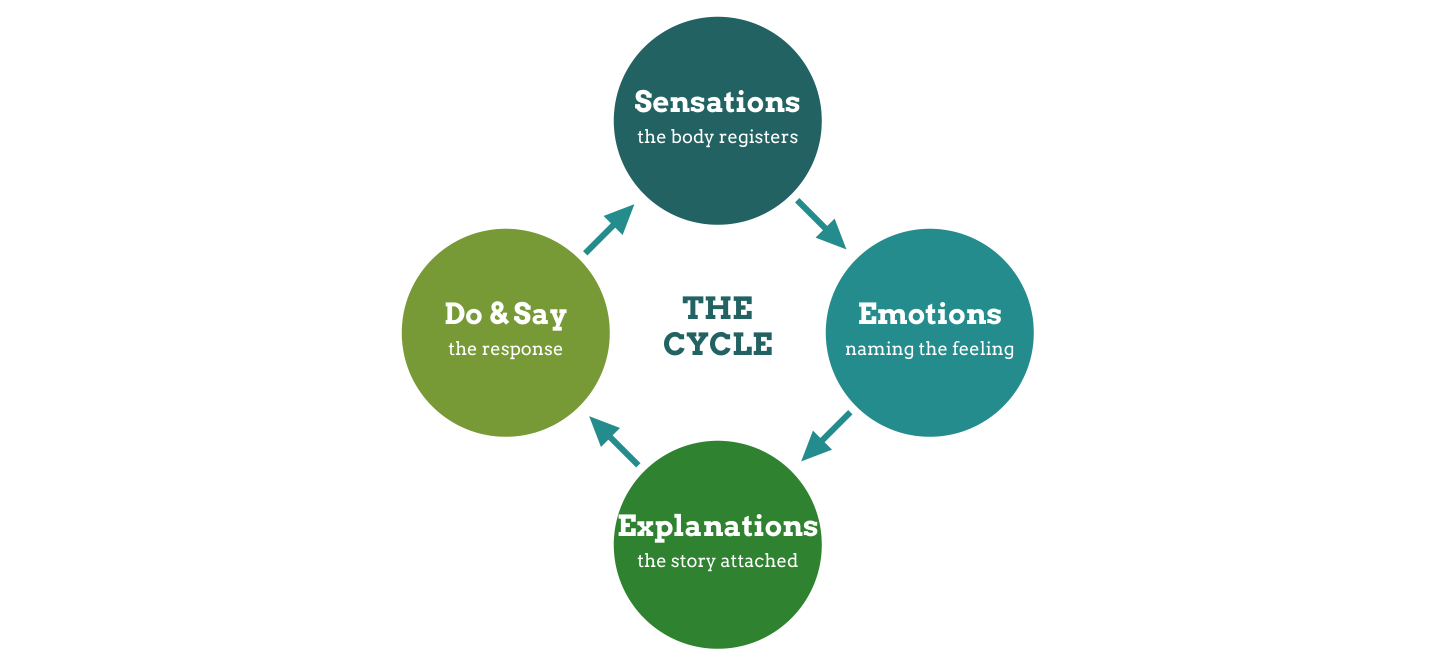
Sensations
Sight, sound, smell, taste, touch. Heart rate, blood pressure, respiration, temperature. Tense or relaxed. Heavy or light. What else?
Sensations are where every cycle actually starts — the body registers the situation before the conscious mind has said a word about it. A tightening chest in the driveway, a dropped stomach when a certain name appears on your phone. Most people have never been asked to notice this layer, which is exactly why we start here: you can’t work with what you can’t feel.
Emotions
When you feel that set of sensations, what do you call it? What does it tell you about your needs vs. wants, your values and your boundaries?
Naming matters more than it seems. The Psalms are full of this kind of honest naming, and you can borrow their words with our practice for mining the Psalms. Research shows that putting feelings into words measurably calms the brain’s threat response (Lieberman et al., 2007), and people who can distinguish their emotions with precision — “disappointed and a little embarrassed” rather than just “bad” — regulate them better and act out less (Kashdan, Barrett & McKnight, 2015). An emotion is information: about a need going unmet, a value being stepped on, a boundary being crossed.
Explanations
The stories we attach: “I am…” “He is…” “She is…” “We are…” “They are…” “This is…”
Between what happens and what we do sits a story — and the story, not the event, usually drives the outcome. “She’s late because she doesn’t respect me” and “she’s late because the 101 is a parking lot” produce two different evenings. These explanations run fast and feel like facts. Learning to catch and test them is the core move of an entire family of evidence-based therapies (see the offramps below), and of biblical wisdom: “the one who states his case first seems right, until the other comes and examines him” (Proverbs 18:17).
Do & Say
How we respond. Helpful or harmful? Skilled or unskilled? Intention vs. impact?
This is the only part of your cycle that other people can actually see — and the part of theirs that becomes the next input to yours. Two questions we come back to constantly: was that response helpful or harmful, and was it skilled or unskilled? And when it landed badly: what was the gap between your intention and your impact?
Story follows state: the polyvagal layer
Here’s something that makes the whole cycle click into place — and it comes from outside our own work, so credit where it’s due. This section is indebted to Polyvagal Perspectives on Emotionally Focused Couple Therapy, a handout by Camille Scent, Ed.S., LPC, LMFT (an ICEEFT-certified EFT therapist and supervisor), which integrates the polyvagal theory of neuroscientist Stephen Porges with the accessible “ladder” metaphor of Deb Dana, LCSW. We’re summarizing their framework, not claiming it — read their work for the full picture.
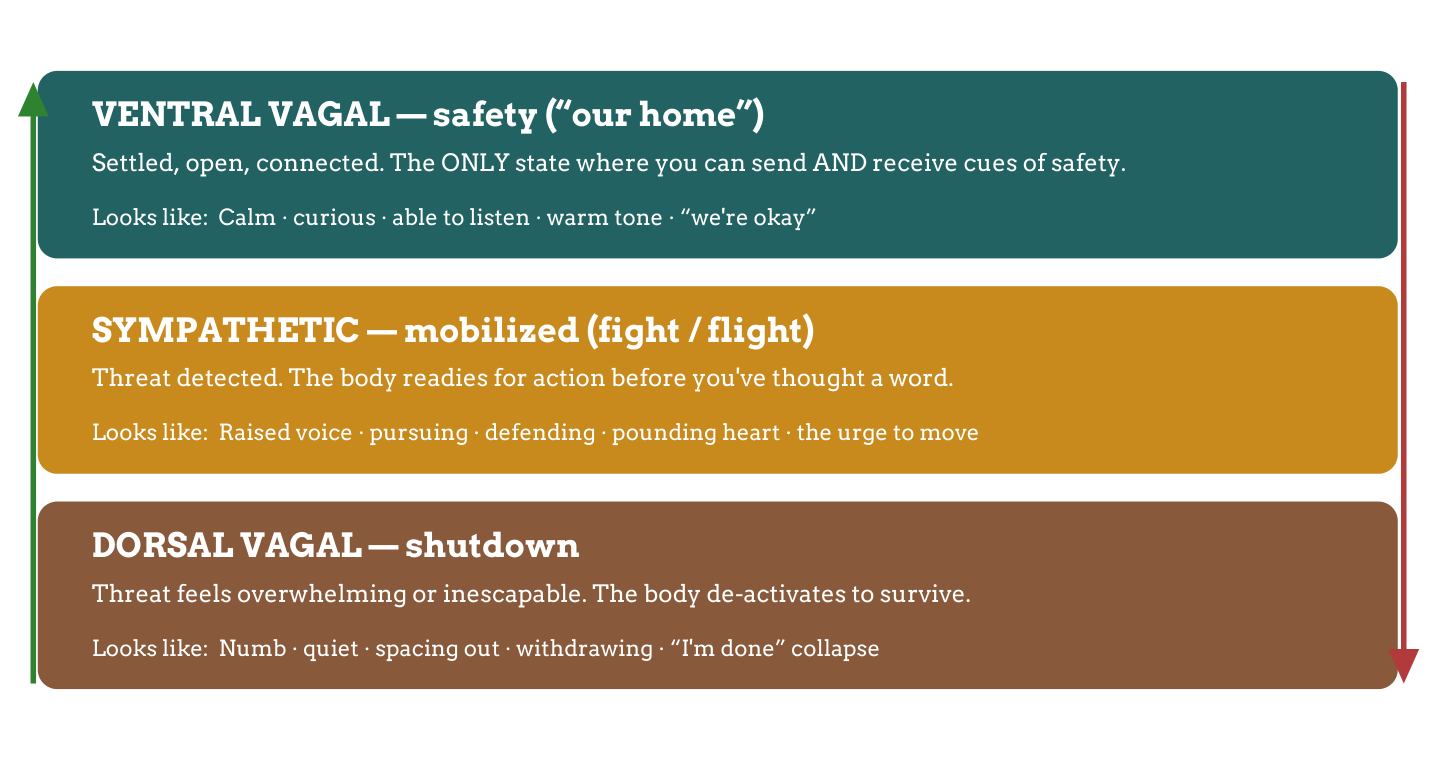
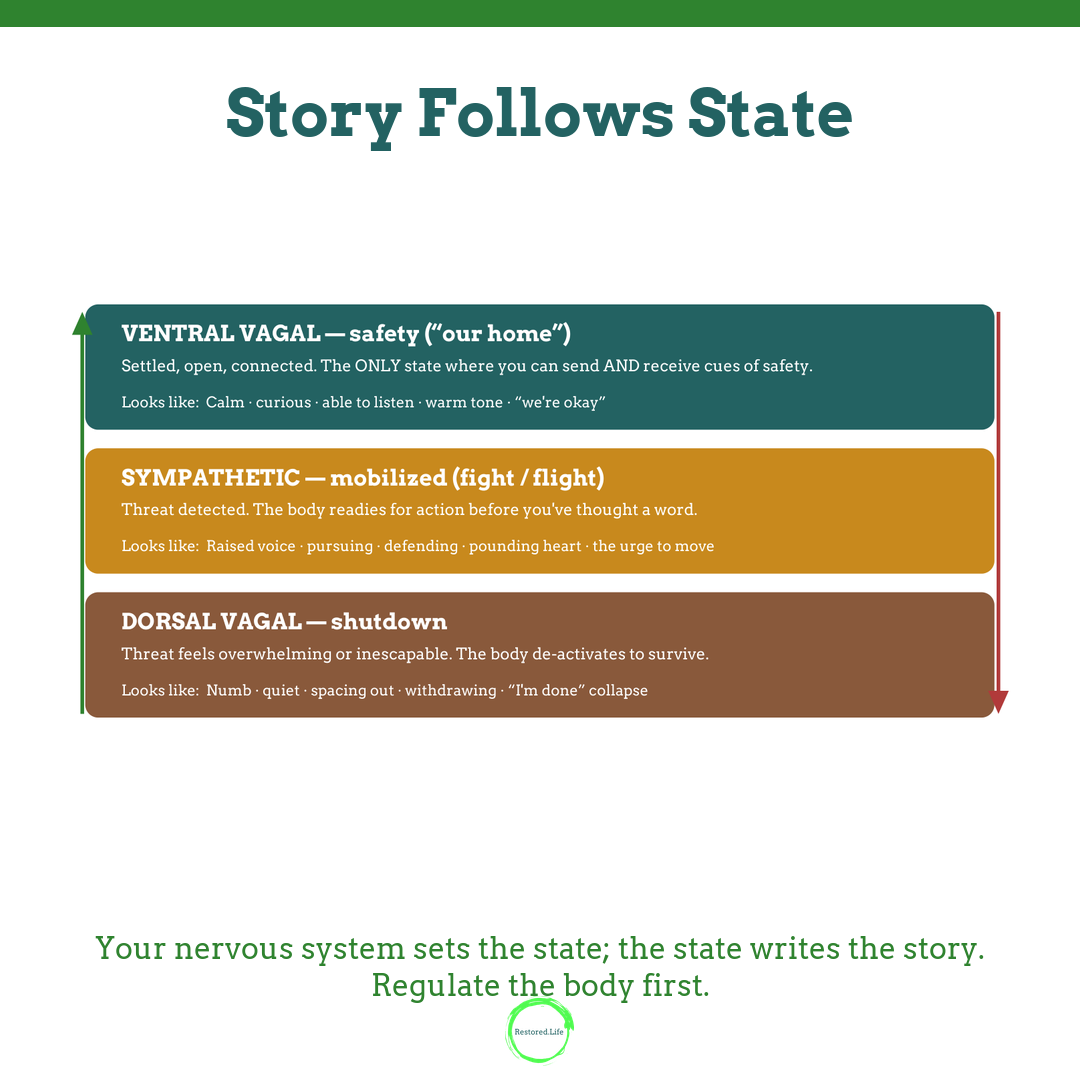
The core idea: *almost entirely outside your awareness, your nervous system is constantly scanning — your surroundings, your body, and especially your relationships — for cues of safety and cues of danger. Porges calls this scanning neuroception*. What it detects sets your autonomic “state,” and Deb Dana pictures those states as a ladder:
- Ventral vagal — safety (“our home”). When your nervous system reads safe, you feel settled and open. This is the only state in which you can both send and receive cues of safety from your spouse. Real connection only happens here.
- Sympathetic — mobilized (fight or flight). When it reads threat, the body mobilizes: raised voice, defensiveness, pursuing, arguing, a pounding heart, the urge to move. You’ve slid partway down the ladder.
- Dorsal vagal — shutdown. When the threat feels overwhelming or inescapable, the body de-activates: numbing, spacing out, going quiet, withdrawing, that “I’m done” collapse. The bottom of the ladder.
Now connect that to SEEDS. Deb Dana’s memorable phrase is “story follows state” — the state of your nervous system colors everything: what you see and hear, the Sensations you feel, the Emotions you name, the Explanations your mind builds, and finally what you Do & Say. Your Sensations are literally your nervous system’s state, and your Explanation is the story your mind writes to fit that state — a story built for survival, which is exactly why it feels so compelling and so impossible to argue with in the moment. When your spouse seems “unreasonable” or acts like they didn’t hear a word you said, it is usually because their nervous system has shifted so far into mobilization or shutdown that their capacity to reason or listen has genuinely been compromised. That’s what we mean by flooding or shutting down.
This is also why we insist on regulating the body first (the Sensations offramp below): you cannot reason your way out of a state your body is stuck in — you have to help the body feel safe first. Slow breathing is one of the most direct levers, engaging the body’s own calming brake (Zaccaro et al., 2018). None of this is a detour from Scripture’s picture of us; it’s the machinery underneath it. We are embodied souls — fearfully and wonderfully made (Psalm 139:14) — so it should not surprise a Christian that safety, trust, and even our ability to hear one another are carried in the body God gave us. (Polyvagal theory is a clinically useful map that many therapists find illuminating; some of its finer neurophysiological claims are still debated among researchers, so we hold the mechanism lightly and the pastoral point firmly.)
Offramps: where cycles change

For cycles that need to change, there are offramps at each part of the cycle.
Sensations offramps
Self-soothing · new experiences (with a sense of control) · mindful movement · improved attachments.
If your body enters every hard conversation already at a 9 out of 10, no communication technique will survive contact. Regulating the body first — breathing, movement, grounding, safe connection — lowers the baseline so the rest of the cycle has room to change. This is why we often work on sleep, exercise, and nervous-system regulation before we work on conflict scripts.
Emotions offramps
Deepen your practice of emotionally healthy spirituality · clarify your needs vs. wants · clarify your values and boundaries.
The emotional offramp is fluency, not suppression. The Psalms model an emotional honesty most of us were never taught — grief, anger, fear, and joy all brought to God without editing. Clarifying what you actually need (versus want), and what your values and boundaries actually are, turns overwhelming feelings into usable information (Kashdan et al., 2015).
Explanations offramps
Deepen your understanding of your faith and theology · Cognitive Behavioral Therapy · Acceptance and Commitment Therapy · Dialectical Behavior Therapy.
This is the most heavily researched offramp in all of psychotherapy. Cognitive Behavioral Therapy — examining and testing the stories we attach — is supported by hundreds of trials across conditions (Hofmann et al., 2012); Acceptance and Commitment Therapy takes a complementary route, loosening the grip of unhelpful stories rather than debating them (A-Tjak et al., 2015); Dialectical Behavior Therapy adds skills for when emotions run too hot for either. And for the Christian, theology is explanation-work at the deepest level: what is finally true about God, about you, and about the people who hurt you sets the ceiling on every other story you tell.
Do & Say offramps
Change your habits — try Things to Try to Improve Mood, Things to Try to Improve Relationships, and Things to Try to Overcome Chaos — and track your efforts and results.
Sometimes the fastest way to change a cycle is to change the behavior first and let the feelings catch up. Small, repeated, trackable changes in what you do and say give everyone else’s cycle different input — which is often what finally lets their cycle change too.
The infinity loop: how two cycles interact
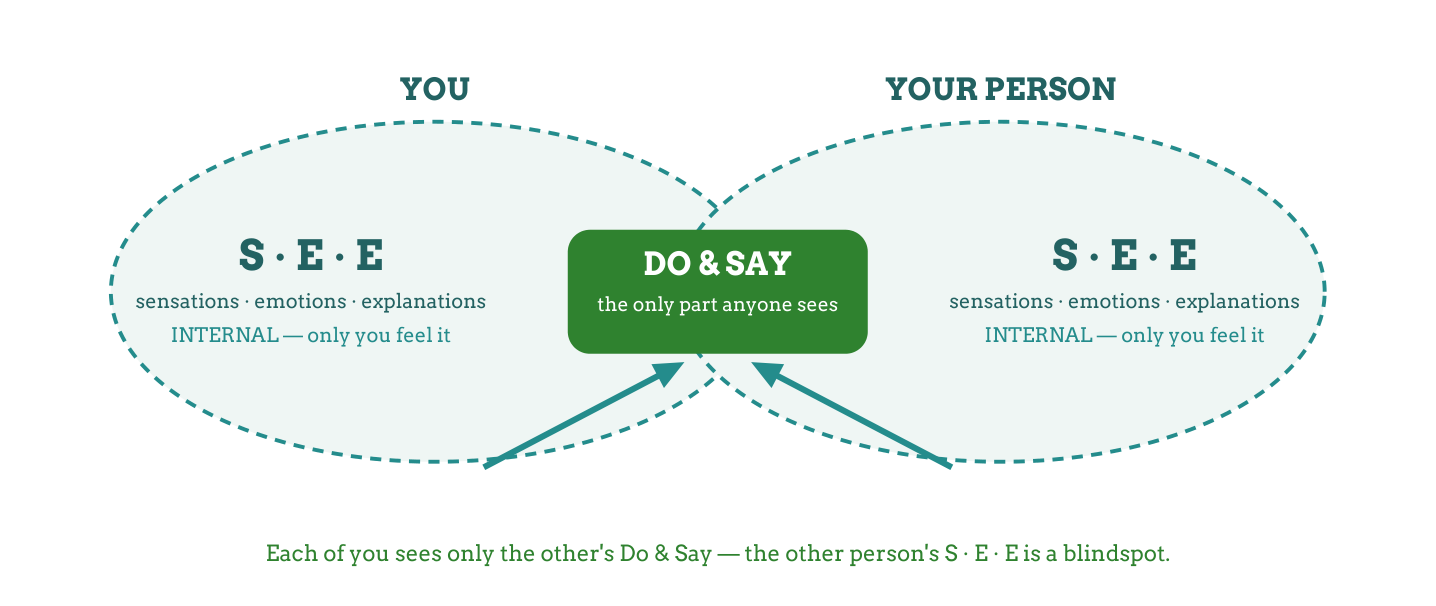
Two or more SEEDS Cycles relating to each other make an infinity loop. Applying the SEEDS Cycle as an infinity loop helps us dissect relationship patterns that cause more disconnection than connection.
Here’s the key insight — and it holds for whatever version of the EFT infinity loop someone is using: parts of each person’s cycle are internal, known only to the person experiencing them, and parts are external, observable by anyone. Your Sensations, Emotions, and Explanations happen inside you; only your Do & Say is visible. So in an infinity loop involving two people, each person is aware of their own full SEEDS — but only the other person’s DS. The other person’s S-E-E is a blindspot.
That blindspot is where most relational damage gets manufactured. You don’t see your spouse’s racing heart, their fear of abandonment, or the story they’re telling themselves — you see the slammed cabinet and the cold shoulder, and you write your own explanation for it (usually an uncharitable one), which drives your next Do & Say, which feeds their cycle in turn. This is how couples end up in the classic pursue-withdraw pattern — one partner escalating to get a response, the other shutting down to get relief — a dynamic so reliable that researchers have been documenting it for decades (Christensen & Heavey, 1990).
The polyvagal layer explains why the loop is so sticky. In EFT terms, each partner’s Do & Say becomes a cue that the other’s nervous system neurocepts as danger — dropping them a rung down the ladder into mobilization or shutdown, where “story follows state” writes the next uncharitable explanation, which drives the next Do & Say, which cues the other again. Two nervous systems, each reading the other as unsafe, each unable to send or receive safety from that state. That’s not a character flaw in either person; it’s two survival systems doing exactly what they were built to do. And it points straight at the way out: the loop changes not when someone finally wins the argument, but when at least one nervous system gets back to safe — which is why much of couples work is simply making the two blindspots visible to each other, on purpose, in safety, so both bodies can climb back up the ladder. Being “quick to hear, slow to speak, slow to anger” (James 1:19) turns out to be nervous-system wisdom with a map in hand.
Download the printable version

Next steps

If you’re ready, you can join the waiting list for counseling at Restored Life — in person in Glendale, AZ or online across Arizona and Washington. Or, if we’re full, not in your area, or just not the right fit, you can get matched with a great therapist at Mental Health Match.
Save and share
Pin or share these — someone you love may need them today.


References
- A-Tjak, J. G. L., Davis, M. L., Morina, N., Powers, M. B., Smits, J. A. J., & Emmelkamp, P. M. G. (2015). A meta-analysis of the efficacy of acceptance and commitment therapy for clinically relevant mental and physical health problems. Psychotherapy and Psychosomatics, 84(1), 30–36. https://doi.org/10.1159/000365764
- Christensen, A., & Heavey, C. L. (1990). Gender and social structure in the demand/withdraw pattern of marital conflict. Journal of Personality and Social Psychology, 59(1), 73–81. https://doi.org/10.1037/0022-3514.59.1.73
- Dana, D. (2018). The polyvagal theory in therapy: Engaging the rhythm of regulation. W. W. Norton. (Source of the “ladder” metaphor and the phrase “story follows state.”)
- Porges, S. W. (2007). The polyvagal perspective. Biological Psychology, 74(2), 116–143. https://doi.org/10.1016/j.biopsycho.2006.06.009
- Porges, S. W. (2009). The polyvagal theory: New insights into adaptive reactions of the autonomic nervous system. Cleveland Clinic Journal of Medicine, 76(Suppl 2), S86–S90. https://doi.org/10.3949/ccjm.76.s2.17
- Scent, C. (n.d.). Polyvagal perspectives on emotionally focused couple therapy [Clinical handout]. ICEEFT. (The integration of polyvagal theory with the EFT cycle that this section summarizes; used with attribution.)
- Hofmann, S. G., Asnaani, A., Vonk, I. J. J., Sawyer, A. T., & Fang, A. (2012). The efficacy of cognitive behavioral therapy: A review of meta-analyses. Cognitive Therapy and Research, 36(5), 427–440. https://doi.org/10.1007/s10608-012-9476-1
- Johnson, S. M., Hunsley, J., Greenberg, L., & Schindler, D. (1999). Emotionally focused couples therapy: Status and challenges. Clinical Psychology: Science and Practice, 6(1), 67–79. https://doi.org/10.1093/clipsy.6.1.67
- Kashdan, T. B., Barrett, L. F., & McKnight, P. E. (2015). Unpacking emotion differentiation: Transforming unpleasant experience by perceiving distinctions in negativity. Current Directions in Psychological Science, 24(1), 10–16. https://doi.org/10.1177/0963721414550708
- Lieberman, M. D., Eisenberger, N. I., Crockett, M. J., Tom, S. M., Pfeifer, J. H., & Way, B. M. (2007). Putting feelings into words: Affect labeling disrupts amygdala activity in response to affective stimuli. Psychological Science, 18(5), 421–428. https://doi.org/10.1111/j.1467-9280.2007.01916.x
Method note: sources were identified via OpenAlex literature search and screened for retractions and editorial notices via Scite before citation. Scripture quotations are from the ESV. This post was prepared with AI assistance and reviewed by Restored Life Counseling’s clinical staff.