

Reduce the shame, anxiety, and depression that travel with compulsive porn use. Rebuild integrity. Don’t stay trapped.
“What I hate, I do”

Nobody has described the war you’re in better than the apostle Paul: “I do not understand my own actions. For I do not do what I want, but I do the very thing I hate” (Romans 7:15). If you’ve promised yourself — and God, and maybe your spouse — that this time was the last time, and it wasn’t, you already know that information and willpower aren’t enough. Paul knew it too. His answer wasn’t a better resolution; it was rescue (Romans 7:24–25). And rescue — in our experience, and in the research below — has a shape: grace, truth, structure, and other people.
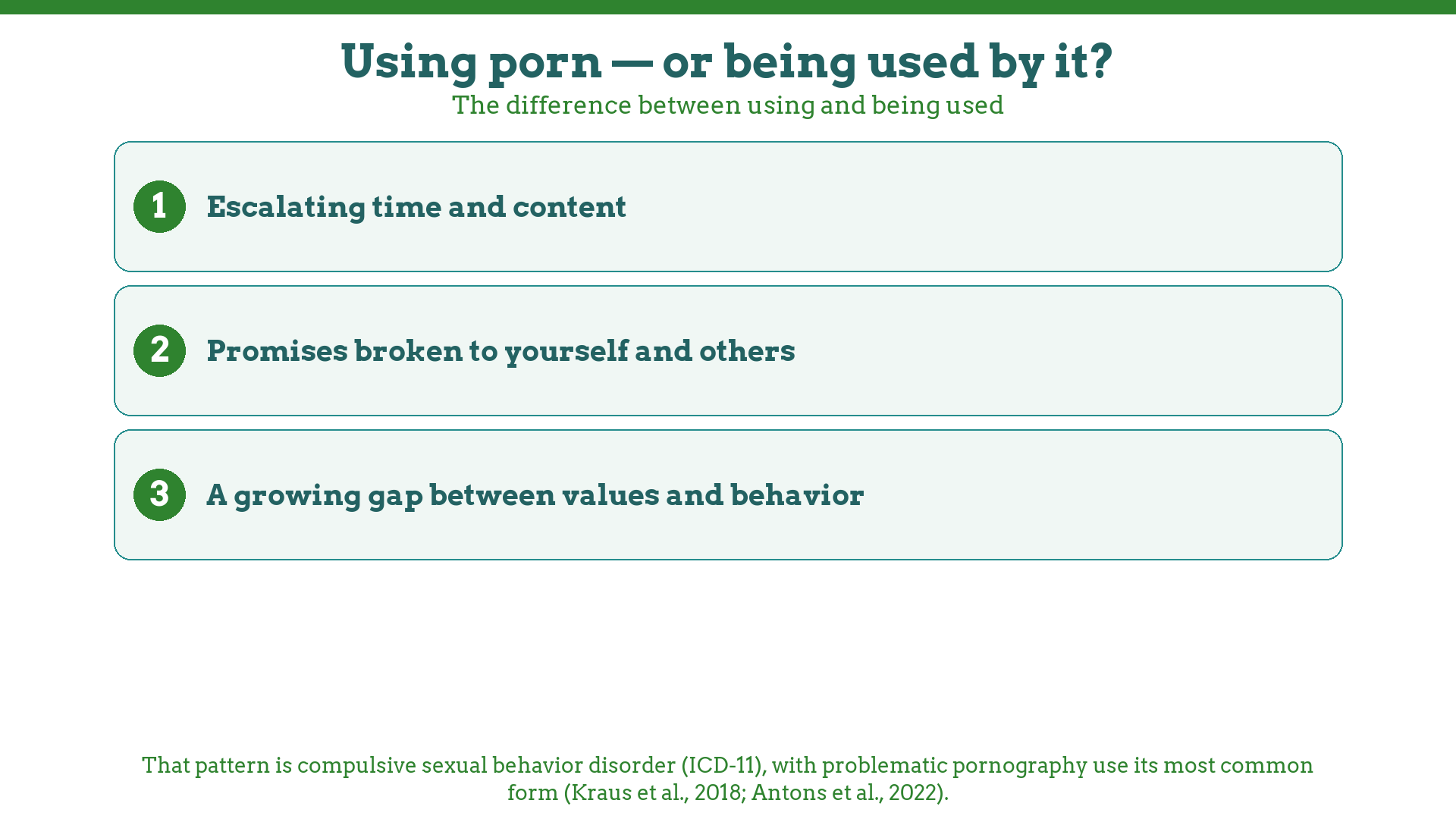
Here’s the clinical picture. There’s a difference between using porn and being used by it: escalating time, escalating content, promises broken to yourself and others, and a growing gap between your values and your behavior. That pattern falls under compulsive sexual behavior disorder, recognized in the WHO’s ICD-11 (Kraus et al., 2018; Reed et al., 2019), with problematic pornography use as its most common presentation (Antons et al., 2022). A systematic review links problematic pornography use with poorer mental health — depression, anxiety, loneliness, and lower life satisfaction (Haupt Vieira & Griffiths, 2024).
If your porn use and your values are at war, you’re not broken beyond repair — you’re a candidate for treatment that works.
A word about labels — and why we treat lives, not labels
Some researchers observe that religious men are quicker to call their porn use an “addiction,” and that moral disapproval itself drives much of the distress (Grubbs et al., 2019). The finding is real, and it deserves a straight answer rather than a dodge: we don’t think the solution to the pain of violating your conscience is to retire your conscience. Whether your pattern meets full diagnostic criteria or “only” wars against your convictions, the gap between your behavior and your values is doing real damage — to your integrity, your intimacy, and your walk with God — and it is worth healing. What the moral-incongruence research rightly warns against is shame-driven self-labeling that substitutes self-hatred for change. So do we: “There is therefore now no condemnation for those who are in Christ Jesus” (Romans 8:1) is where recovery starts, not where it ends.
Treatment works — here’s the evidence

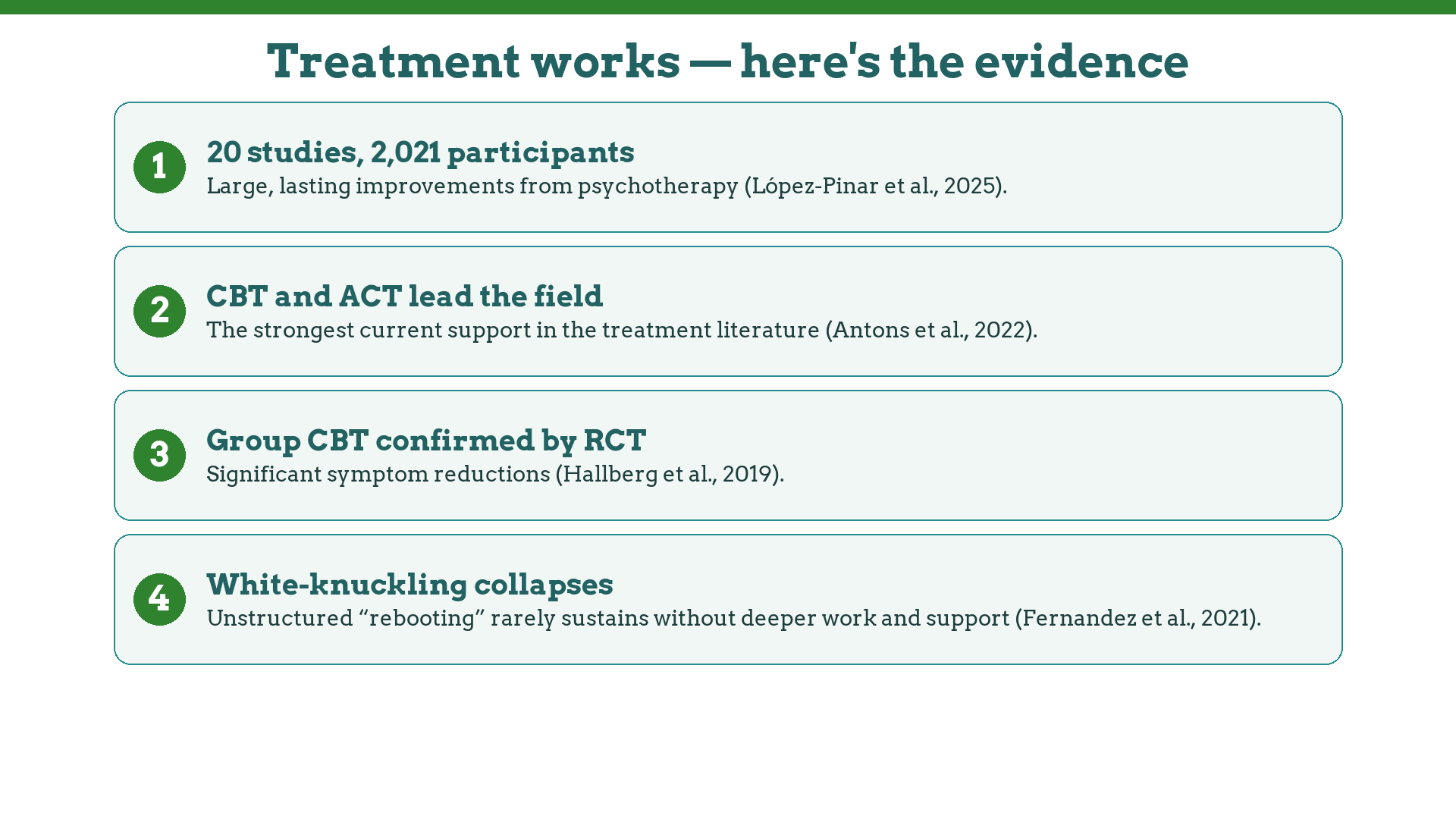
God’s common grace has given this field genuinely good tools, and the trials show it. A comprehensive meta-analysis of psychotherapy for problematic pornography use — 20 studies, 2,021 participants — found that people receiving therapy improved significantly more than controls, with large effects on problematic use that held at follow-up (López-Pinar et al., 2025). The systematic review of the treatment field finds the strongest support for structured cognitive-behavioral and acceptance-and-commitment approaches (Antons et al., 2022); a randomized controlled trial of group-administered CBT for compulsive sexual behavior found significant symptom reductions (Hallberg et al., 2019); and even a brief web-based self-help tool showed preliminary reductions in a randomized feasibility trial (Bőthe et al., 2021).
One caution from the research: white-knuckle “rebooting” attempts on your own are hard to sustain — qualitative research on abstinence forums documents how often unstructured attempts collapse without deeper work and support (Fernandez et al., 2021). Scripture said it first: “Whoever conceals his transgressions will not prosper, but he who confesses and forsakes them will obtain mercy” (Proverbs 28:13). Secrecy is the addiction’s home field. Recovery happens in the light (1 John 1:7).
What recovery looks like here

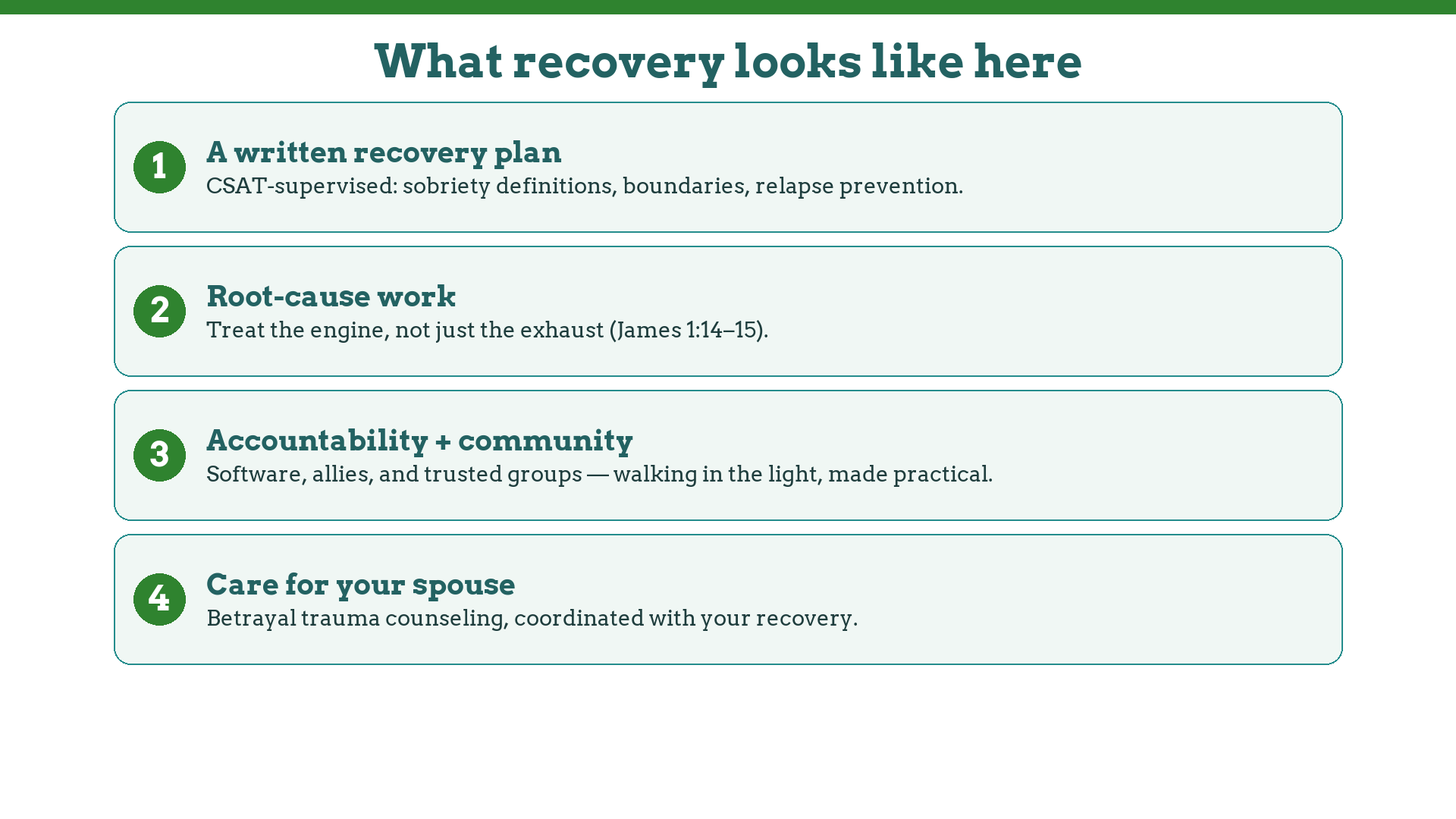
- CSAT-supervised, structured recovery — sobriety definitions, boundaries, relapse-prevention, and a written plan. Start with our most-used guide: How to write your first porn addiction recovery plan.
- Root-cause work. Compulsive porn use rarely exists in a vacuum — the research links it with depression, anxiety, loneliness, and relational strain (Haupt Vieira & Griffiths, 2024), and Scripture’s diagnosis goes deeper still: desire disordered at the level of the heart (James 1:14–15). We treat the engine, not just the exhaust. Our free, anonymous survey screens the challenges that feed the cycle, or take the porn addiction test.
- Accountability that works. Software, allies, and structure — “walking in the light” made practical. See our article on why accountability applications matter in recovery.
- Community. Peer support groups are an evidence-supported part of addiction recovery (Tracy & Wallace, 2016) — and “confess your sins to one another and pray for one another, that you may be healed” (James 5:16) is the oldest group-recovery protocol on record. We connect you to trusted groups — SA, SAA, Celebrate Recovery, Re:generation, Revive 40 — in the Phoenix Valley and Washington.
- Care for your spouse. If your use has wounded your marriage, your spouse needs their own healing — see betrayal trauma counseling — and our team coordinates both journeys.
Grace and structure — you need both

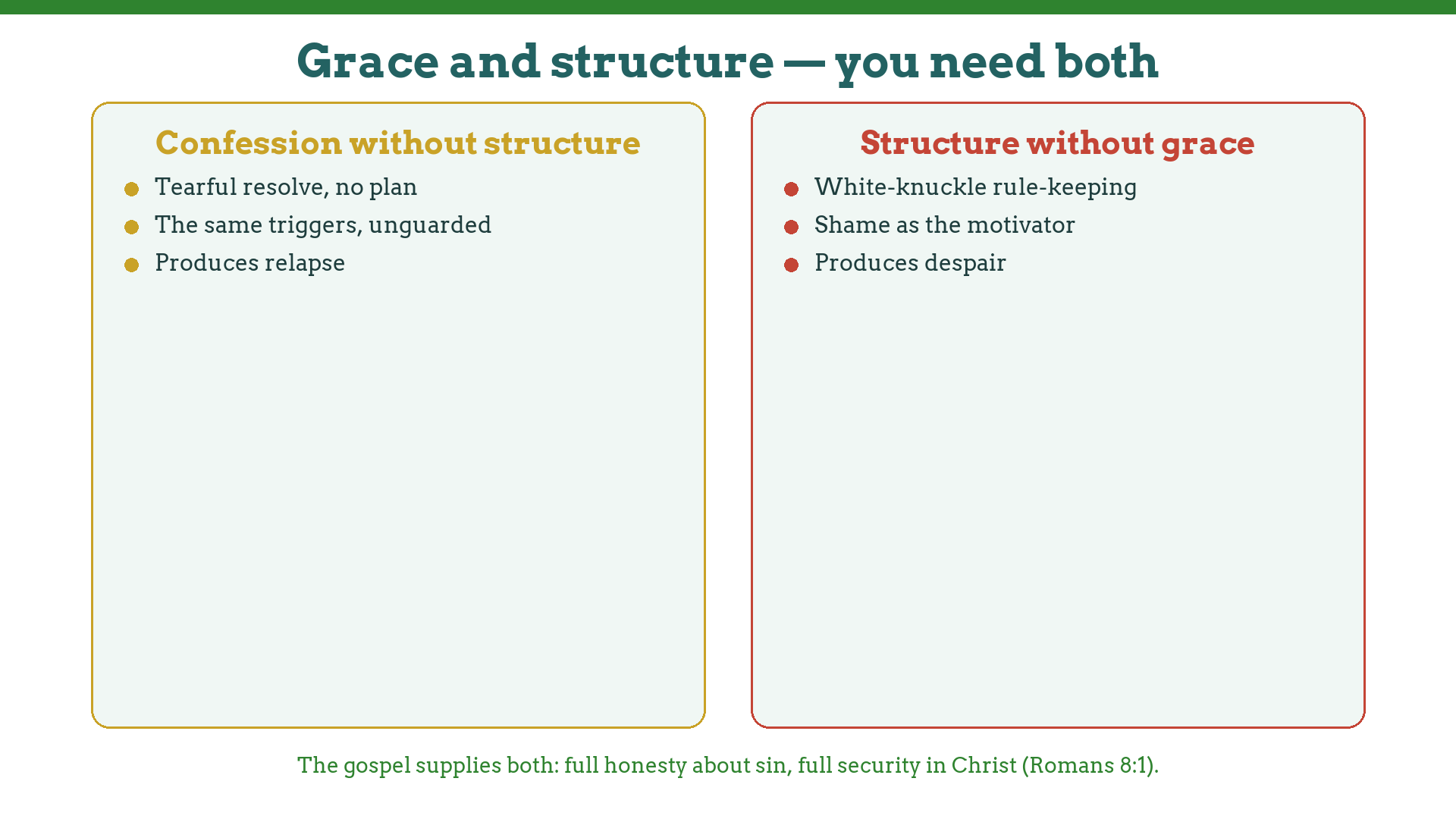
For Christians, compulsive porn use carries a double weight: the behavior itself, and the shame spiral of fighting it alone in the dark. We wrote a full-length treatment of this — the 2026 Christian Guide to Porn Addiction Recovery — but the short version: confession without structure produces relapse; structure without grace produces despair. Recovery needs both, because the gospel supplies both: full honesty about sin, full security in Christ.
The research agrees that faith belongs in the treatment room: religiously and spiritually integrated psychotherapy performs at least as well as standard approaches, with added benefit for spiritual well-being (Smith et al., 2007; Captari et al., 2018). Our integration brings identity, grace, and accountability into clinically structured work — at the pace you set, because grace never coerces.
Porn addiction counseling in Glendale, AZ — and online

We provide porn addiction counseling in person in Glendale, Arizona (17230 N 59th Ave, inside Faith Bible Church — serving Glendale, Peoria, and the north Phoenix Valley) and by telehealth across Arizona and Washington — and telehealth works: internet-delivered structured therapy is an effective delivery format (Carlbring et al., 2018). We accept most major insurance plans and offer a sliding scale with price ranges. Fighting compulsive sexual behavior beyond porn? See sex addiction recovery.
Start today

You’ve tried alone. Try supported. “If we walk in the light, as he is in the light, we have fellowship with one another” (1 John 1:7) — and fellowship is where this battle turns.
Save and share
Pin or share these — someone you love may need them today.


References
- Antons, S., Engel, J., Briken, P., Krüger, T. H. C., Brand, M., & Stark, R. (2022). Treatments and interventions for compulsive sexual behavior disorder with a focus on problematic pornography use: A preregistered systematic review. Journal of Behavioral Addictions, 11(3), 643–666. https://doi.org/10.1556/2006.2022.00061
- Bőthe, B., Baumgartner, C., Schaub, M. P., Demetrovics, Z., & Orosz, G. (2021). Hands-off: Feasibility and preliminary results of a two-armed randomized controlled trial of a web-based self-help tool to reduce problematic pornography use. Journal of Behavioral Addictions, 10(4), 1015–1035. https://doi.org/10.1556/2006.2021.00070
- Captari, L. E., Hook, J. N., Hoyt, W., Davis, D. E., McElroy-Heltzel, S. E., & Worthington, E. L., Jr. (2018). Integrating clients’ religion and spirituality within psychotherapy: A comprehensive meta-analysis. Journal of Clinical Psychology, 74(11), 1938–1951. https://doi.org/10.1002/jclp.22681
- Carlbring, P., Andersson, G., Cuijpers, P., Riper, H., & Hedman-Lagerlöf, E. (2018). Internet-based vs. face-to-face cognitive behavior therapy for psychiatric and somatic disorders: An updated systematic review and meta-analysis. Cognitive Behaviour Therapy, 47(1), 1–18. https://doi.org/10.1080/16506073.2017.1401115
- Fernandez, D. P., Kuss, D. J., & Griffiths, M. D. (2021). The pornography “rebooting” experience: A qualitative analysis of abstinence journals on an online pornography abstinence forum. Archives of Sexual Behavior, 50(2), 711–728. https://doi.org/10.1007/s10508-020-01858-w
- Grubbs, J. B., Perry, S. L., Wilt, J. A., & Reid, R. C. (2019). Pornography problems due to moral incongruence: An integrative model with a systematic review and meta-analysis. Archives of Sexual Behavior, 48(2), 397–415. https://doi.org/10.1007/s10508-018-1248-x
- Hallberg, J., Kaldo, V., Arver, S., Dhejne, C., Jokinen, J., & Öberg, K. G. (2019). A randomized controlled study of group-administered cognitive behavioral therapy for hypersexual disorder in men. Journal of Sexual Medicine, 16(5), 733–745. https://doi.org/10.1016/j.jsxm.2019.03.005
- Haupt Vieira, C., & Griffiths, M. D. (2024). Problematic pornography use and mental health: A systematic review. Sexual Health & Compulsivity. https://doi.org/10.1080/26929953.2024.2348624
- Kraus, S. W., Krueger, R. B., Briken, P., First, M. B., Stein, D. J., Kaplan, M. S., Voon, V., Abdo, C. H. N., Grant, J. E., Atalla, E., & Reed, G. M. (2018). Compulsive sexual behaviour disorder in the ICD-11. World Psychiatry, 17(1), 109–110. https://doi.org/10.1002/wps.20499
- López-Pinar, C., Esparza-Reig, J., & Bőthe, B. (2025). Psychotherapy for problematic pornography use: A comprehensive meta-analysis. Journal of Behavioral Addictions. https://doi.org/10.1556/2006.2025.00018
- Reed, G. M., First, M. B., Kogan, C. S., Hyman, S. E., Gureje, O., et al. (2019). Innovations and changes in the ICD-11 classification of mental, behavioural and neurodevelopmental disorders. World Psychiatry, 18(1), 3–19. https://doi.org/10.1002/wps.20611
- Smith, T. B., Bartz, J., & Richards, P. S. (2007). Outcomes of religious and spiritual adaptations to psychotherapy: A meta-analytic review. Psychotherapy Research, 17(6), 643–655. https://doi.org/10.1080/10503300701250347
- Tracy, K., & Wallace, S. P. (2016). Benefits of peer support groups in the treatment of addiction. Substance Abuse and Rehabilitation, 7, 143–154. https://doi.org/10.2147/sar.s81535
Method note: sources were identified via OpenAlex and Scite literature search and screened for retractions and editorial notices via Scite before citation. Scripture quotations are from the ESV. This page was prepared with AI assistance and reviewed by Restored Life Counseling’s clinical staff.