

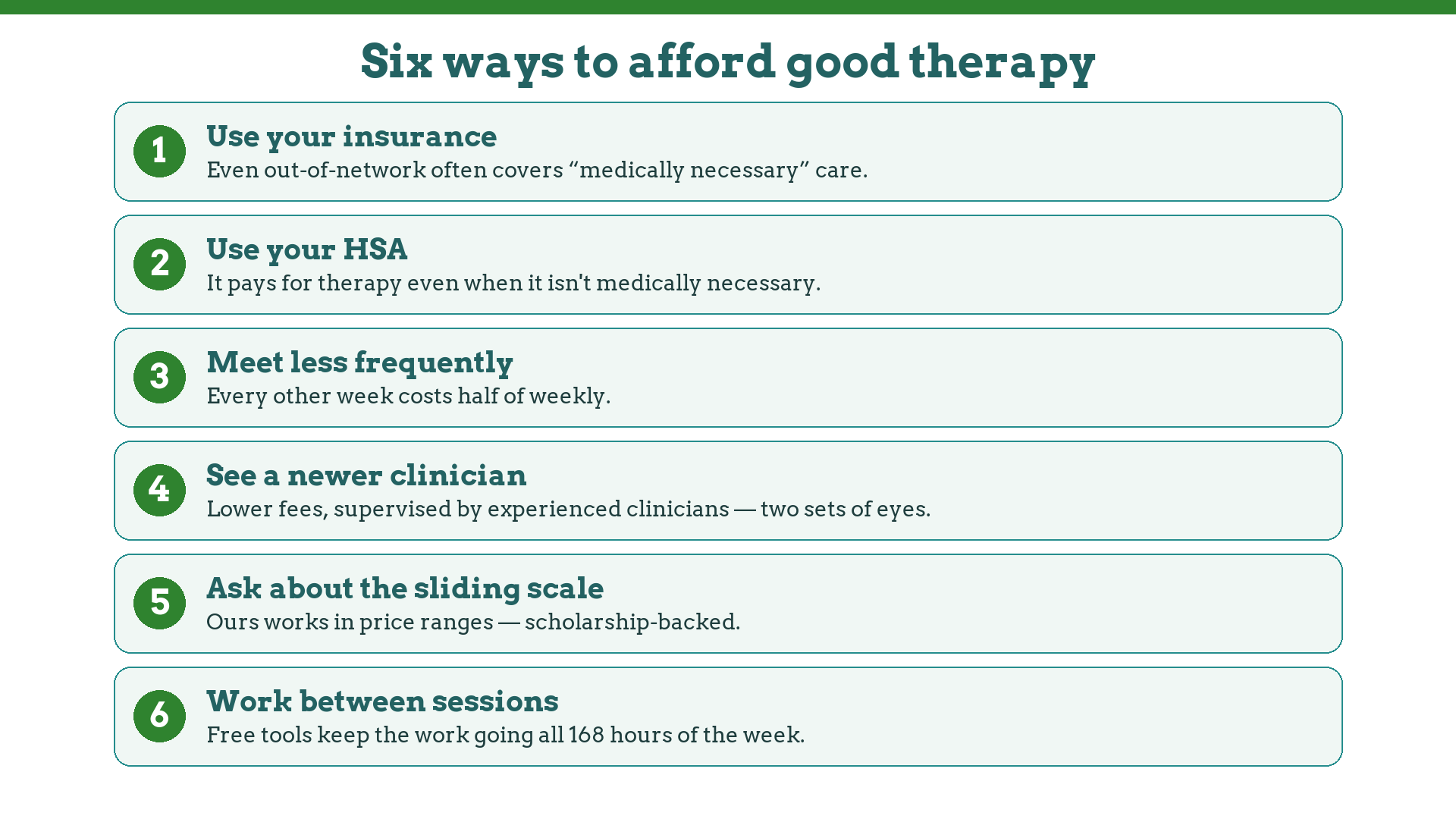
We don’t believe money should decide who gets care — that conviction shapes our whole practice — and we also believe in stewarding well what God has entrusted to you (1 Peter 4:10). Therapy is an investment — and like any investment, how you use it matters as much as what you spend on it. These strategies will maximize your budget for therapy and, more importantly, your benefit from therapy.
Work outside of your sessions
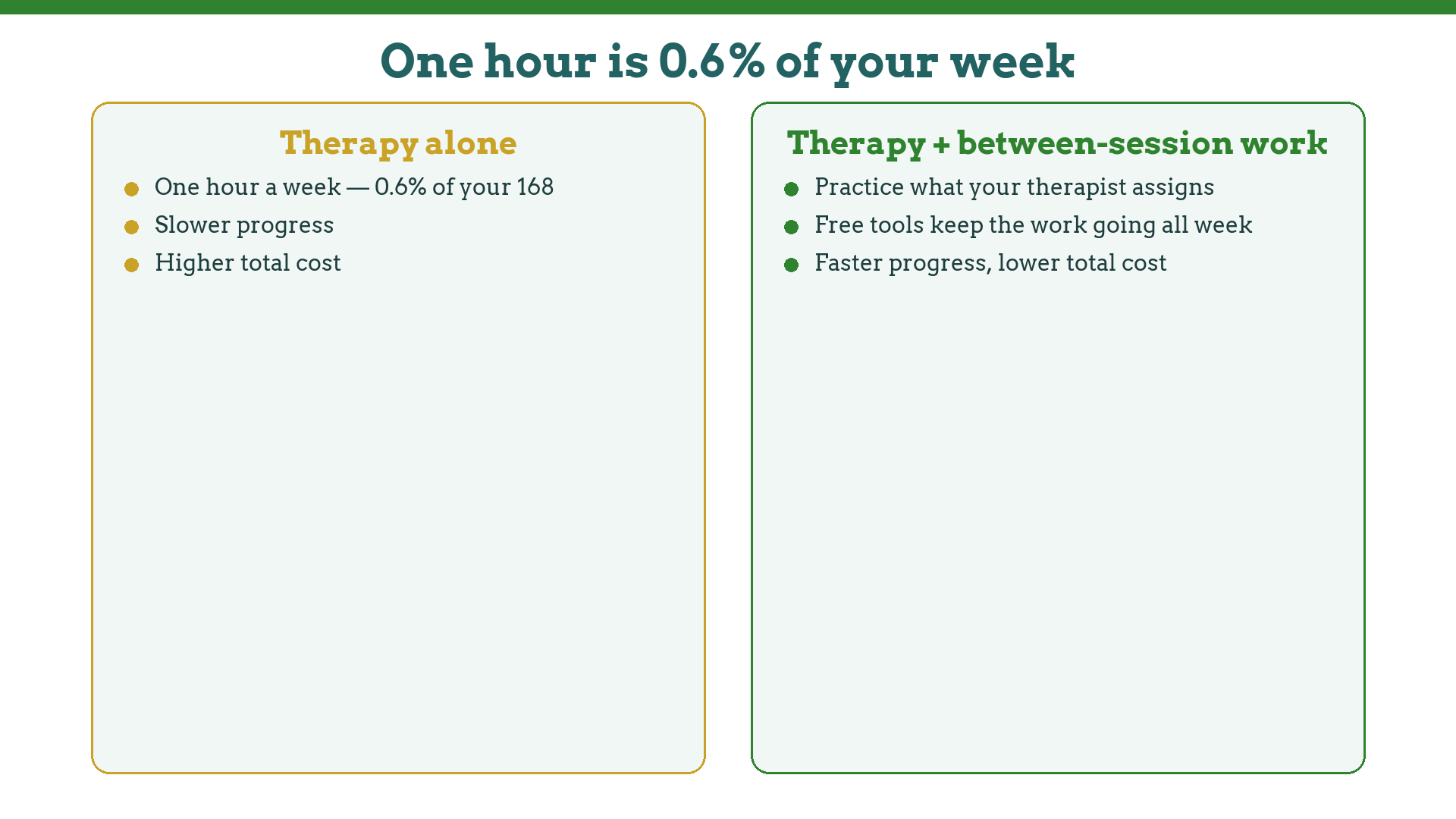
Weekly therapy is only one hour out of the 168 hours in your week — 0.6% of your week. If that’s all you’re investing in overcoming your challenges, therapy will take longer and cost more. Ask your therapist what to practice between sessions, and use our free tools to keep the work going all week.
Compare the cost of not doing therapy
Are your challenges causing you to miss work, home, or family duties? Will not facing your challenges make divorce more likely? What are those things worth?
Use your insurance
Even if you have to go out of network, insurance will usually cover most of the cost of therapy if it can be deemed “medically necessary.” See our guide to getting the most out of your insurance coverage, and our current in-network plans on the pricing page.
Use your HSA
If you have a Health Savings Account or Health Spending Account, you can use it to pay for therapy even if your therapy is not medically necessary.
Meet less frequently
Meeting every other week costs half as much as meeting weekly. Some seasons call for weekly work; others can hold steady at a lighter rhythm. Talk with your therapist about the frequency that fits your goals and your budget.
See a newer clinician
Interns and provisionally licensed clinicians tend to have lower fees — and they’re supervised by experienced clinicians, so you get two sets of eyes on your care.
Ask about a sliding scale
Many practices offer reduced fees based on financial need. At Restored Life, our sliding scale offers price ranges that fit real budgets — and our donor-supported Scholarship Fund pays providers the gap, so a reduced fee for you never means reduced care. Complete the waiting list and we’ll walk you through the options.
Save and share
Pin or share these — someone you love may need them today.
Next steps

If you’re ready, you can join the waiting list for counseling at Restored Life — in person in Glendale, AZ or online across Arizona and Washington. Or, if you’re not sure whether you need counseling, take the free survey to screen for the most common mental health challenges people face.
References
- Howard, K. I., Kopta, S. M., Krause, M. S., & Orlinsky, D. E. (1986). The dose-effect relationship in psychotherapy. American Psychologist, 41(2), 159–164. https://doi.org/10.1037/0003-066X.41.2.159
- Mojtabai, R., Olfson, M., Sampson, N. A., et al. (2011). Barriers to mental health treatment: Results from the National Comorbidity Survey Replication. Psychological Medicine, 41(8), 1751–1761. https://doi.org/10.1017/S0033291710002291
- Cuijpers, P., Karyotaki, E., Weitz, E., Andersson, G., Hollon, S. D., & van Straten, A. (2014). The effects of psychotherapies for major depression in adults on remission, recovery and improvement: A meta-analysis. Journal of Affective Disorders, 159, 118–126. https://doi.org/10.1016/j.jad.2014.02.026