

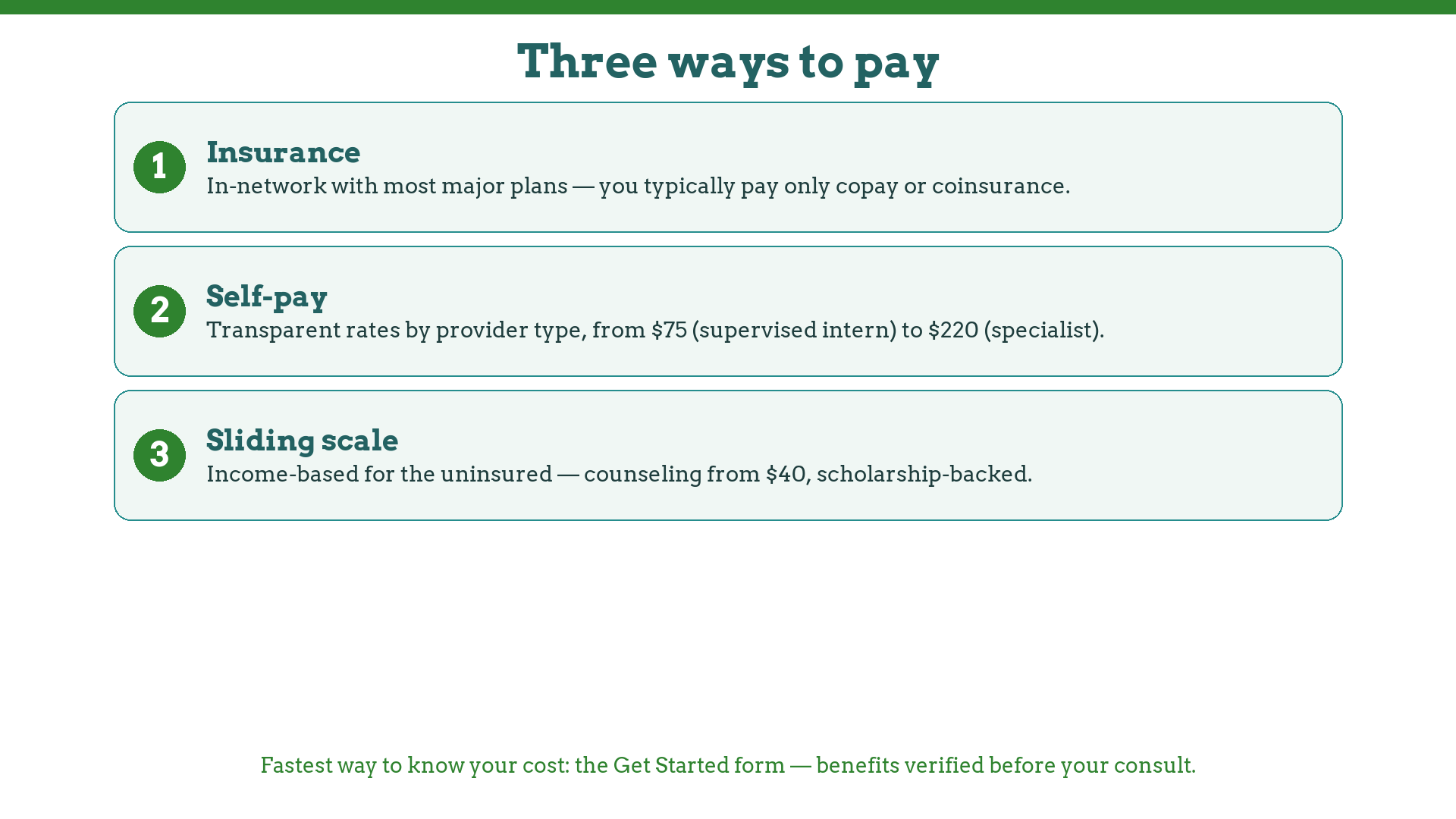
Most people who come to us use insurance — and almost no one pays our full cash rate. If you’re insured, you typically pay only your plan’s copay or coinsurance. If you’re not insured, we have a limited number of sliding-scale spots so cost is less likely to stand between you and care.
The fastest way to know your cost is to join our waiting list. It asks how you’d like to pay — insurance, private pay, or financial assistance — and most of the time we’ll verify your benefits before your consult, so you have a straight answer up front.
Using insurance
We’re in-network with most major plans. What we accept depends on your state and which clinician you see — we’ll confirm your specific benefits before your consult.
Arizona (in person in Glendale & telehealth)
With Dan Stephens and Sarah Olney, we’re in-network with Aetna, Cigna, UnitedHealthcare / Optum, and Tricare.
Washington (telehealth only)
With Dan Stephens and Adam Halvorsen, we’re in-network with Aetna, Cigna, UnitedHealthcare / Optum, Blue Cross Blue Shield, and Tricare.
Psychiatric medication management (with our PMHNP, Emilie Michael) is billed separately. Emilie is additionally in-network with Arizona Blue (BCBS AZ); we’ll confirm your specific plan at your consult.
Paying without insurance (self-pay & sliding scale)
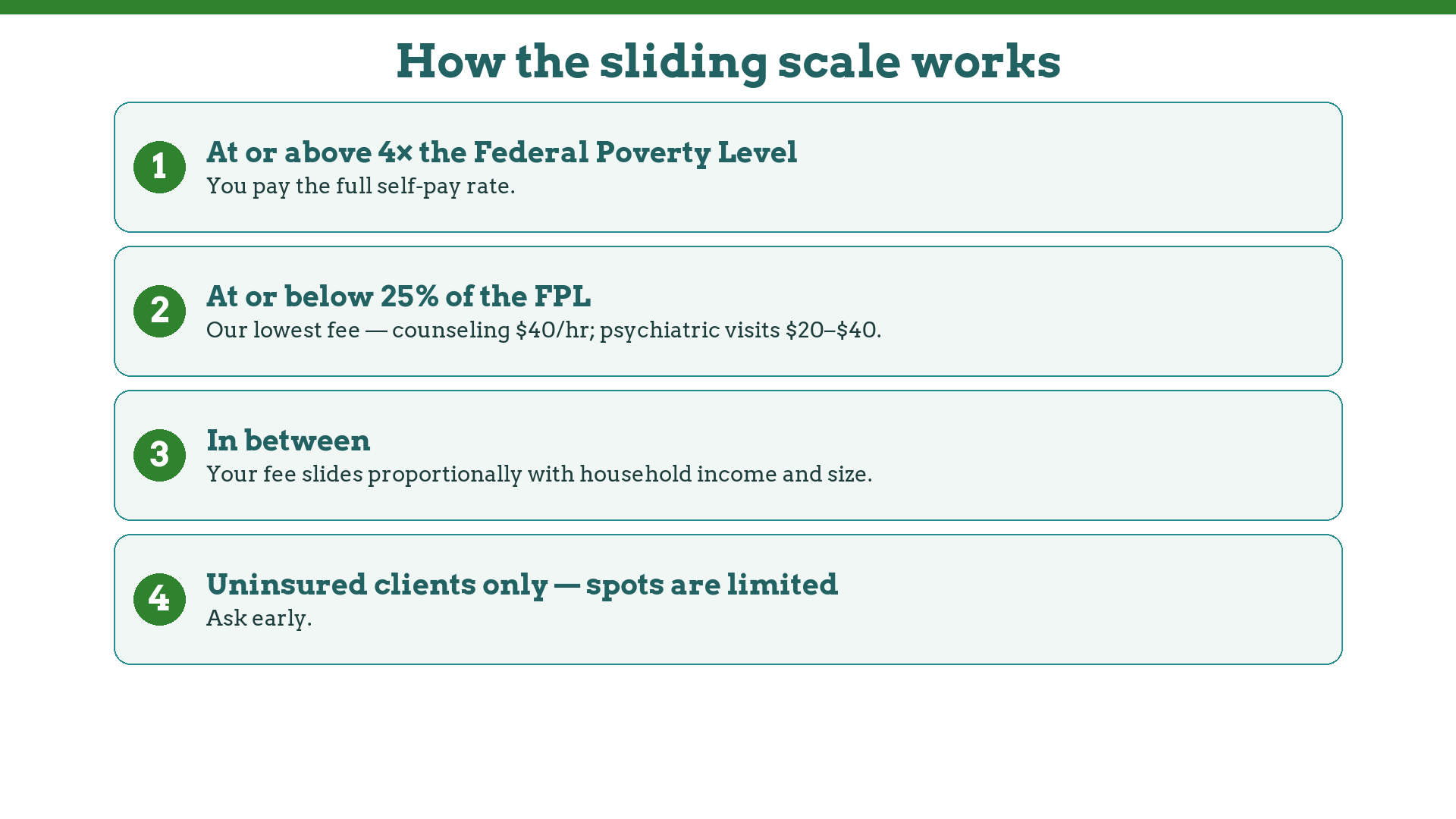
If you don’t have insurance, you can pay our cash rate or apply for our sliding scale, which sets your fee based on your household income and size (uninsured clients only). The lowest fees start at $40 per counseling hour (psychiatric visits as low as $20–$40). Sliding-scale spots are limited, so ask early.
Representative self-pay counseling rates by provider type (a 60-minute session):
| Provider type | 60-minute session | |—|–:| | Independently licensed specialist | $220 | | Independently licensed counselor | $180 | | Associate (post-graduate, supervised) | $140 | | Intern (graduate, supervised) | $75 |
Psychiatric medication management with our PMHNP runs $80–$280 depending on visit type; initial psychiatric evaluations $240. Exact rates for every service and CPT code are available on request.
How the sliding scale works
Your fee is based on your yearly household income and how many people live in your home, compared to the Federal Poverty Level (FPL):
- Make 4× the FPL or more → you pay the full self-pay rate.
- Make 25% of the FPL or less → you pay our lowest fee (counseling $40/hr; psychiatric visits $20–$40).
- In between → your fee slides proportionally between those two.
To apply, just ask, then show proof of income (pay stubs, W-2/1040, Social Security or unemployment letter, or a bank letter) and household size, sign a short statement that your household savings are under our limit, and show that you’re uninsured. The full price ranges and the exact formula are in our Sliding Scale Policy — ask us for a copy any time.
What makes the sliding scale possible
Our Scholarship Fund is what lets us offer the sliding scale. When you qualify for a reduced fee, the fund pays your counselor the difference — so you get care you can afford and your counselor is still paid fairly. That structure is deliberate theology: the worker is worthy of his wages (1 Timothy 5:18), and cost should not decide who gets care — so donors, not counselors or clients, absorb the gap. Gifts to the fund go directly toward keeping care within reach for people who can’t pay the full rate.
Save and share
Pin or share these — someone you love may need them today.


How to start

- Join our waiting list. It asks whether you’ll use insurance, pay privately, or need financial assistance — then a few quick follow-ups based on your answer.
- We verify your benefits. Most of the time we’ll confirm your coverage and likely out-of-pocket cost before your consult.
- Book your free 15-minute consult. You’ll have a clear picture of cost before your first full session.