

Four tools for saying true things without drowning — because “speak the truth in love” (Ephesians 4:15) takes more than good intentions when your heart rate is 110.
Why hard conversations feel impossible right now

God made you an embodied soul — and after betrayal, the body votes first. When a hard conversation starts, your nervous system reads it as a threat: heart rate spikes, breathing shortens, thinking narrows. Marriage researchers call this flooding, and it’s not a character flaw — it’s physiology, and it’s measurable. Couples whose conflict conversations run physiologically hot are the couples whose relationships deteriorate; the arousal itself, not just the words, does the damage (Gottman & Levenson, 1992). And in recovery from sexual betrayal the stakes are higher still, because the betrayed partner is having these conversations inside a trauma response — in the landmark study of wives of sexual addicts, most met the symptom criteria for PTSD after disclosure (Steffens & Rennie, 2006).
So the goal is not to feel less and say less. It’s to downregulate your nervous system so you can stay present to more truth for longer. That’s what every tool below is for. None of them are complicated. All of them are practice.
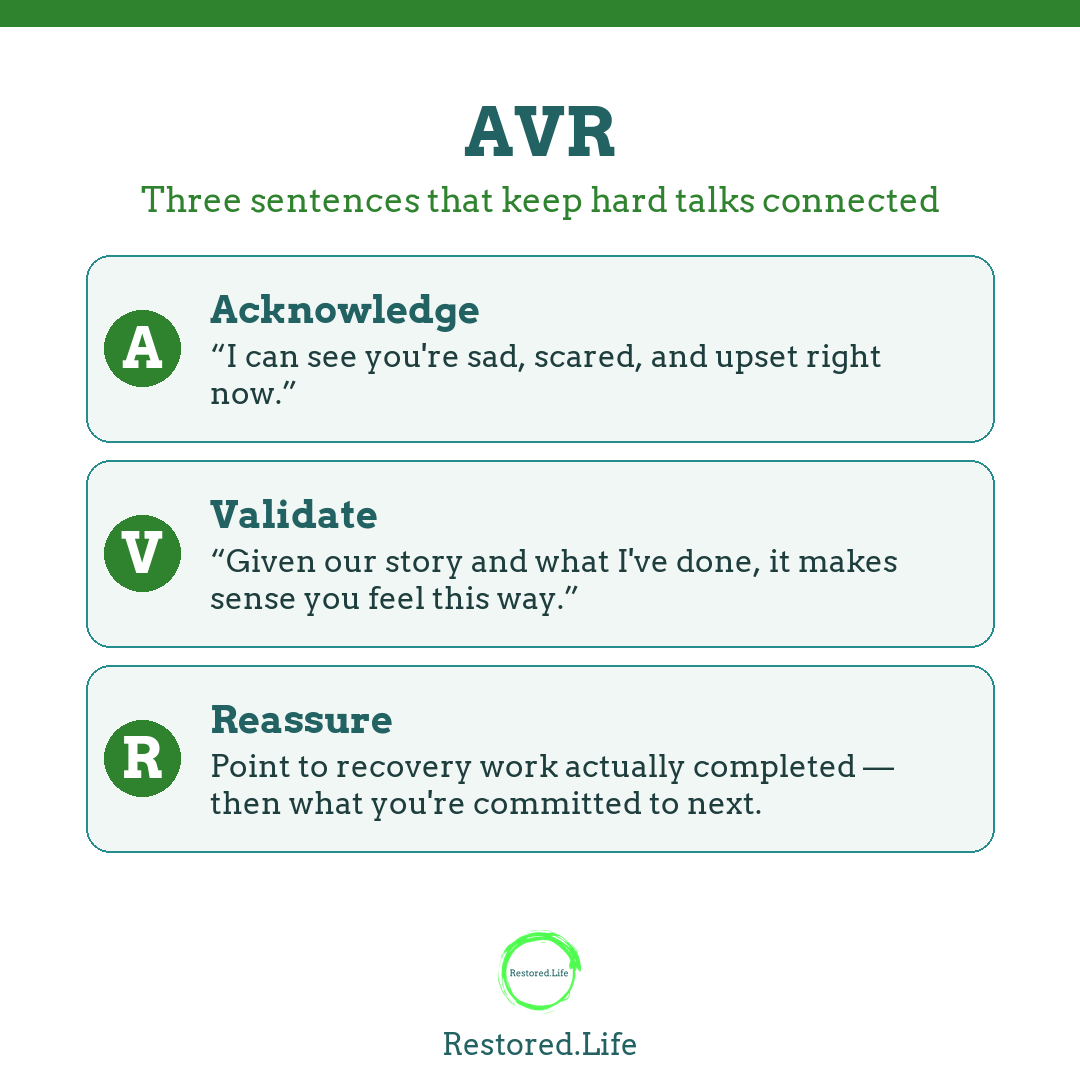
Tool 1 — AVR: Acknowledge, Validate, Reassure

When your spouse’s pain is on display, the worst moves are the instinctive ones: defend, explain, minimize, fix. AVR replaces them with three sentences:
- Acknowledge whatever emotions are on display. “I can see that you’re sad, scared, and upset right now.” Just naming what you see, out loud, without commentary.
- Validate the story behind the emotions — even if you disagree with the actions or words coming out of them. “Given our story and what I’ve done, it makes sense that you feel that way.”
- Reassure your betrayed spouse that you’re working on recovery. First point to recovery activities you have actually completed — then to the ones you’re committed to next. Reassurance built on completed actions is credible; reassurance built on promises alone is what got you here.
This isn’t a script for avoiding hard content — it’s what makes hard content survivable. Laboratory research bears it out: when people in distress receive validating responses, their negative arousal settles; invalidating responses (correcting, dismissing, explaining away) measurably re-escalate it (Shenk & Fruzzetti, 2011). And for the long road of rebuilt trust, the research on forgiveness finds that genuine expressions of responsibility and apology are among the strongest predictors of a wounded partner’s ability to forgive (Fehr, Gelfand & Nag, 2010). Scripture got there first: “let every person be quick to hear, slow to speak, slow to anger” (James 1:19) — AVR is simply James 1:19 with training wheels.
Tool 2 — The Daily Recovery Journal

Recovery that lives only in your head evaporates under stress. The Daily Recovery Journal puts it on paper, every day. The rules are simple: answer every question, every day; write your answers down; ask your spouse to do the same; then talk about your entries together.
The daily questions:
- What are three things you’re thankful for today? No repeats from this month. (Gratitude journaling isn’t a nicety — in the classic experiments, counting blessings reliably improved well-being compared with recording burdens or neutral events; Emmons & McCullough, 2003.)
- How are you feeling today? Pick two emotions from a feeling wheel (we use — with credit and thanks — PositivePsychology.com’s Feeling Wheel, which is printed inside the journal PDF below). The wheel forces precision past “fine” and “stressed.” Precision matters: putting feelings into words measurably calms the brain’s threat response (Lieberman et al., 2007), and people who name their emotions with granularity regulate them better (Kashdan, Barrett & McKnight, 2015).
- What are the main stories behind those two emotions? (Structured written disclosure of emotional experience carries measurable psychological benefit — Frattaroli, 2006.)
- What recovery activities or tools have you done since your last check-in? Solo tools (sleep, eating well, exercise, prayer, journaling, Bible reading/listening/memorization/copying, recovery reading, worksheets) and — at least as important — relationship-based tools (group, church, check-in calls and 1:1 time with a sponsor or mentor, accountability partner, friend or family member, spouse).
- What have you learned about yourself, your story, or recovery?
- In the next seven to ten days, what is the main threat to your recovery? And which three tools will you use to face it? At least two of the three must be relationship-based — isolation is where relapse lives, “two are better than one… a threefold cord is not quickly broken” (Ecclesiastes 4:9–12).
- Pick two or three traits your spouse demonstrated in the last week — no repeats this month — and write the stories behind them.
- What is something you need from your spouse?
- What is something you need to own up to or apologize for?
- What have you struggled with this week?
- What recovery work are you currently focused on (one of the 12 steps, Carnes’ 30 tasks, a book you’re working through with your sponsor), how is it going, and what questions do you have for your sponsor or mentor about it?
If a therapist or group has given you a FANOS or FASSTT check-in, you’ll notice the journal walks you through that same ground — feelings, affirmation, needs, ownership, sobriety — without you having to memorize an acronym. Share your entries with each other and you have naturally completed the daily check-in. The only thing left to do is pray together.
The printable version includes the full question list, the activities checklists, the Feeling Wheel (credit: PositivePsychology.com), and the spouse-traits list — keep it as a reference tool beside your journal.
Tool 3 — The 10-minute break

Every tool in this post depends on this one: when either of you starts to flood, stop and take a real 10-minute break. Not a door-slam, not a disappearance — a named, time-boxed pause: “I want to keep talking about this, and I need ten minutes first.”
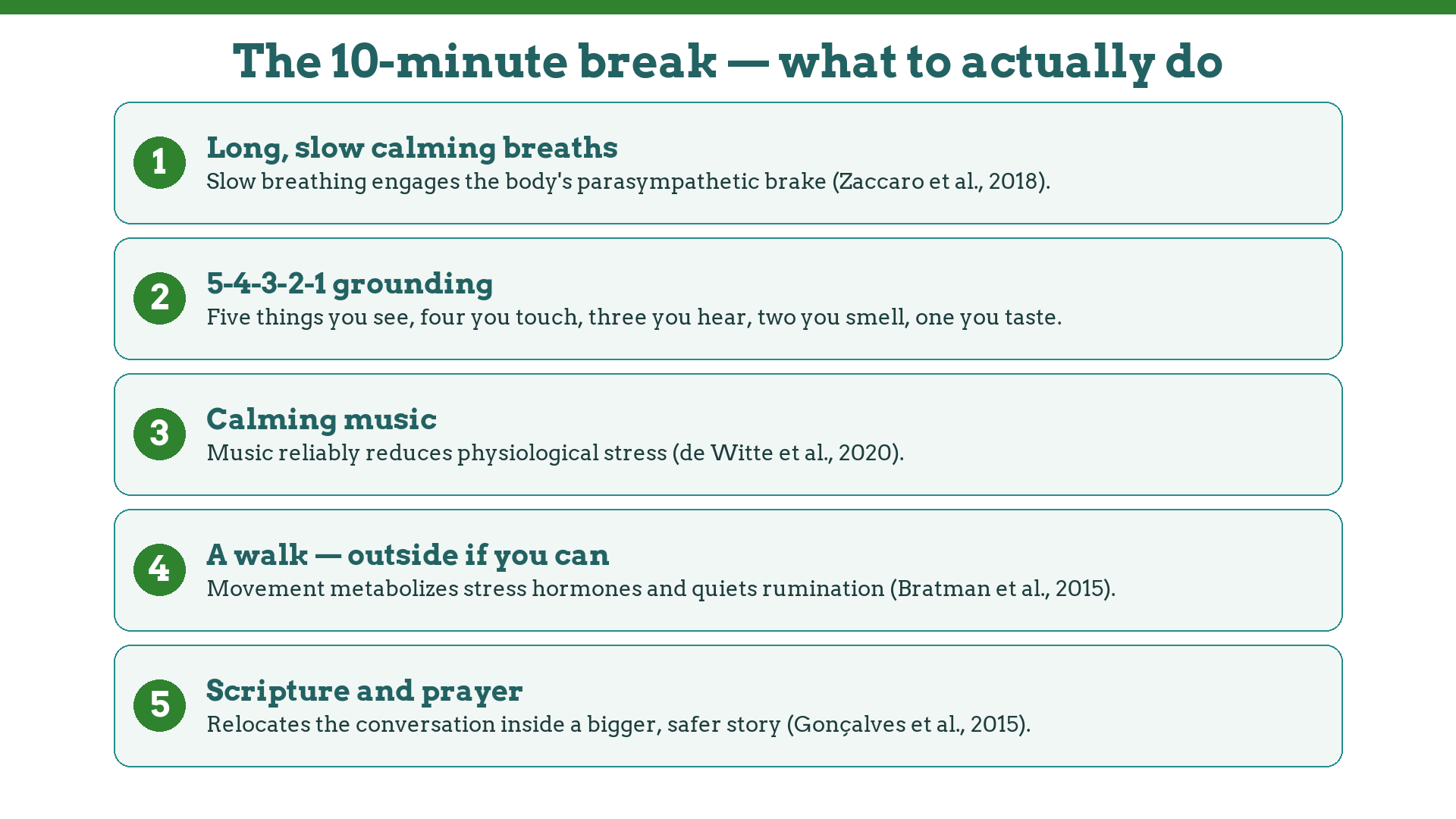
What to do with the ten minutes:
- Long, slow, deep calming breaths. Slow breathing directly engages the body’s parasympathetic brake — the physiology is well documented (Zaccaro et al., 2018).
- The 5-4-3-2-1 grounding method. Five things you can see, four you can touch, three you can hear, two you can smell, one you can taste. It anchors a racing mind back into the present through the senses.
- Listen to calming music. Music interventions reliably reduce physiological and psychological stress (de Witte et al., 2020).
- Take a walk. Movement metabolizes stress hormones, and walking — especially outside — quiets the ruminating mind (Bratman et al., 2015).
- Read Scripture and pray. Spiritual practice is not a garnish here; randomized trials of religious and spiritual interventions show reduced anxiety and stress (Gonçalves et al., 2015) — and prayer relocates the conversation you’re bracing for inside a bigger, safer story.
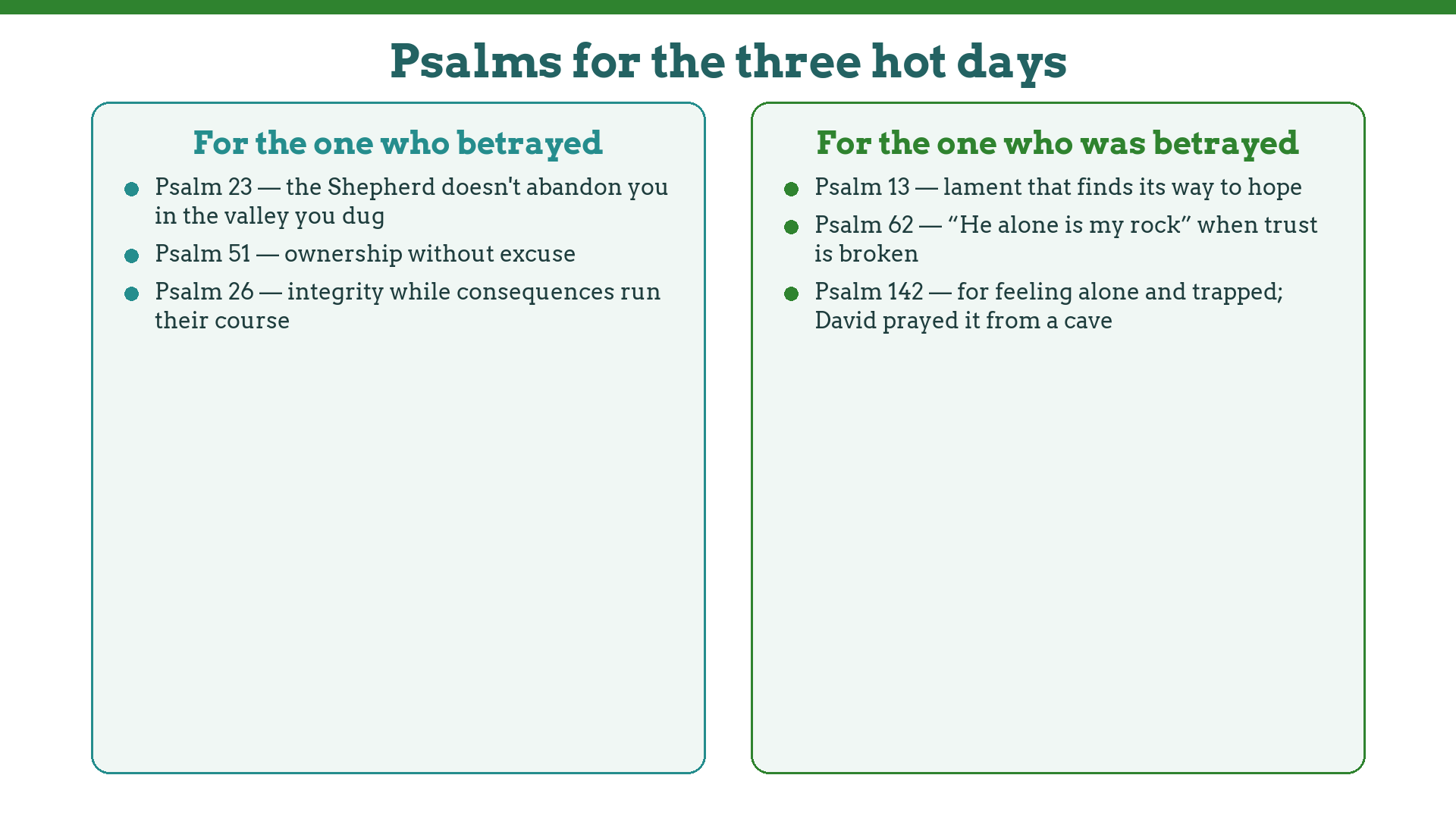
Psalms for the one who betrayed
Read and meditate on Psalm 23 (protection — the Shepherd doesn’t abandon you in the valley you dug), Psalm 51 (repentance — David’s model of ownership without excuse), and Psalm 26 (integrity — walking honestly while consequences run their course).
Psalms for the one who was betrayed
Read and meditate on Psalm 13 (lament that finds its way to hope — “How long, O LORD?” is a prayer, not a failure of faith), Psalm 62 (stability when trust is broken — “He alone is my rock”), and Psalm 142 (for feeling alone and trapped — David prayed it from a cave).
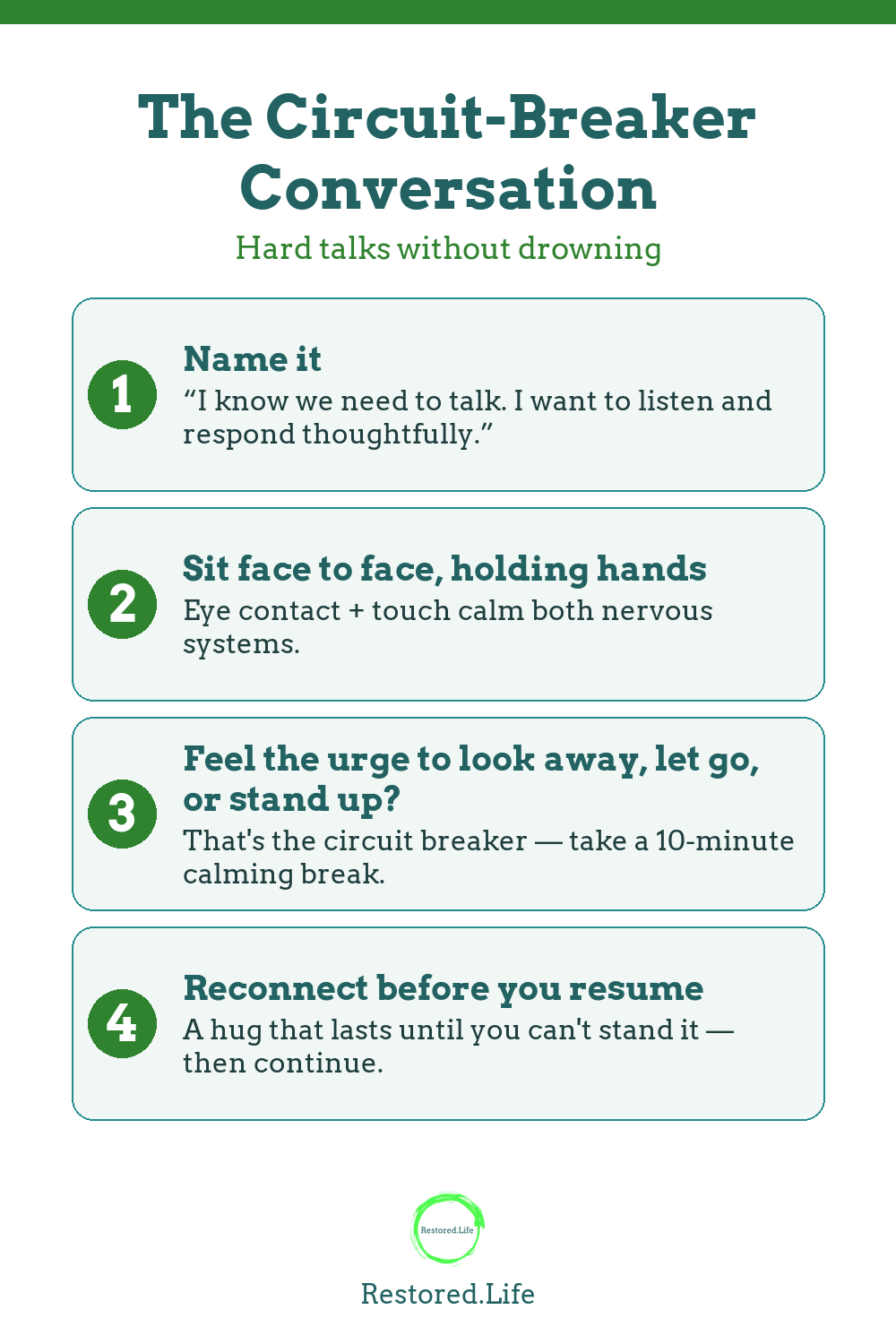
Tool 4 — The circuit-breaker conversation

For the conversations you know will be hard, don’t wing it — wire in circuit breakers ahead of time:
- Name it. Tell your spouse you know you need to talk, and that you want to listen and respond thoughtfully.
- Sit facing each other, holding hands. This sounds sentimental; it’s actually neuroscience. In brain-imaging research, holding a partner’s hand measurably reduced the brain’s threat response to anticipated stress (Coan, Schaefer & Davidson, 2006) — you are literally lending each other a calmer nervous system.
- The circuit breaker: the minute either of you needs to break eye contact, drop the hand-hold, or stand up — that’s the signal. Take a 10-minute break (Tool 3). No penalty, no scorekeeping; the break is obedience to the structure you both agreed to.
- Reconnect before you resume. When you come back, give each other a hug that lasts until you can’t stand it. Don’t restart the conversation until after that long hug. Warm partner contact lowers blood pressure and stress reactivity (Holt-Lunstad et al., 2008), and people who are hugged more weather stress and conflict measurably better (Cohen et al., 2015).
Repeat as many times as the conversation needs. A hard topic handled in three 20-minute installments with two breaks is a success, not a failure.
How the four tools fit together

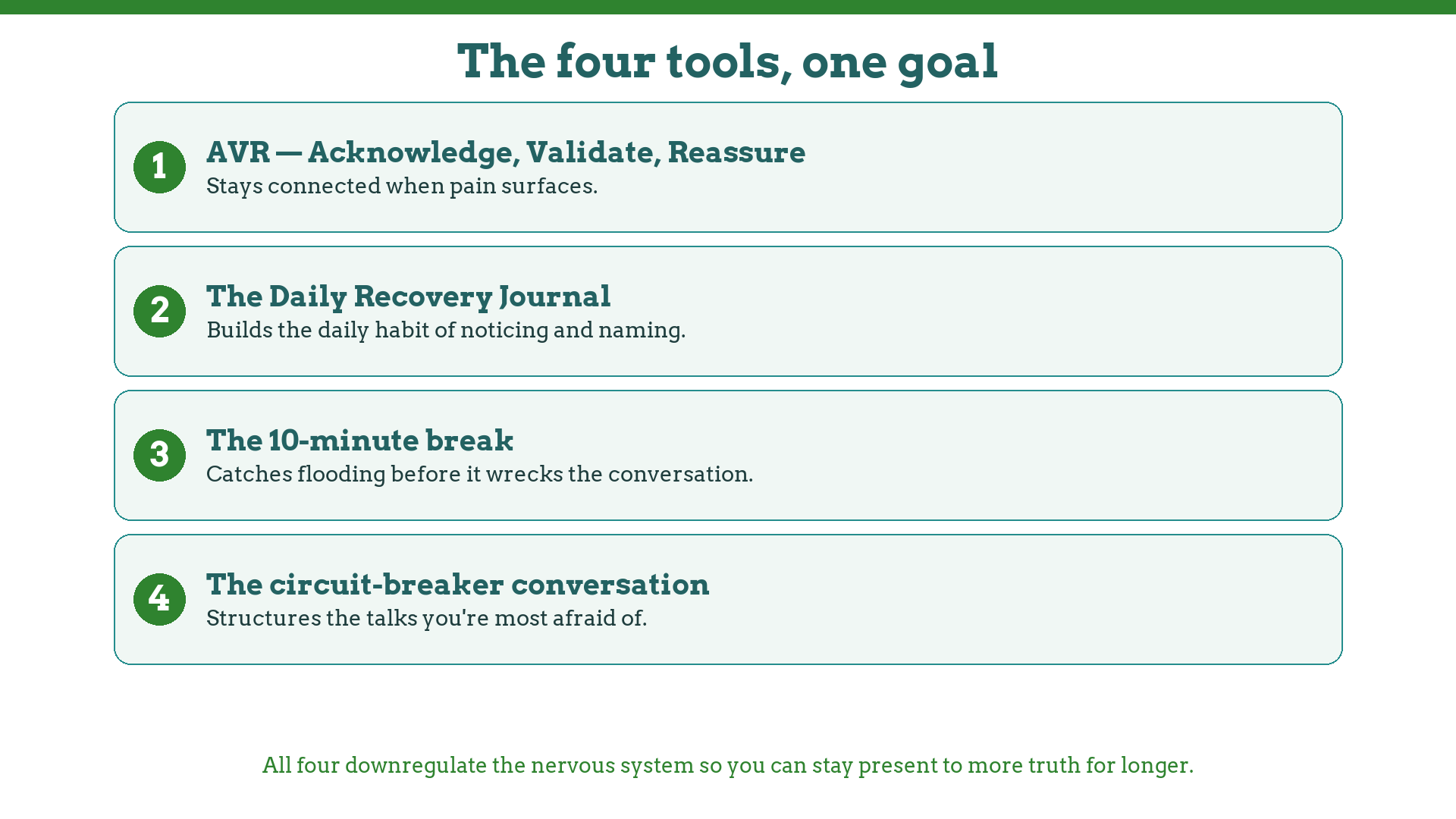
All of these tools do the same thing from different angles: they downregulate your nervous system so you can discuss difficult topics for longer without becoming overwhelmed. The journal builds the daily habit of noticing and naming; AVR keeps you connected when pain surfaces; the 10-minute break catches flooding before it wrecks the conversation; the circuit breakers structure the conversations you’re most afraid of. Practiced together, they turn the question “can we survive talking about this?” into “when do we want to schedule it?”
They pair naturally with the other free tools on this site — the SEEDS Cycle for understanding what’s happening inside each of you, and Things to Try to Improve Relationships for rebuilding connection outside the hard conversations.
You don’t have to do this alone

These tools work best inside a real recovery structure: individual counseling for each of you, group support, and — when you’re both ready — couples work. That’s what we do. Our CSAT-supervised team provides betrayal trauma counseling for the betrayed partner, sex addiction and porn addiction recovery for the betrayer, and couples counseling — in person in Glendale, Arizona (17230 N 59th Ave, inside Faith Bible Church) and by telehealth across Arizona and Washington. We accept most major insurance plans and offer a sliding scale with published price ranges.
“He heals the brokenhearted and binds up their wounds” (Psalm 147:3) — and He usually does it one honest, regulated conversation at a time.
Save and share
Pin or share these — someone you love may need them today.
References
- Bratman, G. N., Hamilton, J. P., Hahn, K. S., Daily, G. C., & Gross, J. J. (2015). Nature experience reduces rumination and subgenual prefrontal cortex activation. Proceedings of the National Academy of Sciences, 112(28), 8567–8572. https://doi.org/10.1073/pnas.1510459112
- Coan, J. A., Schaefer, H. S., & Davidson, R. J. (2006). Lending a hand: Social regulation of the neural response to threat. Psychological Science, 17(12), 1032–1039. https://doi.org/10.1111/j.1467-9280.2006.01832.x
- Cohen, S., Janicki-Deverts, D., Turner, R. B., & Doyle, W. J. (2015). Does hugging provide stress-buffering social support? A study of susceptibility to upper respiratory infection and illness. Psychological Science, 26(2), 135–147. https://doi.org/10.1177/0956797614559284
- de Witte, M., Spruit, A., van Hooren, S., Moonen, X., & Stams, G.-J. (2020). Effects of music interventions on stress-related outcomes: A systematic review and two meta-analyses. Health Psychology Review, 14(2), 294–324. https://doi.org/10.1080/17437199.2019.1627897
- Emmons, R. A., & McCullough, M. E. (2003). Counting blessings versus burdens: An experimental investigation of gratitude and subjective well-being in daily life. Journal of Personality and Social Psychology, 84(2), 377–389. https://doi.org/10.1037/0022-3514.84.2.377
- Fehr, R., Gelfand, M. J., & Nag, M. (2010). The road to forgiveness: A meta-analytic synthesis of its situational and dispositional correlates. Psychological Bulletin, 136(5), 894–914. https://doi.org/10.1037/a0019993
- Frattaroli, J. (2006). Experimental disclosure and its moderators: A meta-analysis. Psychological Bulletin, 132(6), 823–865. https://doi.org/10.1037/0033-2909.132.6.823
- Gonçalves, J. P. B., Lucchetti, G., Menezes, P. R., & Vallada, H. (2015). Religious and spiritual interventions in mental health care: A systematic review and meta-analysis of randomized controlled clinical trials. Psychological Medicine, 45(14), 2937–2949. https://doi.org/10.1017/s0033291715001166
- Gottman, J. M., & Levenson, R. W. (1992). Marital processes predictive of later dissolution: Behavior, physiology, and health. Journal of Personality and Social Psychology, 63(2), 221–233. https://doi.org/10.1037/0022-3514.63.2.221
- Holt-Lunstad, J., Birmingham, W. A., & Light, K. C. (2008). Influence of a “warm touch” support enhancement intervention among married couples on ambulatory blood pressure, oxytocin, alpha amylase, and cortisol. Psychosomatic Medicine, 70(9), 976–985. https://doi.org/10.1097/PSY.0b013e318187aef7
- Kashdan, T. B., Barrett, L. F., & McKnight, P. E. (2015). Unpacking emotion differentiation: Transforming unpleasant experience by perceiving distinctions in negativity. Current Directions in Psychological Science, 24(1), 10–16. https://doi.org/10.1177/0963721414550708
- Lieberman, M. D., Eisenberger, N. I., Crockett, M. J., Tom, S. M., Pfeifer, J. H., & Way, B. M. (2007). Putting feelings into words: Affect labeling disrupts amygdala activity in response to affective stimuli. Psychological Science, 18(5), 421–428. https://doi.org/10.1111/j.1467-9280.2007.01916.x
- Shenk, C. E., & Fruzzetti, A. E. (2011). The impact of validating and invalidating responses on emotional reactivity. Journal of Social and Clinical Psychology, 30(2), 163–183. https://doi.org/10.1521/jscp.2011.30.2.163
- Steffens, B. A., & Rennie, R. L. (2006). The traumatic nature of disclosure for wives of sexual addicts. Sexual Addiction & Compulsivity, 13(2–3), 247–267. https://doi.org/10.1080/10720160600870802
- Zaccaro, A., Piarulli, A., Laurino, M., Garbella, E., Menicucci, D., Neri, B., & Gemignani, A. (2018). How breath-control can change your life: A systematic review on psycho-physiological correlates of slow breathing. Frontiers in Human Neuroscience, 12, 353. https://doi.org/10.3389/fnhum.2018.00353
Method note: sources were identified via OpenAlex literature search and screened for retractions and editorial notices via Scite before citation. Scripture quotations are from the ESV. This post describes tools we coach clients through in recovery from betrayal and sexual addiction; it is educational, not a substitute for individualized clinical care. Prepared with AI assistance and reviewed by Restored Life Counseling’s clinical staff.