

Restore trust and commitment. Process the pain without shame. Believe in yourself — and your relationship — again.
The God of the whole Bible deals in restored covenants

Infidelity is the wound Scripture takes most seriously — seriously enough that God uses it to describe how He has been treated (Hosea, Jeremiah 3, Ezekiel 16). That matters for two reasons. First: if you’ve been betrayed, God is not neutral about what happened to you; He knows this pain from the inside. Second: the same Scriptures that name adultery honestly are the story of a God who pursues, restores, and remarries the unfaithful — which means an affair, however serious, does not have to be the final chapter. Redemption is not naïveté. It’s the family business.
So here is the first clinical word, which is also a pastoral one: you don’t have to make permanent decisions from the most painful week of your marriage. Whether you were betrayed, you were unfaithful, or you’re not even sure what to call what happened — infidelity is among the most-studied relationship crises (Warach et al., 2024), couple therapy has developed specific, research-informed models for affair recovery (Lebow & Snyder, 2022), and couples who complete infidelity-focused therapy improve at rates comparable to distressed couples without infidelity (Atkins et al., 2010) — with gains that persist five years later (Marín et al., 2014).
How affair recovery works

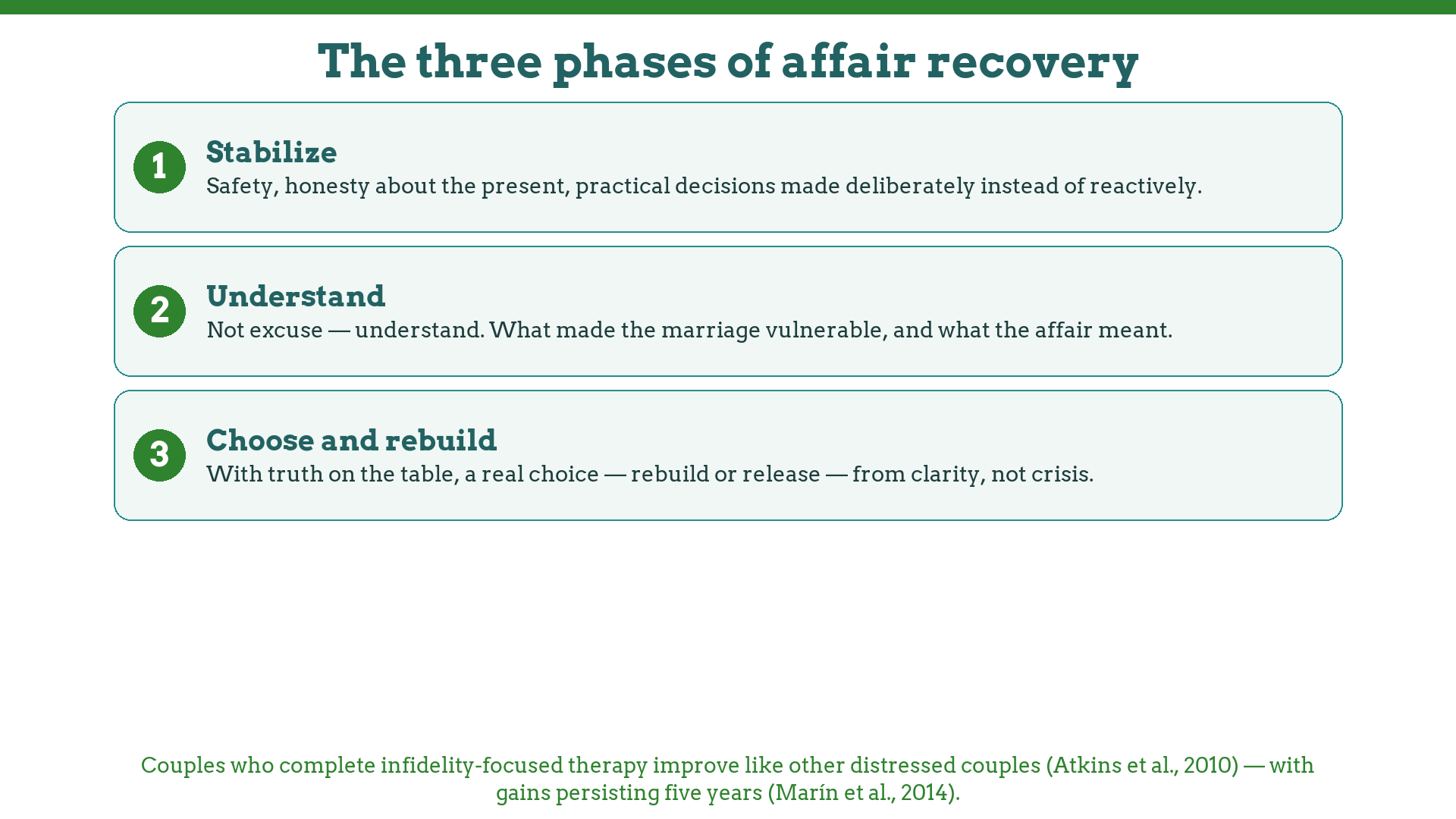
Recovery from infidelity is not one conversation; the treatment models the field has developed are staged processes (Lebow & Snyder, 2022) — and the stages track the Bible’s own anatomy of repair: truth, repentance, and rebuilt trust. Our work typically moves through three overlapping phases:
1. Stabilize. Stop the bleeding: safety, honesty about the present, managing the flood of emotion, and practical decisions (what to tell the kids, who sleeps where) made deliberately instead of reactively. 2. Understand. Not excuse — understand. What made the marriage vulnerable, what the affair meant, and what each partner’s story brings to it. In Emotionally Focused Therapy terms, an affair is an attachment injury, and EFT offers a specific clinical process for healing it (Schade & Sandberg, 2012). 3. Choose and rebuild. With truth on the table and pain processed, couples make a real choice — rebuild or release — from clarity rather than crisis.
What about forgiveness?

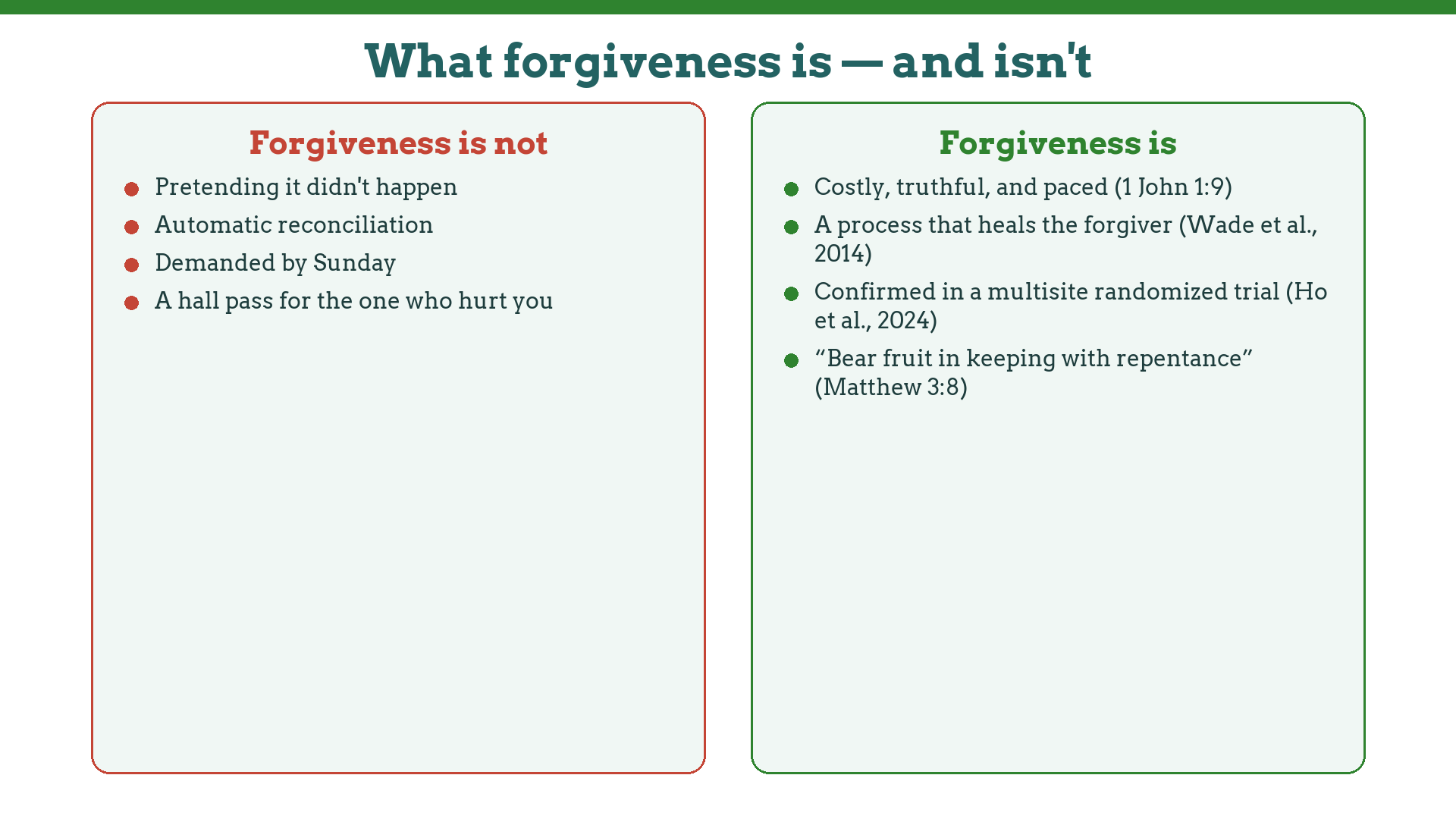
If you grew up in church, someone has probably already told you to forgive — quickly, completely, and preferably by Sunday. That is not what the Bible asks of the betrayed, and it is not what we practice. Biblical forgiveness is costly, truthful, and paced (even God’s forgiveness runs through confession — 1 John 1:9); reconciliation additionally requires trustworthiness rebuilt over time. The clinical research maps the same road: couple-therapy researchers have traced how couples actually move through forgiveness after infidelity — from the impact of the injury, through the unfaithful partner’s genuine remorse, to a rebuilt bond (Meneses & Greenberg, 2011); interpersonal models of treatment place forgiveness at the center of infidelity work (Fife et al., 2011); and forgiveness interventions have randomized-trial support — a multisite trial of the REACH forgiveness model found increased forgiveness and reduced depression and anxiety (Ho et al., 2024), consistent with the broader meta-analytic evidence that forgiveness work heals the forgiver (Wade et al., 2014).
Two things forgiveness is not: it is not pretending it didn’t happen, and it is not automatic reconciliation. Trust is rebuilt by trustworthy behavior over time — “bear fruit in keeping with repentance” (Matthew 3:8) is a couples-therapy principle wearing first-century clothes.
When the affair involves porn or sex addiction

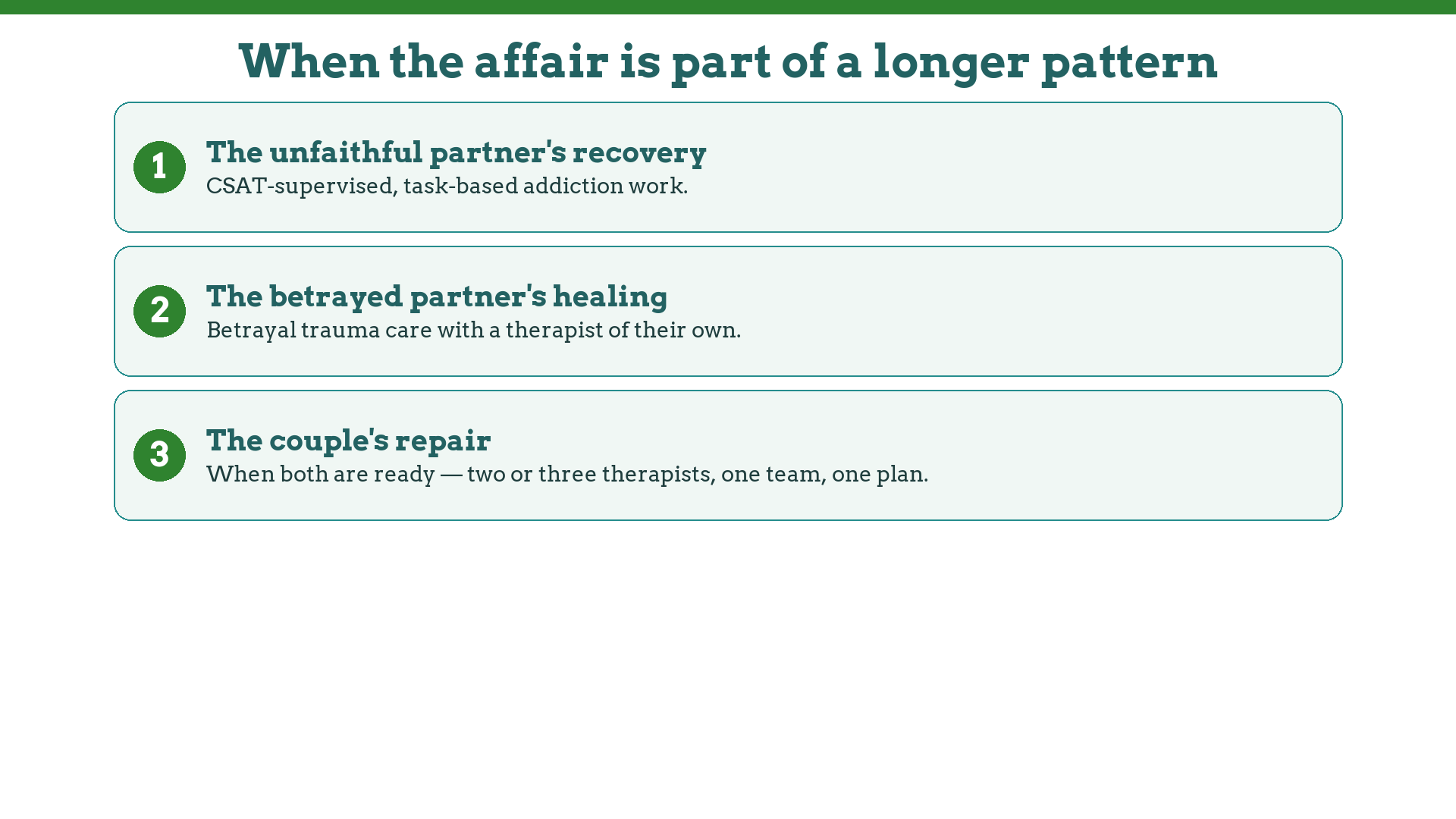
Sometimes an affair is a one-time breach. Sometimes it’s the visible edge of a longer pattern — compulsive pornography use, escalating secrecy, a sexual addiction. In our clinical experience, those situations call for more than couples counseling alone. Our CSAT-supervised team coordinates the addicted partner’s recovery work, the betrayed partner’s betrayal trauma care, and the couple’s repair — two or three therapists, one team, one plan. If you’re the betrayed partner and this page doesn’t quite match your experience, start with betrayal trauma counseling — and our article on recovering from the ultimate betrayal.
Counseling with covenant weight — and covenant hope

We are a Christian practice, so we don’t treat your marriage as a disposable arrangement or your pain as a private inconvenience. Infidelity carries covenant weight — and so does redemption; we take both seriously, for the betrayed and the unfaithful alike. The research supports integrating faith into this work: religiously and spiritually integrated psychotherapy performs at least as well as standard approaches, with added spiritual benefit (Smith et al., 2007; Captari et al., 2018). Confession, repentance, lament, forgiveness — the real, costly kind — sit alongside structured clinical work. No shortcuts, no shame, no coercion.
Infidelity counseling in Glendale, AZ — and online

We provide infidelity counseling in person in Glendale, Arizona (17230 N 59th Ave, inside Faith Bible Church — serving Glendale, Peoria, and the north Phoenix Valley) and by telehealth across Arizona and Washington. We accept most major insurance plans and offer a sliding scale with price ranges. Related reading: How to overcome trauma from infidelity.
Start today

The affair doesn’t get the last word. What you do next does.
Save and share
Pin or share these — someone you love may need them today.


References
- Atkins, D. C., Marín, R. A., Lo, T. T. Y., Klann, N., & Hahlweg, K. (2010). Outcomes of couples with infidelity in a community-based sample of couple therapy. Journal of Family Psychology, 24(2), 212–216. https://doi.org/10.1037/a0018789
- Captari, L. E., Hook, J. N., Hoyt, W., Davis, D. E., McElroy-Heltzel, S. E., & Worthington, E. L., Jr. (2018). Integrating clients’ religion and spirituality within psychotherapy: A comprehensive meta-analysis. Journal of Clinical Psychology, 74(11), 1938–1951. https://doi.org/10.1002/jclp.22681
- Fife, S. T., Weeks, G. R., & Stellberg-Filbert, J. (2011). Facilitating forgiveness in the treatment of infidelity: An interpersonal model. Journal of Family Therapy, 35(4), 343–367. https://doi.org/10.1111/j.1467-6427.2011.00561.x
- Ho, M. Y., Worthington, E. L., Cowden, R. G., Bechara, A. O., Chen, Z. J., et al. (2024). International REACH forgiveness intervention: A multisite randomised controlled trial. BMJ Public Health, 2(1), e000072. https://doi.org/10.1136/bmjph-2023-000072
- Lebow, J. L., & Snyder, D. K. (2022). Couple therapy in the 2020s: Current status and emerging developments. Family Process, 61(4), 1359–1385. https://doi.org/10.1111/famp.12824
- Marín, R. A., Christensen, A., & Atkins, D. C. (2014). Infidelity and behavioral couple therapy: Relationship outcomes over 5 years following therapy. Couple and Family Psychology: Research and Practice, 3(1), 1–12. https://doi.org/10.1037/cfp0000012
- Meneses, C. W., & Greenberg, L. S. (2011). The construction of a model of the process of couples’ forgiveness in emotion-focused therapy for couples. Journal of Marital and Family Therapy, 37(4), 491–502. https://doi.org/10.1111/j.1752-0606.2011.00234.x
- Schade, L. C., & Sandberg, J. G. (2012). Healing the attachment injury of marital infidelity using emotionally focused couples therapy: A case illustration. American Journal of Family Therapy, 40(5), 434–444. https://doi.org/10.1080/01926187.2011.631374
- Smith, T. B., Bartz, J., & Richards, P. S. (2007). Outcomes of religious and spiritual adaptations to psychotherapy: A meta-analytic review. Psychotherapy Research, 17(6), 643–655. https://doi.org/10.1080/10503300701250347
- Wade, N. G., Hoyt, W. T., Kidwell, J. E. M., & Worthington, E. L., Jr. (2014). Efficacy of psychotherapeutic interventions to promote forgiveness: A meta-analysis. Journal of Consulting and Clinical Psychology, 82(1), 154–170. https://doi.org/10.1037/a0035268
- Warach, B., Bornstein, R. F., Gorman, B. S., & Moyer, A. (2024). The current state of affairs in infidelity research: A systematic review and meta-analysis of romantic infidelity. Personal Relationships, 31(3). https://doi.org/10.1111/pere.12571
Method note: sources were identified via OpenAlex and Scite literature search and screened for retractions and editorial notices via Scite before citation. Scripture quotations are from the ESV. This page was prepared with AI assistance and reviewed by Restored Life Counseling’s clinical staff.