

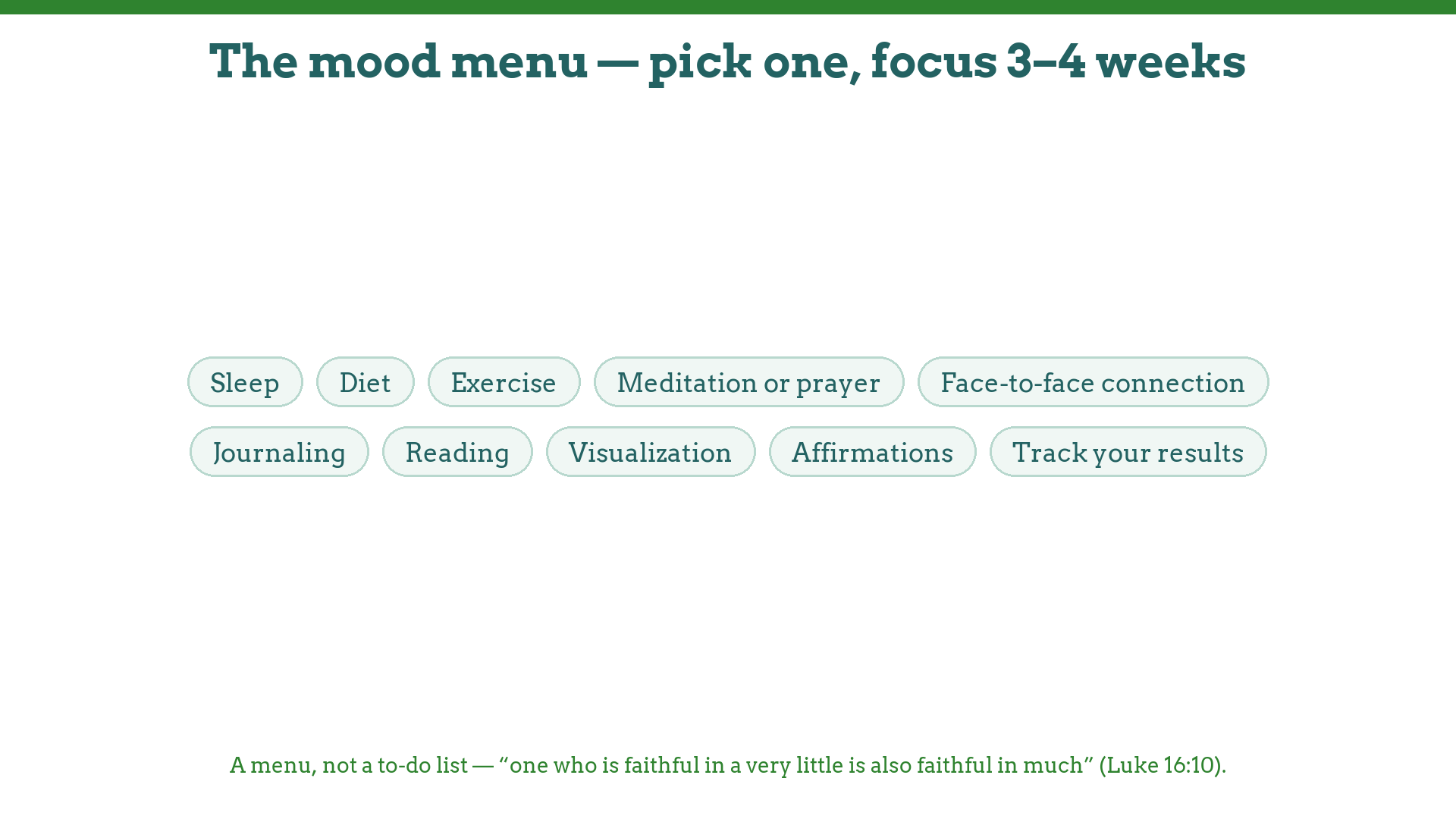
God tends to grow big things from small faithfulness — “one who is faithful in a very little is also faithful in much” (Luke 16:10). Here is a menu of small habits that can make big changes for depression, anxiety, or anger. Treat this like a menu, not a to-do list. Pick one thing to try at a time, focus on it for 3 to 4 weeks, then try something else.
Sleep
Aim for 7 to 9 hours of uninterrupted sleep. Cut off screen time at least 30 minutes before bedtime. Cut off alcohol at least 3 hours before bedtime. Cut off caffeine 8–10 hours before bedtime. Make your room as dark as possible.
Diet
The best diet is one that you can stick to. Many of us know how to eat healthy but don’t do it. Do one thing each day to eat healthier than you did yesterday.
Exercise
The best exercise is something you enjoy, that you can do year-round, that increases your heart rate.
Meditation or prayer
Try one of these apps: Headspace, Calm, or Abide (Judeo-Christian meditation). Or pray the Psalms when you are low: here is a practice for mining the Psalms.
Build connection
Connect face to face with someone you care about for 30 minutes or more, without screens or other distractions. Play a game. Talk about the weather, sports, or politics. Talk about what you have been reading or praying about. Just be together.
Journaling
Pick a time — bedtime or first thing in the morning. Write down your thoughts and feelings about the day behind you and the day ahead of you. Check out this guide for ideas to get started.
Reading
Read for personal or spiritual growth. Read the Bible. Or listen to podcasts or audiobooks. Or watch YouTube videos. JUST. NEVER. STOP. LEARNING. Check out this list for some of our favorites.
Visualization
Picture what life would look like, feel like, smell like if you achieved your goals for the day, week, month, or year ahead. Try to import the hopeful emotions that come up into the present, to give you energy and motivation for today.
Affirmations
Remind yourself of your values and goals out loud or in writing. Then add to that: “Yesterday I lived out my values / moved toward my goal by…” (list what you did) and “Today I will live out my values / move toward my goals by…” (list what you will do).
Track your efforts and results
The printable version of this resource includes an efforts-and-results tracker to help you see what’s working.
Save and share

Pin or share these — someone you love may need them today.


Next steps
If small habits aren’t enough on their own, that’s not failure — it’s information. Our team offers depression counseling and anxiety counseling in Glendale, AZ and online across Arizona and Washington. Or get matched with a great therapist at Mental Health Match.
References
- Cuijpers, P., van Straten, A., & Warmerdam, L. (2007). Behavioral activation treatments of depression: A meta-analysis. Clinical Psychology Review, 27(3), 318–326. https://doi.org/10.1016/j.cpr.2006.11.001
- Emmons, R. A., & McCullough, M. E. (2003). Counting blessings versus burdens: An experimental investigation of gratitude and subjective well-being in daily life. Journal of Personality and Social Psychology, 84(2), 377–389. https://doi.org/10.1037/0022-3514.84.2.377
- Goyal, M., Singh, S., Sibinga, E. M. S., et al. (2014). Meditation programs for psychological stress and well-being: A systematic review and meta-analysis. JAMA Internal Medicine, 174(3), 357–368. https://doi.org/10.1001/jamainternmed.2013.13018
- Holt-Lunstad, J., Smith, T. B., & Layton, J. B. (2010). Social relationships and mortality risk: A meta-analytic review. PLoS Medicine, 7(7), e1000316. https://doi.org/10.1371/journal.pmed.1000316
- Schuch, F. B., Vancampfort, D., Richards, J., Rosenbaum, S., Ward, P. B., & Stubbs, B. (2016). Exercise as a treatment for depression: A meta-analysis adjusting for publication bias. Journal of Psychiatric Research, 77, 42–51. https://doi.org/10.1016/j.jpsychires.2016.02.023
- Irish, L. A., Kline, C. E., Gunn, H. E., Buysse, D. J., & Hall, M. H. (2015). The role of sleep hygiene in promoting public health: A review of empirical evidence. Sleep Medicine Reviews, 22, 23–36. https://doi.org/10.1016/j.smrv.2014.10.001