

“He heals the brokenhearted and binds up their wounds” (Psalm 147:3). Infidelity breaks something deep, and healing from it is real work — but it is not hopeless work. This page answers the questions we hear most from people reeling after an affair. If you want the overview first, see infidelity counseling and betrayal trauma counseling.
What is infidelity?

Infidelity is the violation of a couple’s agreement about sexual and/or emotional exclusivity — a disloyal act that betrays trust. It can happen in troubled relationships and, painfully, in happy ones too.
Can infidelity really cause trauma?

Yes. Discovering a partner’s betrayal is genuinely traumatic: in the landmark study of wives of sexual addicts, most met the symptom criteria for post-traumatic stress disorder after disclosure (Steffens & Rennie, 2006). What you’re feeling — intrusive thoughts, hypervigilance, alternating numbness and rage, an inability to stop scanning for more painful information — is a normal trauma response to a profound relational injury, not a defect in you.
Why does betrayal wound so deeply?

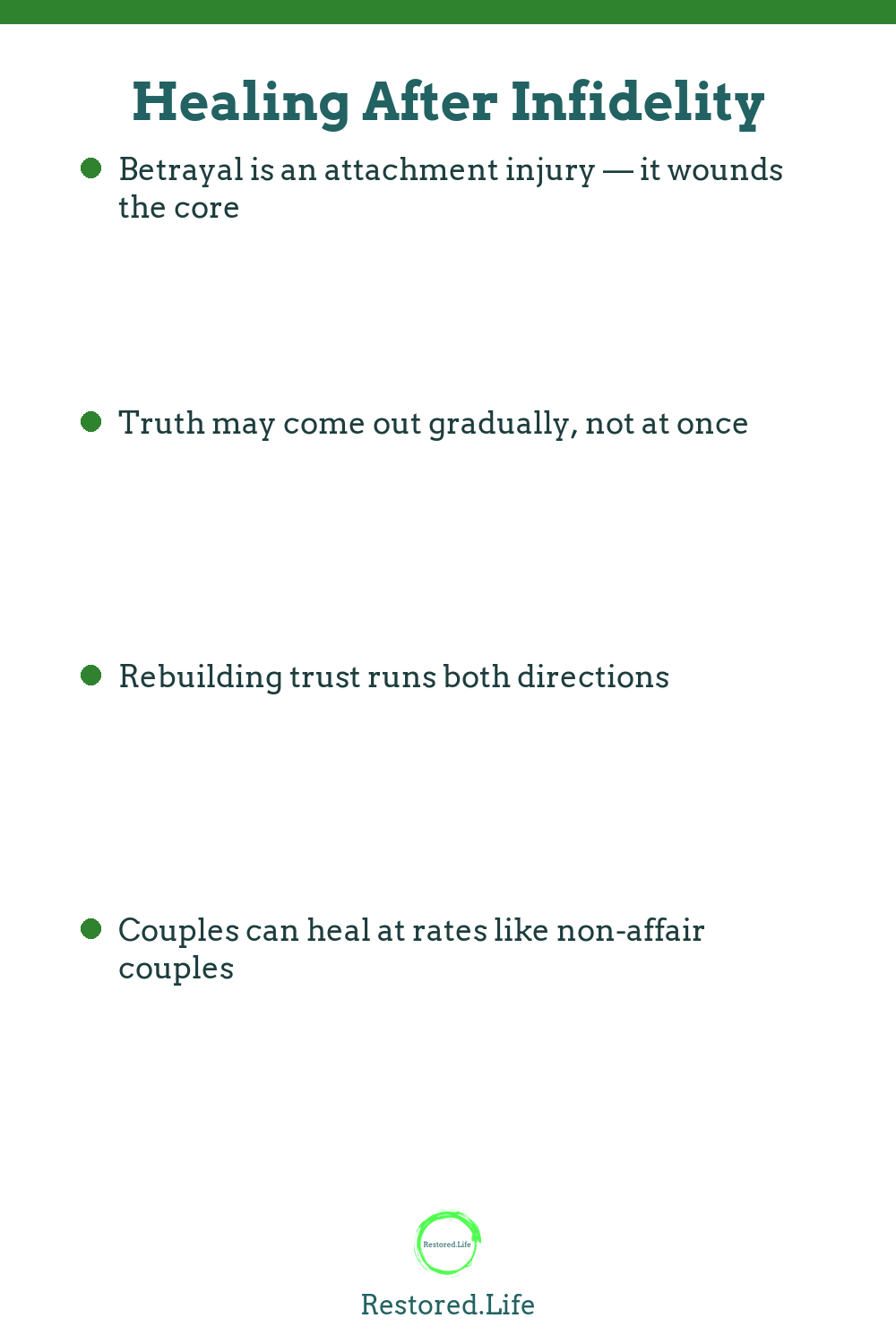
Because it is an attachment injury: the person you would normally turn to for comfort is the person who caused the harm. Couple researchers describe these moments of abandonment or betrayal as attachment injuries that can come to define the whole relationship (Johnson, Makinen & Millikin, 2001). God designed marriage as one-flesh trust — “naked and unashamed” (Genesis 2:24–25) — which is precisely why its violation registers in the body like a car crash.
How do you start healing from infidelity?
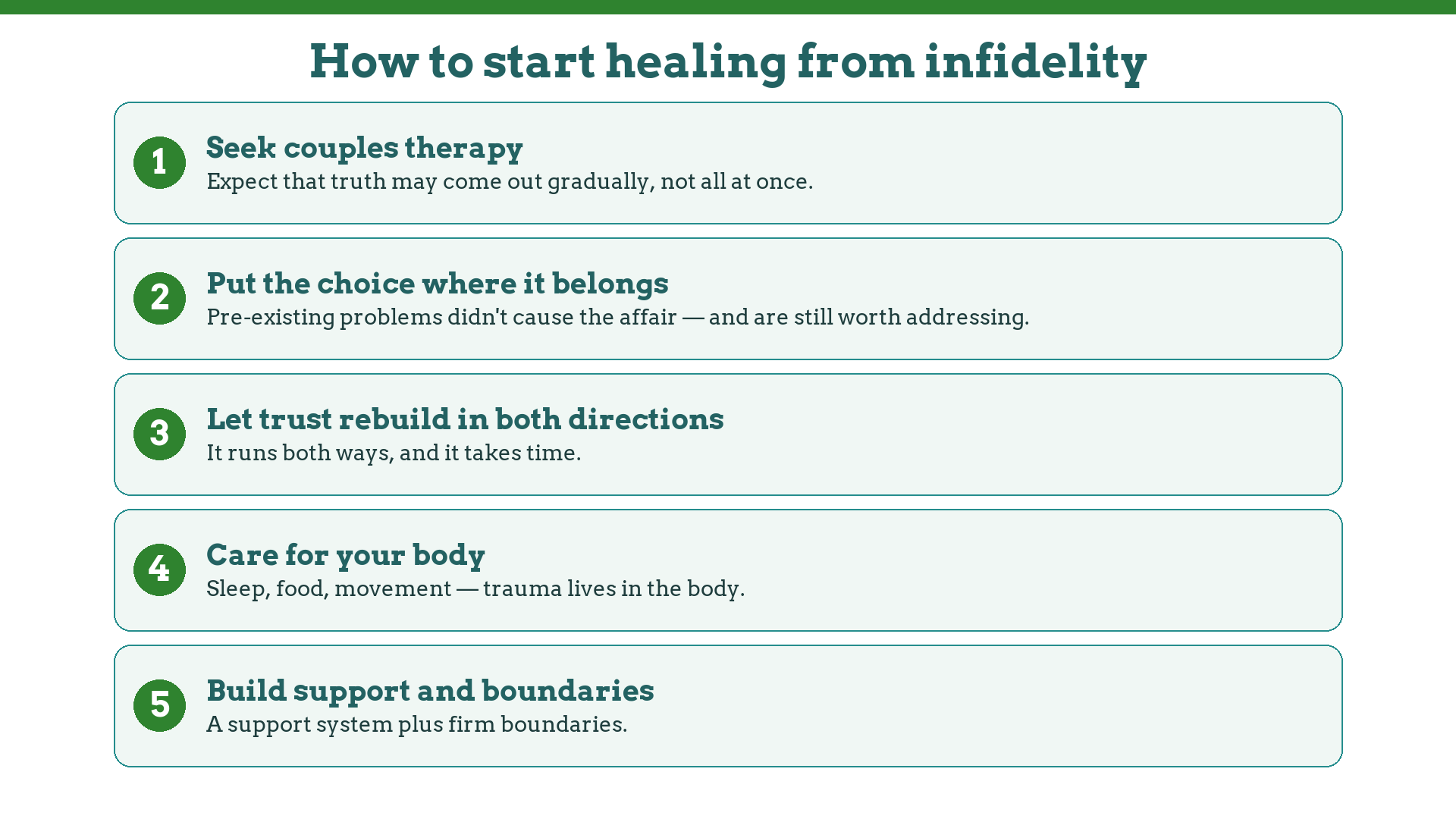
- Seek couples therapy — and expect that truth may come out gradually, not all at once.
- Understand that pre-existing problems didn’t cause the affair (the choice belongs to the one who made it), but they are still worth addressing.
- Recognize that rebuilding trust runs in both directions and takes time.
- Care for your body — sleep, food, movement — because trauma lives in the body.
- Build a support system, and set firm boundaries.
How do you forgive a partner after infidelity?

Slowly, and for your own sake. Forgiveness does not excuse the behavior or require reconciliation; it opens the possibility of repair if the relationship is repairable and both partners want it. It is hardest when the offending partner won’t own what they did. And it heals the forgiver: a meta-analysis of forgiveness interventions found they reliably reduce depression and anxiety while increasing hope (Wade et al., 2014). Biblical forgiveness is a process worked in you by God, in His timing — never a demanded shortcut.
Can the relationship recover?

Sometimes — and the decision doesn’t have to be made today. Couples who complete infidelity-focused couple therapy improve at rates comparable to distressed couples without infidelity (Atkins et al., 2010), and there are well-developed, research-informed models specifically for affair recovery (Gordon, Baucom & Snyder, 2004). Recovery is not guaranteed, but it is genuinely possible.
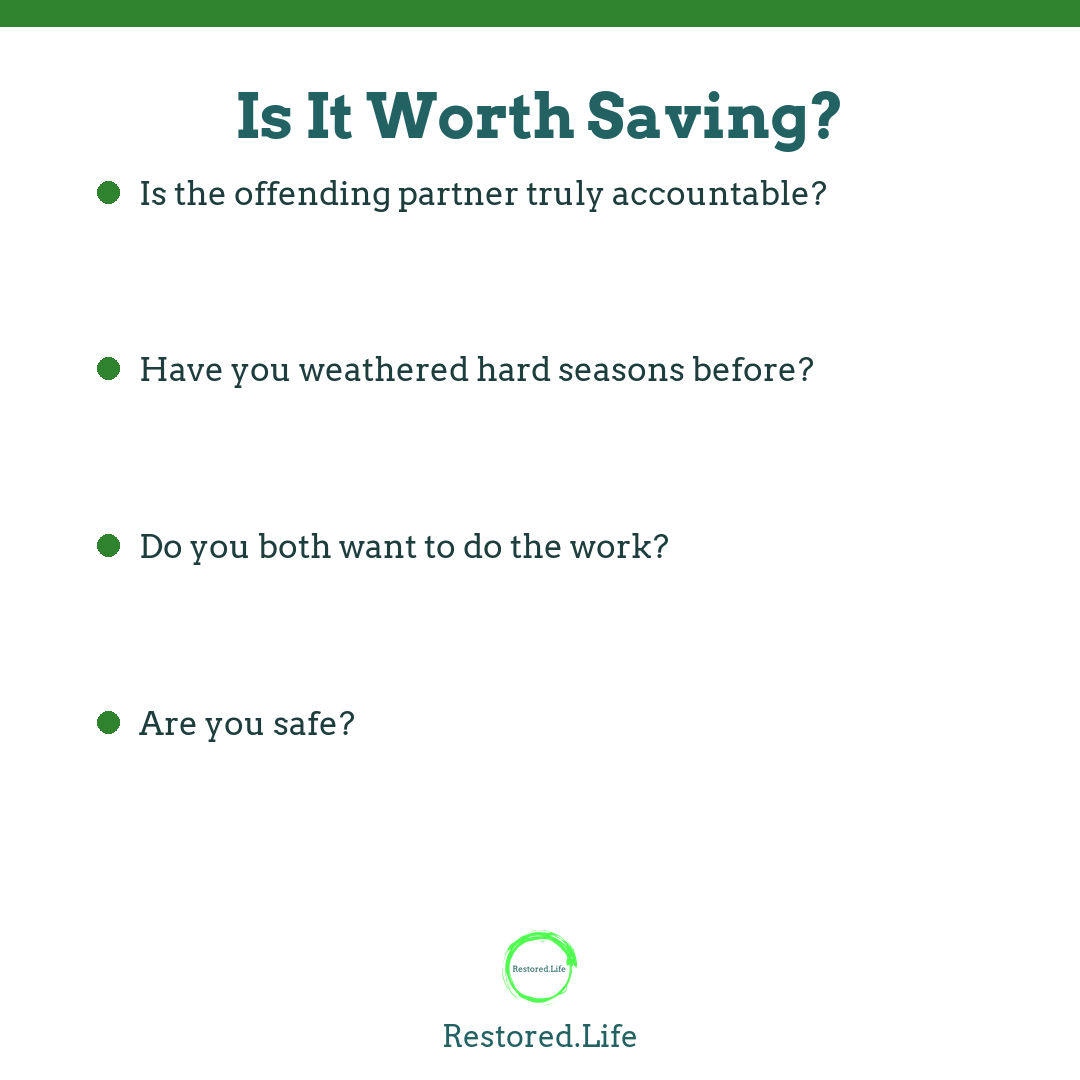
How do you know if the relationship is worth saving?
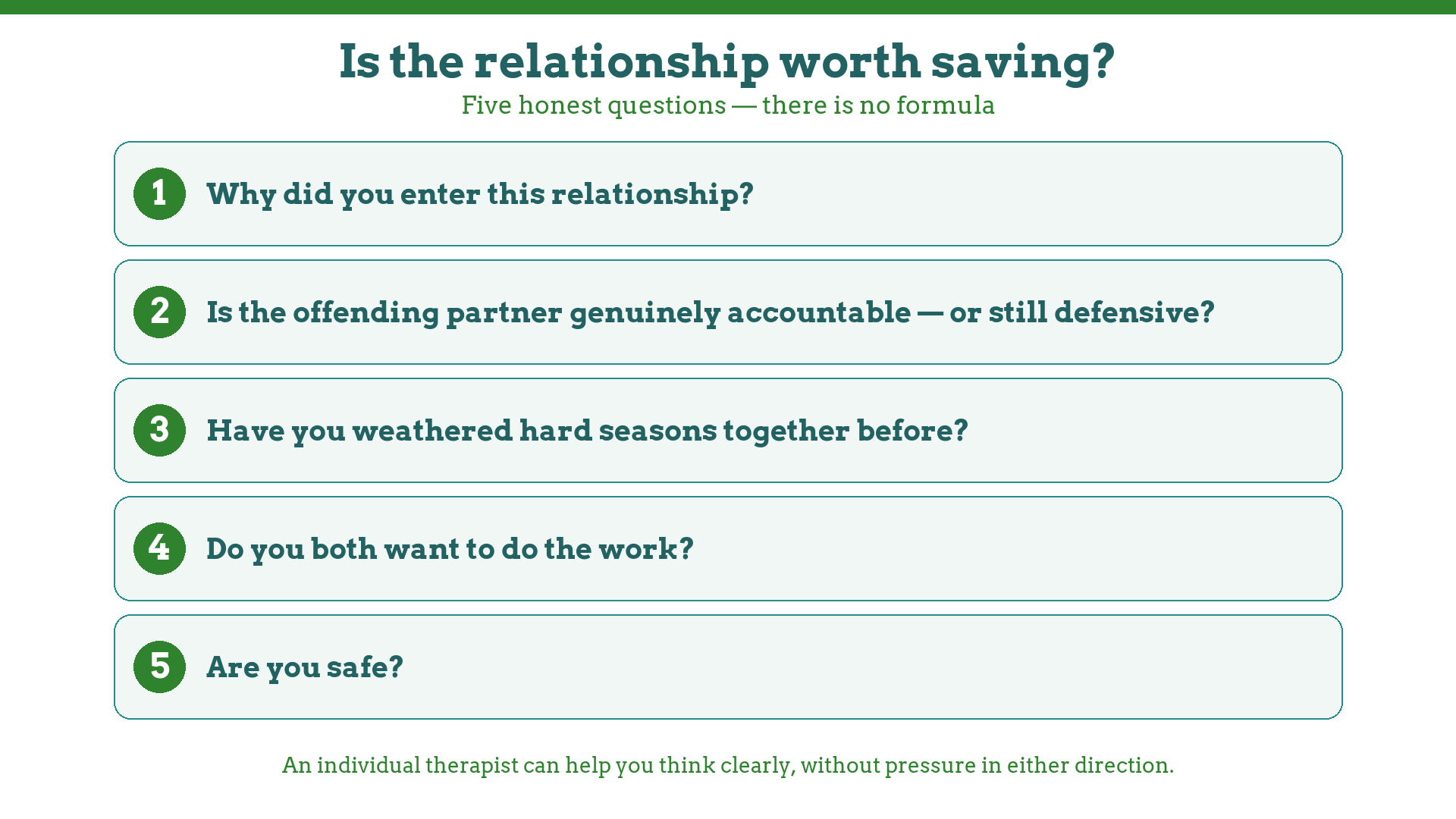
There’s no formula, but honest questions help:
- Why did you enter this relationship?
- Is the offending partner genuinely accountable, or still defensive?
- Have you weathered hard seasons together before?
- Do you both want to do the work?
- Are you safe?
An individual therapist can help you think clearly without pressure in either direction.
What are the different forms of infidelity?
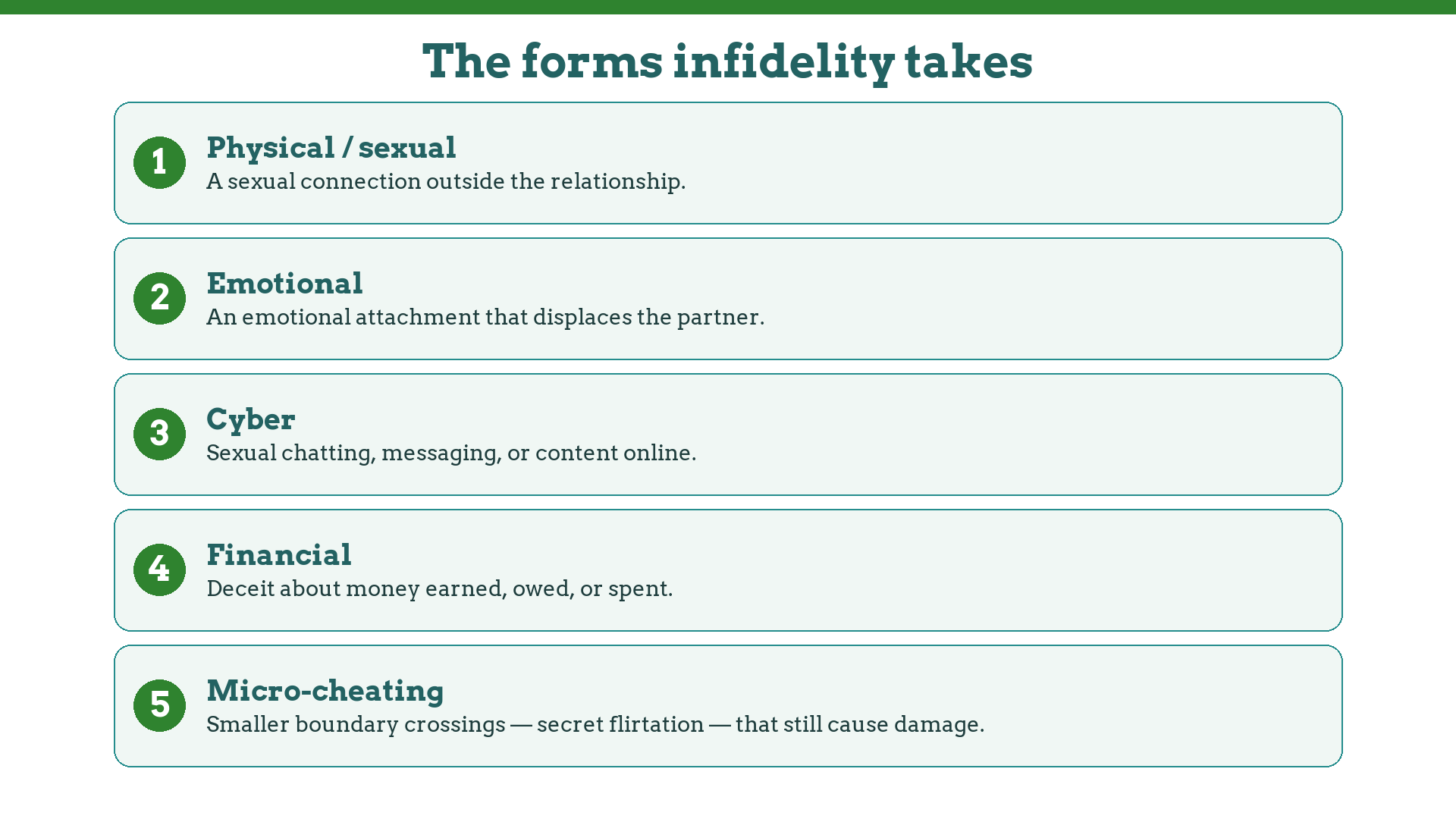
- Physical/sexual — a sexual connection outside the relationship.
- Emotional — an emotional attachment that displaces the partner.
- Cyber — sexual chatting, messaging, or content online.
- Financial — deceit about money earned, owed, or spent.
- Micro-cheating — smaller boundary crossings (secret flirtation) that still cause damage.
What does research say about how affairs begin?

Couple researchers like John Gottman describe cheating not as a bolt from the blue but as the end of a slow, often-undetected drift — turning away from the partner in small ways long before any physical betrayal. That’s not to blame the betrayed partner; it’s to say that repair usually involves understanding the whole relationship, not just the final act.
What therapy approaches help?

The best-supported couple approaches for infidelity include Emotionally Focused Therapy (EFT) — one of the most validated couple treatments (Johnson et al., 2001) — the Gottman Method, and integrative affair-recovery models (Gordon et al., 2004). Our approach also coordinates individual work for each partner alongside the couples work.
Does the pain ever go away?

It may feel permanent. It usually isn’t. With time, support, and good therapy, the sharp edges dull and life re-widens — whether or not the marriage survives. “Weeping may tarry for the night, but joy comes with the morning” (Psalm 30:5).
Counseling that treats your faith as a resource

We are a Christian practice, and the evidence says integrating faith helps rather than hinders: religiously and spiritually integrated psychotherapy performs at least as well as standard approaches, with added benefit for spiritual well-being (Smith, Bartz & Richards, 2007). We provide infidelity and couples counseling in person in Glendale, Arizona and by telehealth across Arizona and Washington.
Save and share
Pin or share these — someone you love may need them today.
References
- Atkins, D. C., Marín, R. A., Lo, T. T. Y., Klann, N., & Hahlweg, K. (2010). Outcomes of couples with infidelity in a community-based sample of couple therapy. Journal of Family Psychology, 24(2), 212–216. https://doi.org/10.1037/a0018789
- Gordon, K. C., Baucom, D. H., & Snyder, D. K. (2004). An integrative intervention for promoting recovery from extramarital affairs. Journal of Marital and Family Therapy, 30(2), 213–231. https://doi.org/10.1111/j.1752-0606.2004.tb01235.x
- Johnson, S. M., Makinen, J. A., & Millikin, J. W. (2001). Attachment injuries in couple relationships: A new perspective on impasses in couples therapy. Journal of Marital and Family Therapy, 27(2), 145–155. https://doi.org/10.1111/j.1752-0606.2001.tb01152.x
- Smith, T. B., Bartz, J., & Richards, P. S. (2007). Outcomes of religious and spiritual adaptations to psychotherapy: A meta-analytic review. Psychotherapy Research, 17(6), 643–655. https://doi.org/10.1080/10503300701250347
- Steffens, B. A., & Rennie, R. L. (2006). The traumatic nature of disclosure for wives of sexual addicts. Sexual Addiction & Compulsivity, 13(2–3), 247–267. https://doi.org/10.1080/10720160600870802
- Wade, N. G., Hoyt, W. T., Kidwell, J. E. M., & Worthington, E. L., Jr. (2014). Efficacy of psychotherapeutic interventions to promote forgiveness: A meta-analysis. Journal of Consulting and Clinical Psychology, 82(1), 154–170. https://doi.org/10.1037/a0035268
Method note: sources were identified via OpenAlex literature search and screened for retractions and editorial notices via Scite before citation. Two unsupported claims from the earlier version of this page (a ketogenic-diet panic-disorder claim and specific cardiovascular benefits of forgiveness) were removed. Scripture quotations are from the ESV. This page is educational and not a substitute for individualized clinical care. Prepared with AI assistance and reviewed by Restored Life Counseling’s clinical staff.