

“For which of you, desiring to build a tower, does not first sit down and count the cost?” (Luke 14:28). Jesus assumed that anything worth building starts with a written-down reckoning — and rebuilding a life in recovery from porn or sex addiction is no exception. Your recovery plan must be a written document that you create as soon as possible in the recovery process. It is a living document that will get updated and adjusted as you learn more about recovery and your specific challenges.
“If you fail to plan, you are planning to fail.” – Benjamin Franklin
No plan is real until it’s written down. That’s not just a slogan — in a meta-analysis of 94 studies, people who wrote out specific if-then plans for their goals achieved them at substantially higher rates than people who relied on intention alone (Gollwitzer & Sheeran, 2006).
When I first wrote this article, I taught the classic “three circles” that many twelve-step communities use. I still start there — but over years of walking with clients, my own version of the plan has grown to five circles. This updated guide gives you both: the classic model, and the two additions that close its biggest loopholes.
Why a written plan beats willpower

Here’s the part most people miss: early recovery is not a willpower problem you can muscle through, because the addiction itself has damaged the equipment willpower runs on. Brain-imaging research shows that addiction disrupts the prefrontal cortex — the seat of impulse control, judgment, and follow-through — so the very “brakes” you’d use to resist a craving are the part that’s compromised (Goldstein & Volkow, 2011).
That’s why I tell my clients: a recovery plan works like a cast on a broken bone. The cast doesn’t heal the bone — it holds everything still so the body can heal itself. Your written plan is external structure doing the job your prefrontal cortex can’t do yet. Submit to the cast, and the brain slowly regains its own braking power. Try to white-knuckle it without one, and you’re asking a broken bone to bear weight.
Scripture makes the same promise from the other side: with every temptation God “will also provide the way of escape” (1 Corinthians 10:13). A recovery plan is simply writing your escape routes down before you need them.
Start with the classic three circles
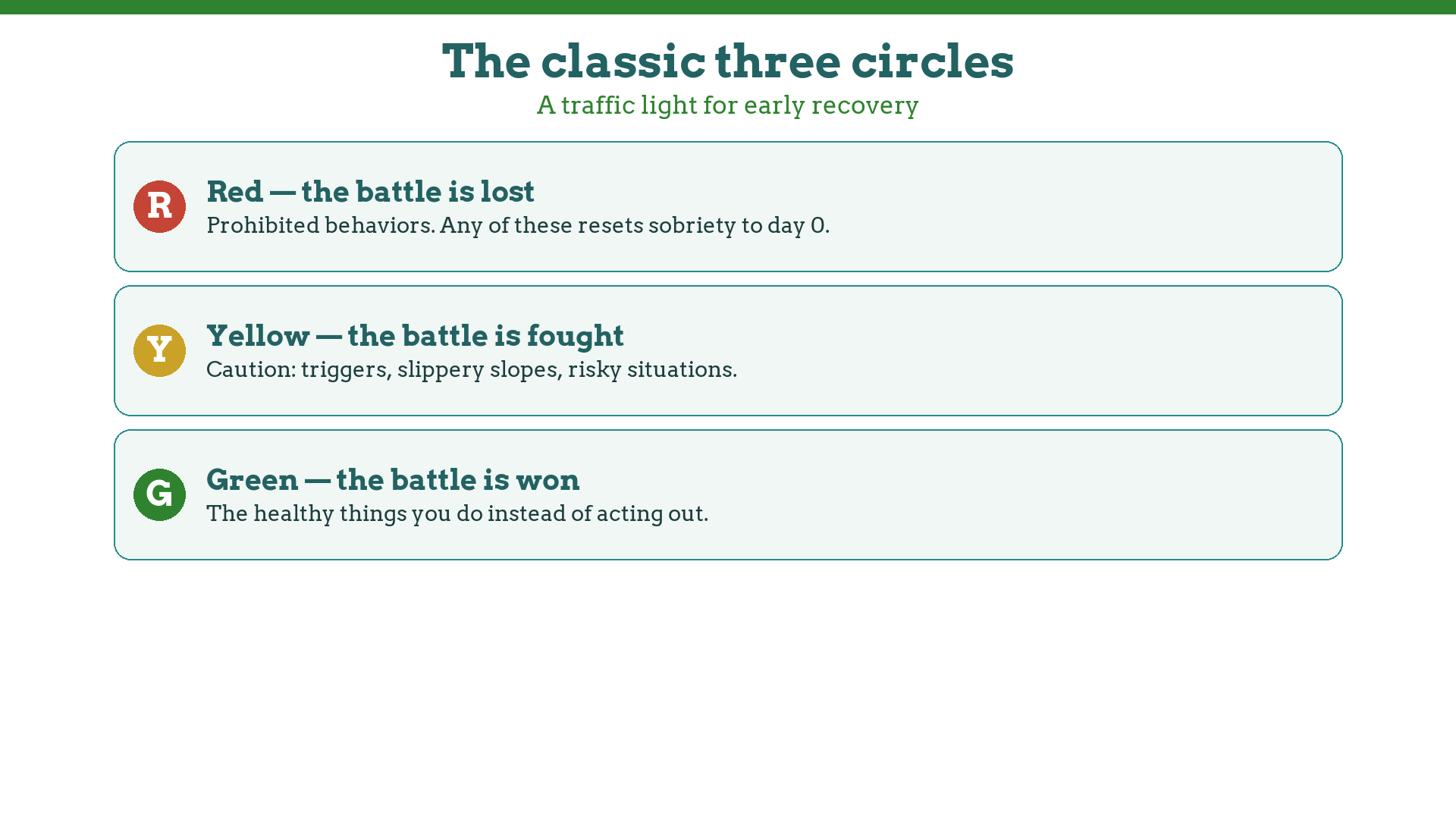
Many of the twelve-step communities that work with porn or sex addiction use “the three circles” to help someone new to recovery make a plan for staying sober. Picture a traffic light: a red inner circle of prohibited behaviors, a yellow middle circle of caution zones, and a green outer circle of healthy things you do instead. My colleague and friend Allan Wheatley at Mountain View Counseling puts it memorably: in the red circle the battle has been lost; the yellow circle is where the battle is fought; the green circle is where the battle is won.
The three circles are a great start — and for many people in early recovery, they’re enough for the first draft. But they have two blind spots. First, a person can be “technically sober” — no red-circle behavior for months — while their daily life quietly fills up with chaos, cut corners, and drift. Second, the three circles tell you what to run from, but never paint a picture of what you’re running to. My five-circle plan adds one circle for each blind spot.
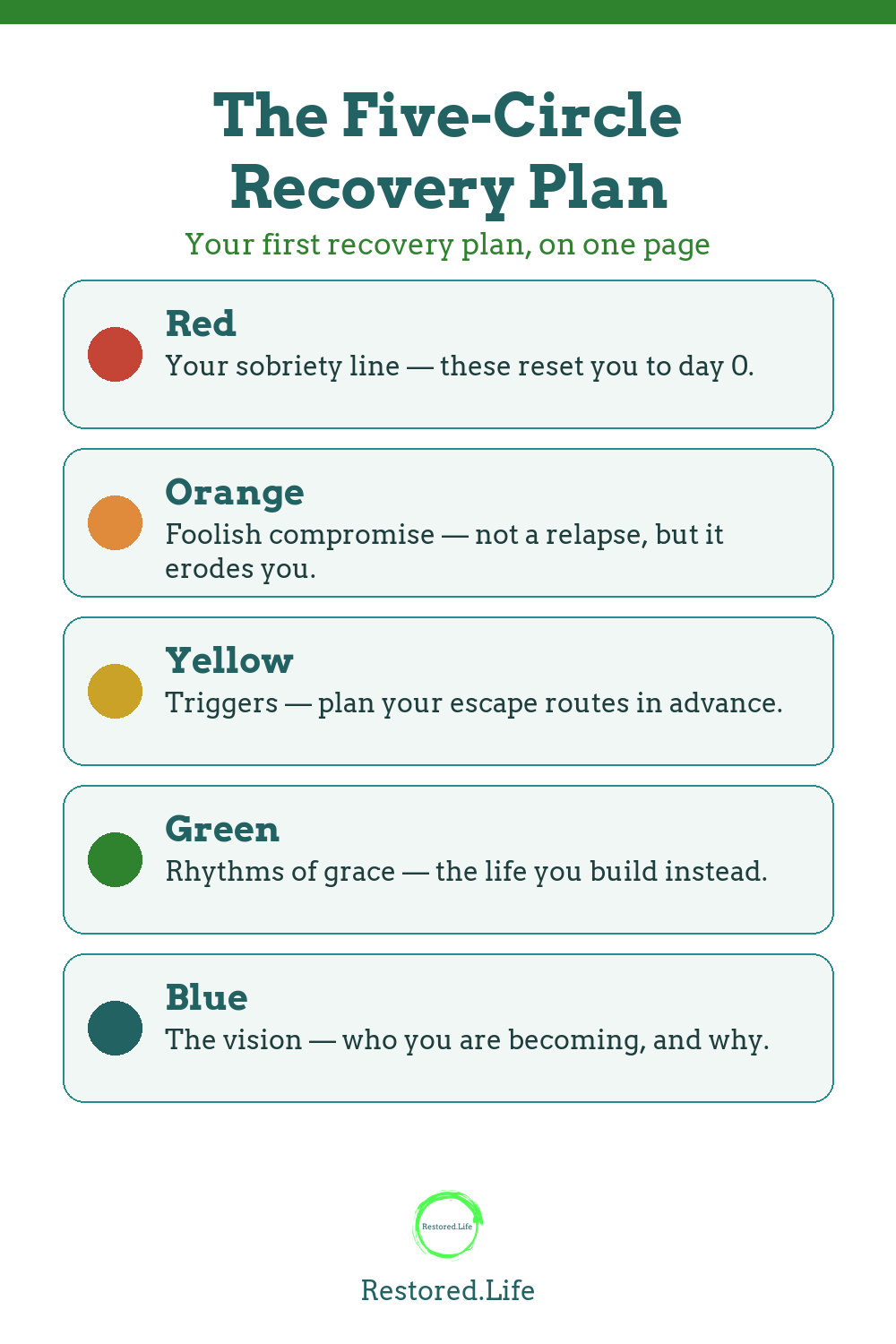
The Five-Circle Recovery Plan
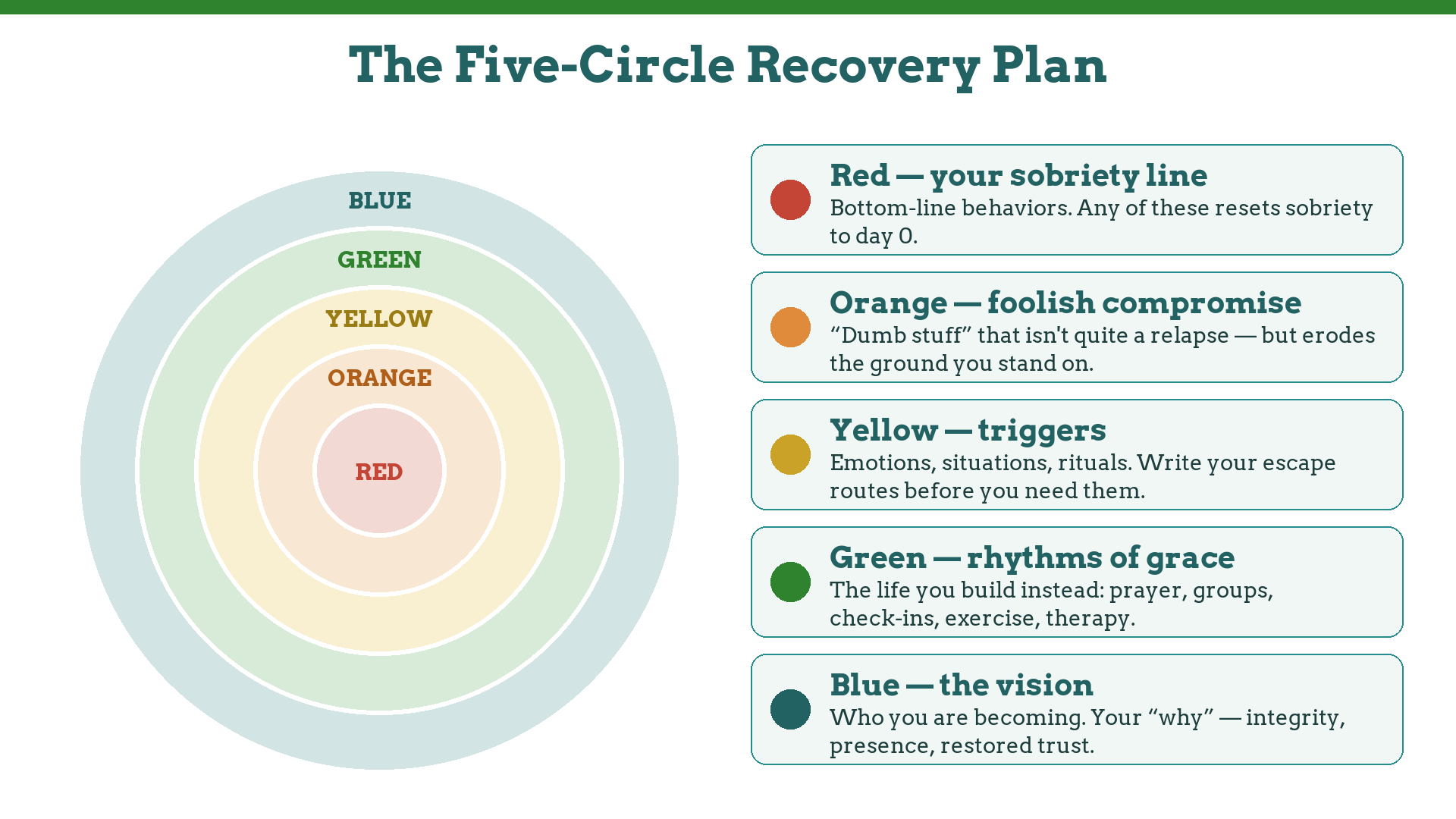
Credit where it’s due: I learned the five-circle version from my friend and colleague Stephen Grant (CSAT), and it has become how I teach recovery plans. Here is each circle, and what goes in it.
The Red Circle – your definition of sobriety
Items in the red circle are prohibited. If you do one of the behaviors in the red circle, you reset your sobriety to 0 days.
The most common red-circle behaviors at the beginning of recovery are:
- No sex outside of marriage or life partnership.
- No porn
- No masturbation
Some other behaviors may be included in the red circle out of respect for your committed relationship, whether or not they are addictive by themselves: slippery-slope behaviors (see the yellow circle), messaging potential partners for hook-ups, or looking up past partners or exes on social media.
It is generally best to err on the conservative side in your definition of sobriety in early recovery. As your recovery advances, you may make changes to your red circle after consulting your sponsor or recovery mentor, your recovery group, and your spouse or partner. You can also consult your therapist if you see one.
The Orange Circle – foolish compromise
This is the first of my two additions, and honestly the one my clients thank me for most. The orange circle catches what I call the “dumb stuff that isn’t quite a relapse.”
- Staying up too late for no reason
- Purposeless, numbed-out scrolling
- Skipping your check-in, your meeting, or your medication
- Blowing off exercise, meals, or sleep until you’re running on fumes
- “Spiritual bypassing” — hiding behind God-talk, Bible study, or church busyness to avoid the actual work of recovery
None of these resets your sobriety date. All of them erode the ground your sobriety stands on. Orange-circle living is how a person stays “technically sober” for ninety days and then wonders why the relapse came out of nowhere — it didn’t; it was assembled one dumb decision at a time. Naming these behaviors in writing closes the loophole. When you catch yourself in the orange circle, you don’t reset your date — you tell your accountability partner, ask what am I avoiding?, and step back into the green circle.
The Yellow Circle – triggers and vulnerabilities
The yellow circle holds the emotions, situations, and rituals that have historically led you toward acting out. Decades of relapse-prevention research say the same thing: lapses cluster around identifiable high-risk situations, and the people who stay sober are the ones who identify theirs ahead of time and decide — in advance — how they’ll respond (Witkiewitz & Marlatt, 2004).
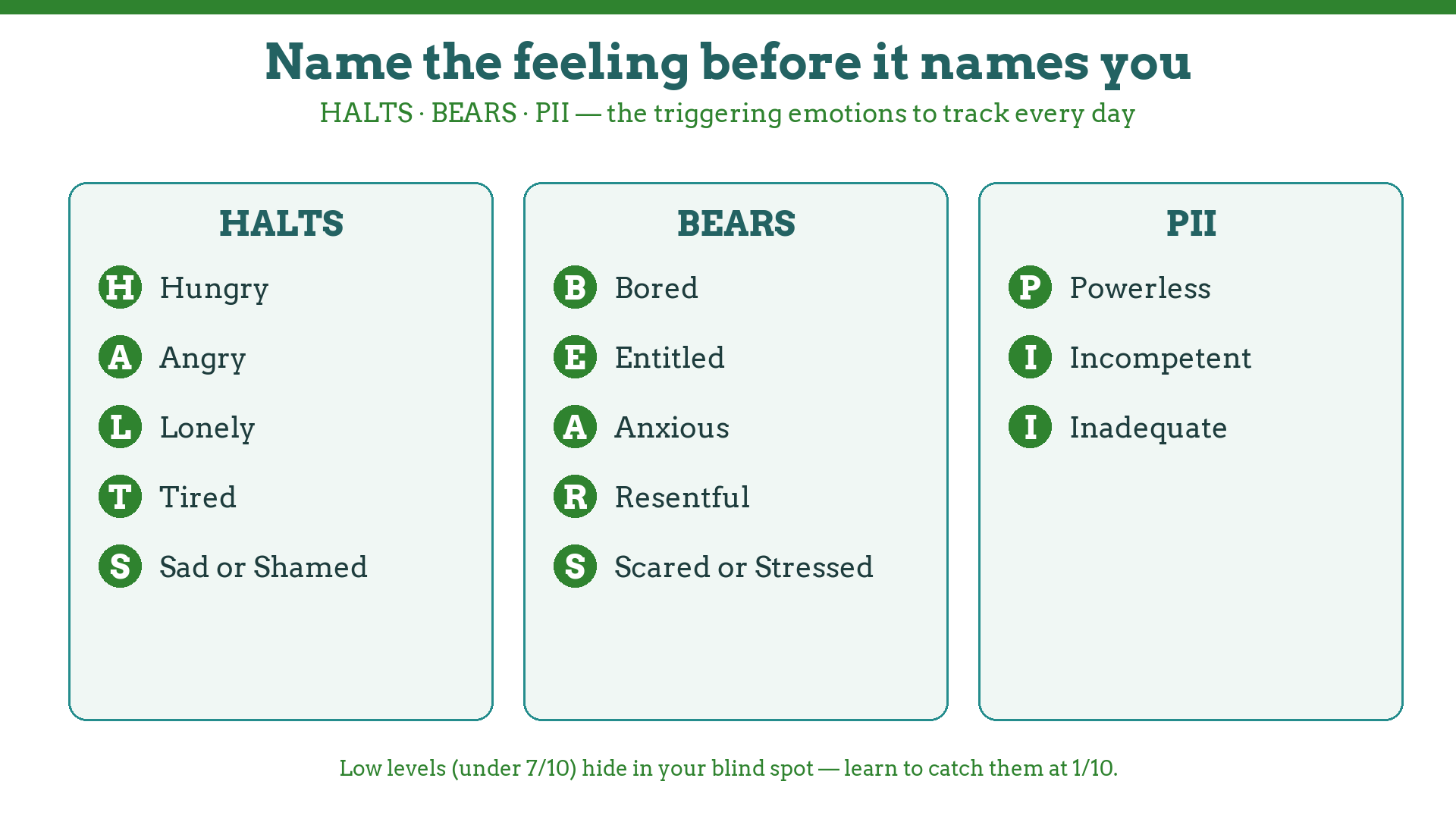
Triggering emotions. The most common triggering emotions fit three acronyms: HALTS (Hungry, Angry, Lonely, Tired, Sad or Shamed), BEARS (Bored, Entitled, Anxious, Resentful, Scared or Stressed), and PII (Powerless, Incompetent, Inadequate). A common challenge is that low levels of these emotions — say, less than a 7 out of 10 — sit in your blind spot. As you grow in recovery, you’ll learn to notice your body’s signals at every level, 1/10 through 10/10. This matters because stress isn’t a side issue: chronic stress measurably increases craving and relapse vulnerability by dysregulating the same brain systems addiction already strains (Sinha, 2008).
Trigger patterns. In my practice, most triggers fall into three patterns worth naming in your plan: the urge to numb out (escaping painful feelings or memories into fantasy), the ache for connection (using intensity or objectified attention to medicate loneliness and feelings of unworthiness), and the drive for stimulation (flooding an overwhelmed nervous system to force it to shut down). Knowing which pattern is yours turns a vague “I got triggered” into a specific need your green circle can actually meet.
Arousal template. Everyone has an arousal template; templates are not good or bad — they just are. When out-of-control sexual behavior is part of your story, your template may have shifted toward things that are dangerous, degrading, or unwelcome by your spouse. Real recovery will most likely require giving those up. Understanding your arousal template is best done in therapy.
Acting-out ritual. In the double life of addiction, acting out follows a ritual. To stay sober you’ll need to understand and disrupt yours. This is where filtering and accountability apps like Covenant Eyes or Accountable2You usually enter the plan.
Slippery slopes. Second looks, long looks, lustful looks; “trolling” social media for images that aren’t quite porn but are still sexually stimulating. Any behavior, place, person, or device that was previously part of your acting-out ritual belongs on this list.
The Green Circle – rhythms of grace
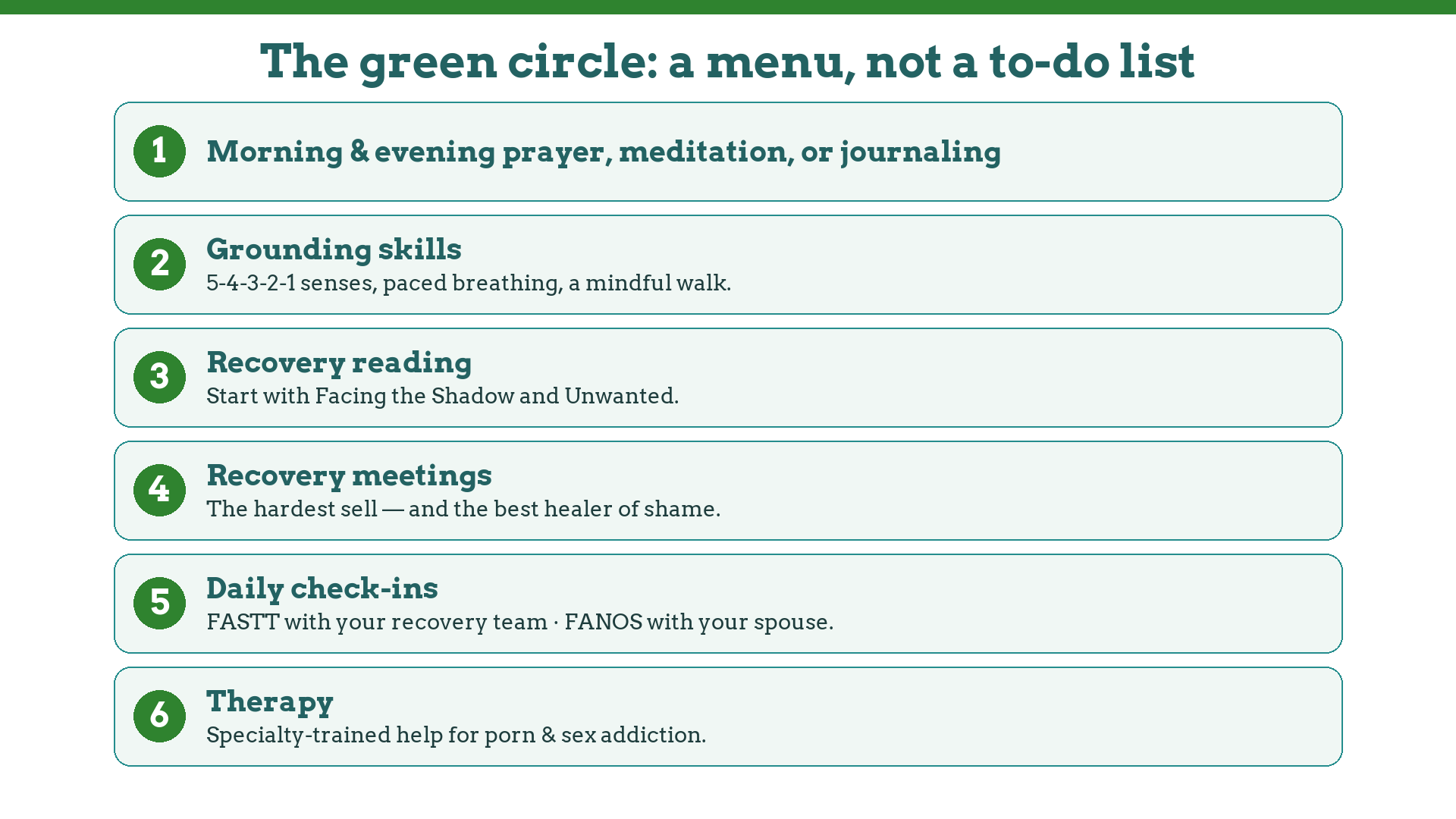
Green means go — the positive things you do instead of acting out, and the circle that gets most uniquely tailored to you. Treat this list as a menu, not a to-do list; trying to do all of it at once in early recovery is its own trigger. As a starting point, I recommend:
- Morning prayer, meditation, or journaling. Apps like Headspace, Calm, or Abide (Judeo-Christian) can help you start, and I’ve written a basic guide to journaling for pen and paper. In the morning, look at the day ahead and ask God for what you need to stay sober today.
- Grounding skills for the yellow circle. Simple practices — the 5-4-3-2-1 senses exercise, slow paced breathing, a mindful walk — give you something to do with a triggered body. This isn’t fluff: in a randomized trial, mindfulness-based relapse prevention outperformed both standard relapse prevention and treatment-as-usual on long-term outcomes (Bowen et al., 2014).
- Reading recovery literature. Start with Facing the Shadow by Patrick Carnes and Unwanted by Jay Stringer.
- Attending recovery meetings. This page lists groups that specifically address porn and sex addiction. Of everything I recommend, this is the hardest sell — and the best healer of shame. The strongest evidence we have on mutual-help groups (from alcohol recovery, where a Cochrane review found 12-step participation performed as well as or better than other established treatments for sustaining abstinence) points the same direction (Kelly, Humphreys, & Ferri, 2020).
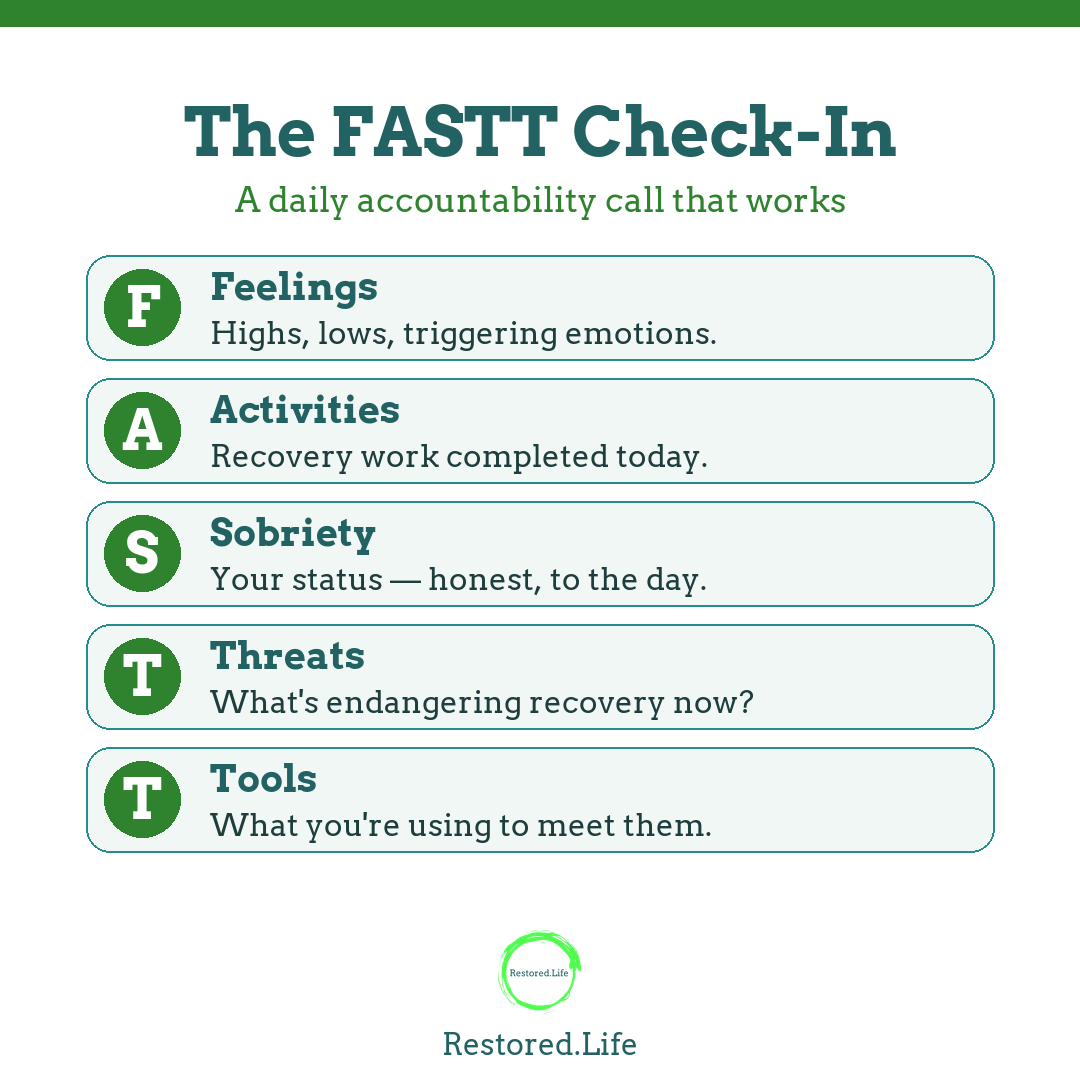
- Daily FASTT check-ins with an accountability partner or sponsor. Feelings, recovery Activities completed, Sobriety status, Threats, and Tools you’re using. The Dobber has a great episode on doing these well.
- FANOS check-ins with your spouse. If you’re married, a short daily FANOS — Feelings, Affirmations, Needs, Ownership, Sobriety status — is one of the most powerful trust-rebuilding rhythms I know. It’s different from the FASTT: the FASTT is for your recovery team; the FANOS is for your marriage.
- Evening prayer, meditation, or journaling. If you stayed sober, thank God. If you didn’t, own it and ask for help to stay sober tomorrow.
- Therapy. Not everyone needs therapy to get sober; some do. A good therapist for porn or sex addiction has specialty training in sex addiction and other process addictions and screens for co-occurring disorders that complicate recovery.
The Blue Circle – your vision
The second addition, and the one that changes the whole plan’s direction of travel. The red through green circles describe what you’re moving away from and how. The blue circle describes who you are becoming: a man or woman of integrity; an emotionally present, covenant-keeping spouse; a parent who breaks the generational cycle; someone whose word can be trusted again.
Write it down in specifics, because this is your why — the thing you re-read on the hard days. And aim high: research on people who have walked through severe struggle consistently finds that profound crisis can catalyze real growth — deeper relationships, changed priorities, stronger faith — not despite the struggle but through it (Tedeschi & Calhoun, 2004). In biblical language: God doesn’t just want you not sinning; He is restoring His image in you (Ephesians 4:22–24 — put off the old self, and put on the new).
Sharing your plan with your spouse or partner

If you are sharing recovery progress with your spouse or partner, share your red circle early and your green and blue circles as soon as possible — clarity there is one of the first building blocks of safety, especially if your spouse is walking through betrayal trauma.
Your yellow circle is different: share the broad strokes, but keep the day-to-day specifics for you, your sponsor, and possibly your therapist. This is not secrecy — it’s for both of your benefit. Oversharing yellow-circle content with a partner experiencing betrayal trauma usually makes betrayal anxiety worse, not better. If you share your red, green, and blue circles, that should be enough (over time) for the hurt partner to feel safe.
From white knuckles to a Rule of Life
One last reframe, because it changes everything about how the plan feels. A recovery plan used as a pure restriction list becomes white-knuckled legalism — and white knuckles always give out. Used rightly, the five circles work more like what Christians have historically called a Rule of Life: a written rhythm of ordinary practices that keeps your time, energy, and worship pointed at God. The plan isn’t the fence around your life; it’s the trellis your new life grows on.
Two things make the difference:
- Community, not solo recovery. We heal best in community — and in the right community: a small team of people (sponsor, group, therapist, a wise friend or pastor) strong enough to carry what you tell them without judgment and without letting you hide. A plan executed alone is just a longer relapse runway.
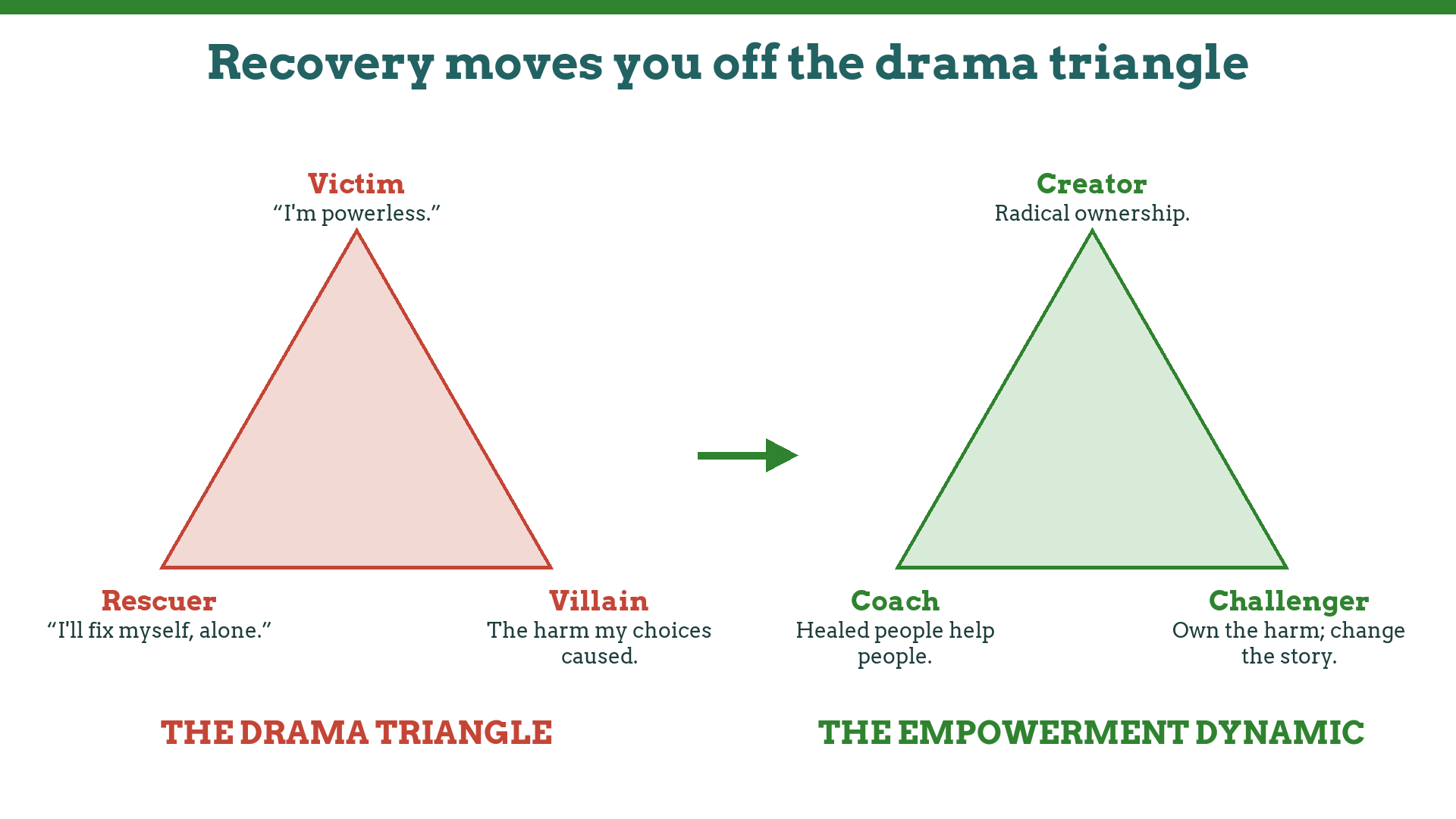
- A new role in the story. Addiction casts you in three bad parts at once — the victim (“I’m powerless, I’m uniquely broken”), the villain (the harm your choices caused), and the rescuer (“I’ll fix myself, alone”). Working the plan in community moves you into three better ones: the creator who takes ownership of the plan, the challenger who owns the harm and changes the story, and — in time — the coach. Because here’s where the blue circle ultimately points: the day your hard-won recovery becomes the comfort you extend to someone else who’s still stuck (2 Corinthians 1:4). Healed people help people.
Getting help

A written plan is where recovery starts — but you don’t have to build it alone. Our team offers specialty-trained counseling for porn and sex addiction, in person in Glendale, Arizona and by telehealth across Arizona and Washington. We can help you write your first five-circle plan, and walk with you as it grows.
Save and share
Pin or share these — someone you love may need them today.
References
- Bowen, S., Witkiewitz, K., Clifasefi, S. L., Grow, J., Chawla, N., Hsu, S. H., Carroll, H. A., Harrop, E. N., Collins, S. E., Lustyk, M. K. B., & Larimer, M. E. (2014). Relative efficacy of mindfulness-based relapse prevention, standard relapse prevention, and treatment as usual for substance use disorders: A randomized clinical trial. JAMA Psychiatry, 71(5), 547–556. https://doi.org/10.1001/jamapsychiatry.2013.4546
- Goldstein, R. Z., & Volkow, N. D. (2011). Dysfunction of the prefrontal cortex in addiction: Neuroimaging findings and clinical implications. Nature Reviews Neuroscience, 12(11), 652–669. https://doi.org/10.1038/nrn3119
- Gollwitzer, P. M., & Sheeran, P. (2006). Implementation intentions and goal achievement: A meta-analysis of effects and processes. Advances in Experimental Social Psychology, 38, 69–119. https://doi.org/10.1016/S0065-2601(06)38002-1
- Kelly, J. F., Humphreys, K., & Ferri, M. (2020). Alcoholics Anonymous and other 12-step programs for alcohol use disorder. Cochrane Database of Systematic Reviews, 2020(9), CD012880. https://doi.org/10.1002/14651858.CD012880.pub2
- Sinha, R. (2008). Chronic stress, drug use, and vulnerability to addiction. Annals of the New York Academy of Sciences, 1141(1), 105–130. https://doi.org/10.1196/annals.1441.030
- Tedeschi, R. G., & Calhoun, L. G. (2004). Posttraumatic growth: Conceptual foundations and empirical evidence. Psychological Inquiry, 15(1), 1–18. https://doi.org/10.1207/s15327965pli1501_01
- Witkiewitz, K., & Marlatt, G. A. (2004). Relapse prevention for alcohol and drug problems: That was Zen, this is Tao. American Psychologist, 59(4), 224–235. https://doi.org/10.1037/0003-066X.59.4.224
Method note: this is a practice piece describing how Restored Life Counseling teaches the five-circle recovery plan, which extends the classic three-circle tool used in many twelve-step communities. The seven cited sources were screened for retractions and editorial notices via Scite; the neuroscience and relapse-prevention evidence comes primarily from substance-use research and is applied to behavioral addiction by extension. Scripture quotations are from the ESV. Educational, not a substitute for individualized clinical care. Prepared with AI assistance and reviewed by Restored Life Counseling’s clinical staff.