

“You will know the truth, and the truth will set you free” (John 8:32). Few places test that promise like the aftermath of sexual betrayal — but therapeutic disclosure exists because a marriage cannot heal around a lie. This FAQ answers the questions we hear most from both partners. For the full walk-through, see our guide to navigating formal disclosure; if you are the betrayed partner, start with betrayal trauma counseling.
What is therapeutic disclosure?

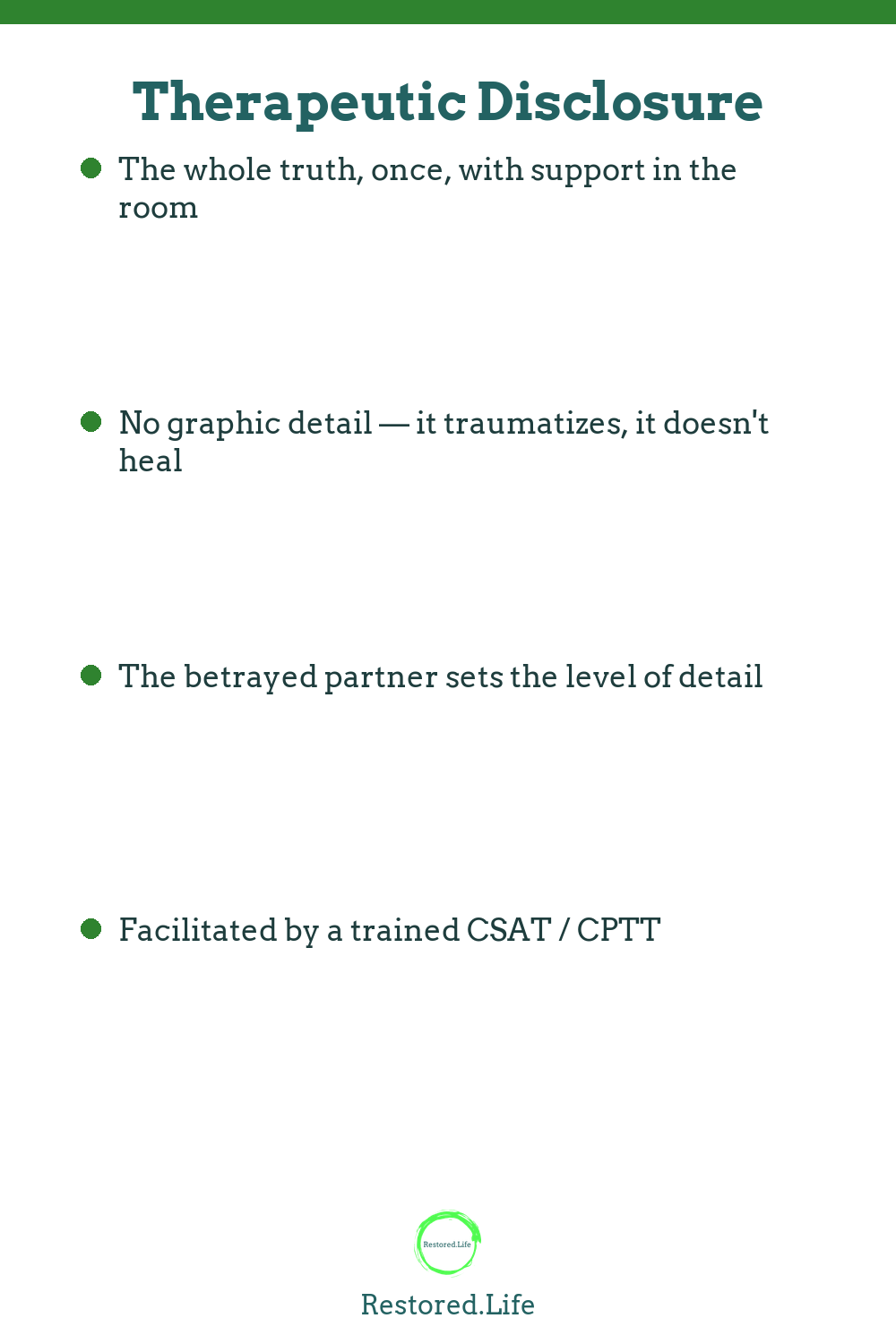
A structured, therapist-facilitated process in which the betraying partner tells the whole truth about their behavior — once, completely, with clinical support in the room — so the betrayed partner can see reality clearly and make informed choices. There are published clinical guidelines for how it should be done (Corley & Schneider, 2002).
How much detail should therapeutic disclosure include?
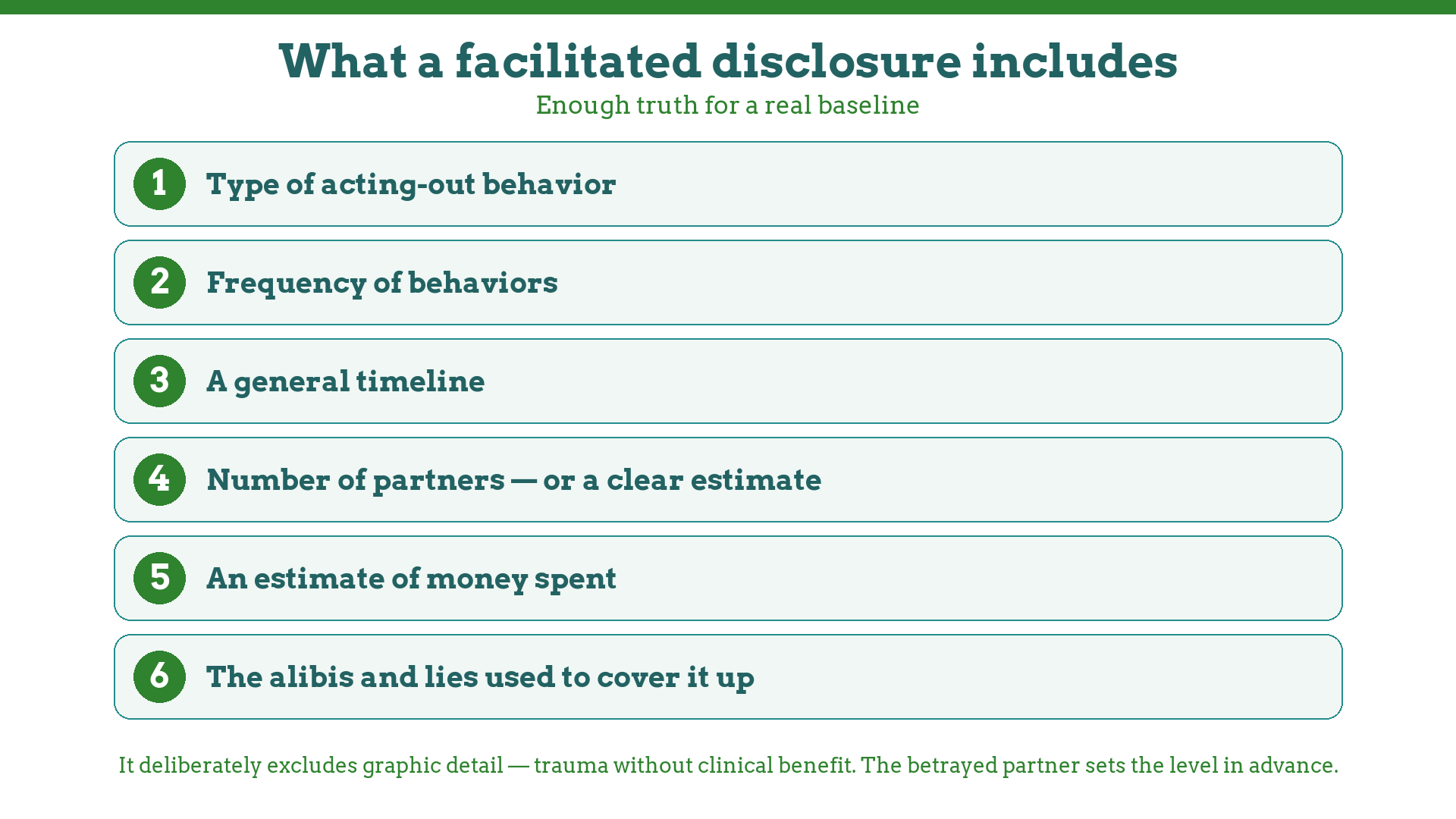
Enough to establish a baseline of truth, without the traumatizing “gory details.” A facilitated disclosure typically includes:
- Type of acting-out behavior
- Frequency of behaviors
- A general timeline
- Number of partners (or a clear estimate)
- An estimate of money spent
- The alibis and lies used to cover up the behavior
What it deliberately excludes is graphic sexual detail, which causes profound trauma and offers no clinical benefit. The betrayed partner sets the level of detail in advance, working with their own therapist.
When should therapeutic disclosure happen?

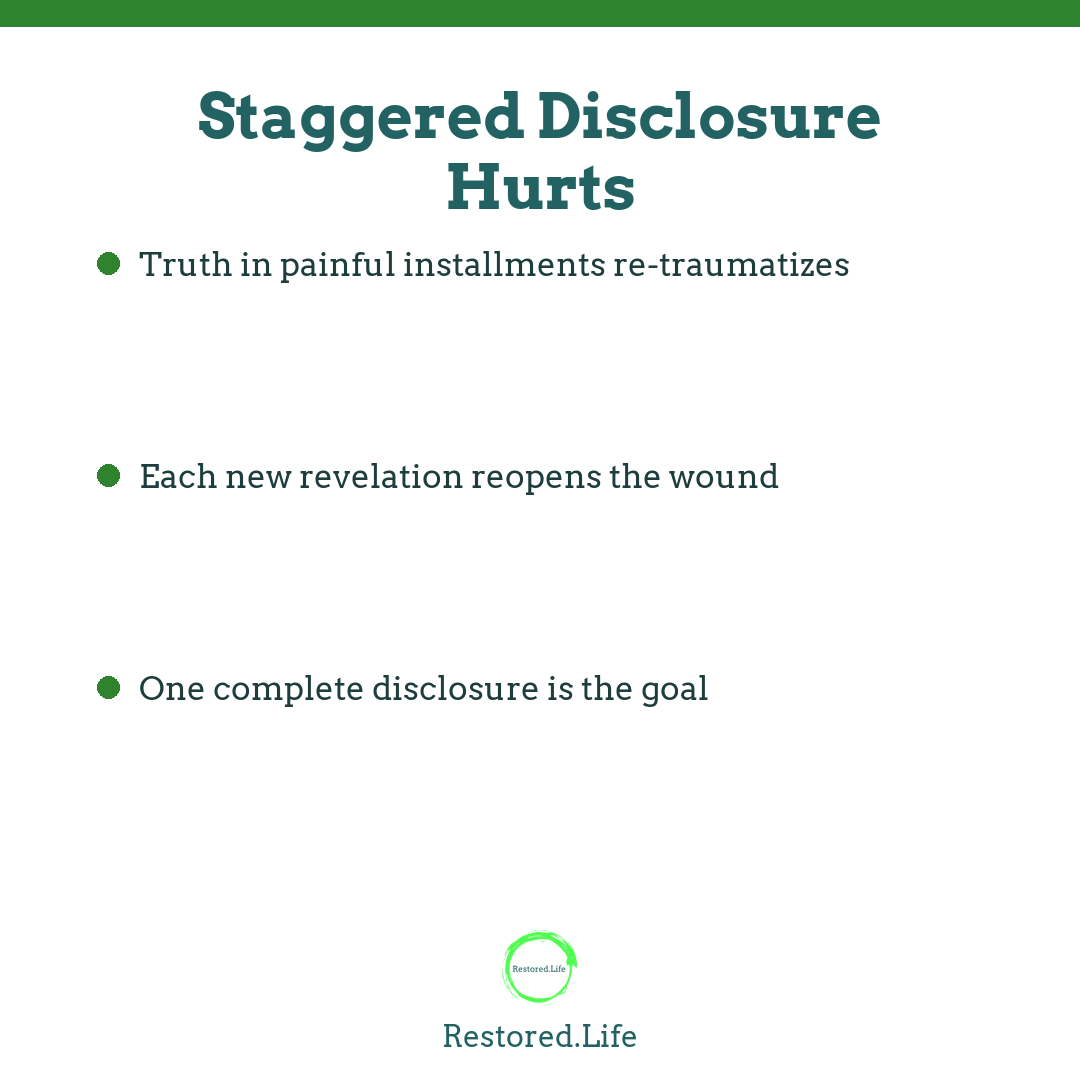
Usually within three to six months after treatment begins. That can feel agonizingly long to the betrayed partner, but rushing disclosure is genuinely harmful: the partner in recovery must first build a foundation of honesty, accountability, and sobriety. Truth that arrives in painful installments — “staggered disclosure” — re-traumatizes, which is exactly what a single, complete, facilitated disclosure is designed to prevent (Steffens & Rennie, 2006).
What is the purpose of disclosure?

Facilitated full disclosure gives the betrayed partner what they need to make a real choice about the relationship — rather than being manipulated into staying by a story that isn’t true. That agency matters, theologically and clinically: you bear the image of God in your own right, and a decision made inside someone else’s fiction is not a free decision. It also lets the betrayer put an end to the double life — terrifying before it’s done, and an immense relief afterward. “Whoever conceals his transgressions will not prosper, but he who confesses and forsakes them will obtain mercy” (Proverbs 28:13).
What is a staggered disclosure?

When the betrayed partner receives repeated, incomplete information about the betrayer’s actions over time — each new revelation reopening the wound. It is one of the most corrosive patterns in betrayal, and the reason we insist truth arrive once and completely (Schneider, Corley & Irons, 1998).
What are the benefits of disclosure in betrayal trauma therapy?
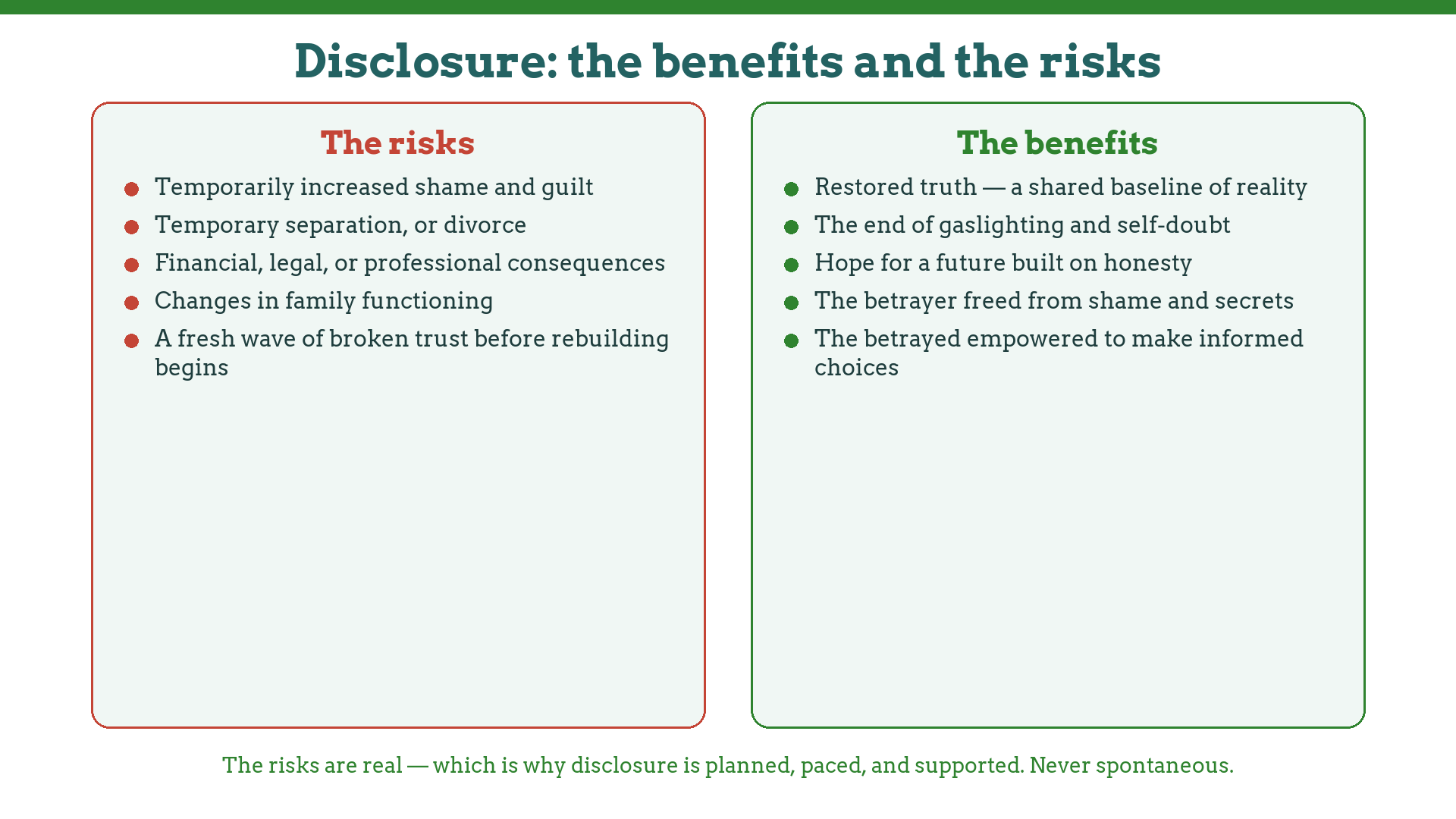
- Restored truth and a shared baseline of reality
- The end of gaslighting and self-doubt
- Hope for a future relationship built on honesty
- The betraying spouse freed from the weight of shame and secrets
- The betrayed spouse empowered to make informed choices about the future
What are the risks of disclosure in betrayal trauma therapy?

- Temporarily increased shame and guilt
- Temporary separation, or divorce
- Financial, legal, or professional consequences
- Changes in family functioning
- A fresh wave of broken trust before rebuilding begins
These risks are real, which is why disclosure is planned, paced, and supported — never spontaneous.
What are the steps in telling the truth?
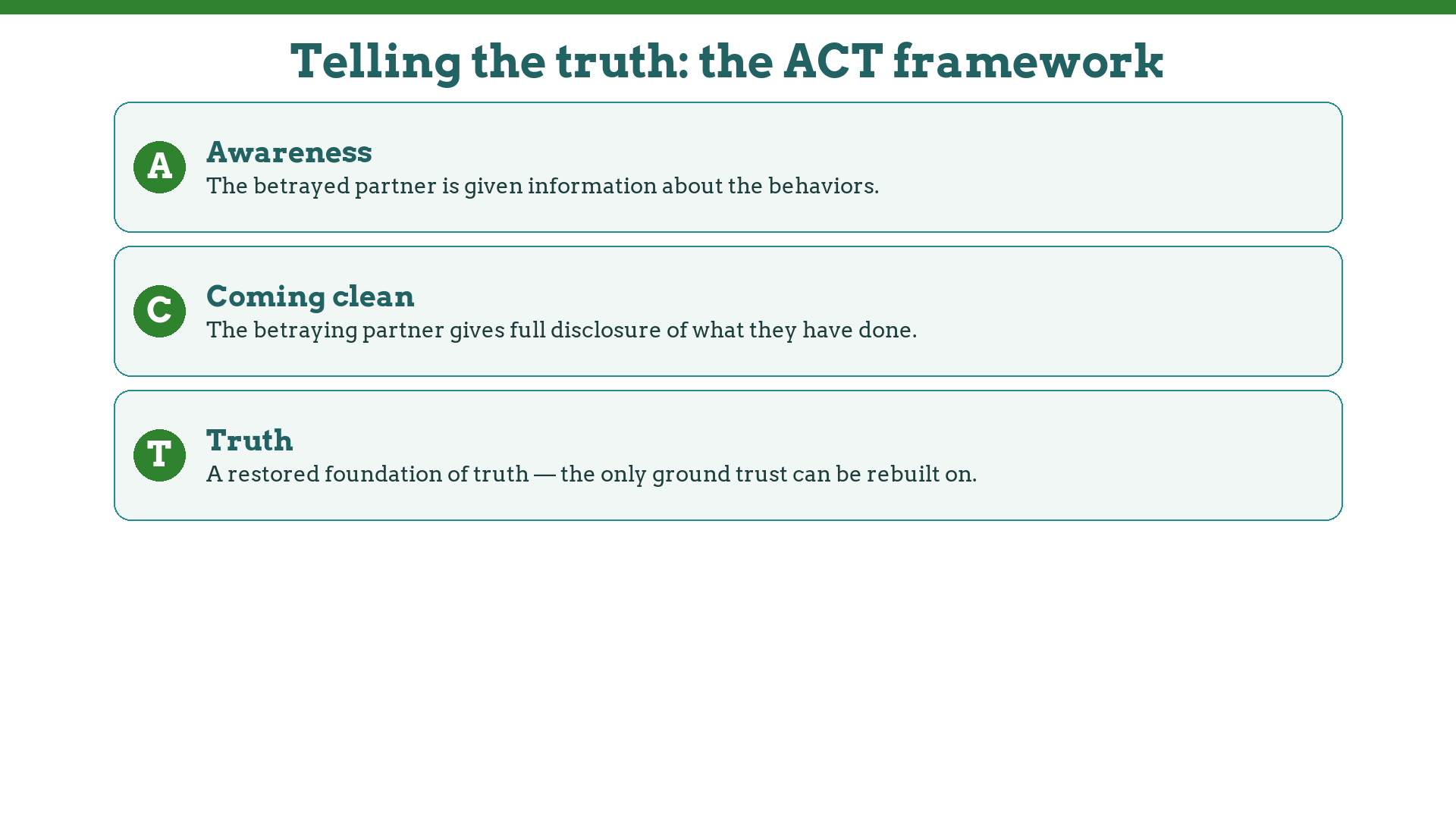
A helpful acronym is ACT:
- Awareness — the betrayed partner is given information about the behaviors.
- Coming clean — the betraying partner gives full disclosure of what they have done.
- Truth — a restored foundation of truth becomes the only ground on which trust can be rebuilt.
What type of mental health professionals use therapeutic disclosure?

For best results, disclosure should be facilitated by therapists trained through the International Institute of Trauma and Addiction Professionals (IITAP), holding one of these specialties:
- Certified Sex Addiction Therapist (CSAT)
- Certified Partner Trauma Therapist (CPTT)
- Pastoral Sex Addiction Professional (PSAP)
Our clinical team is supervised by a CSAT.
What types of betrayal trauma are there?

- Partner betrayal — through sexual betrayal, sexual or substance addiction, infidelity, pornography addiction, and related forms.
- Child abuse — physical, sexual, or emotional.
Why would anyone want a therapeutic full disclosure?

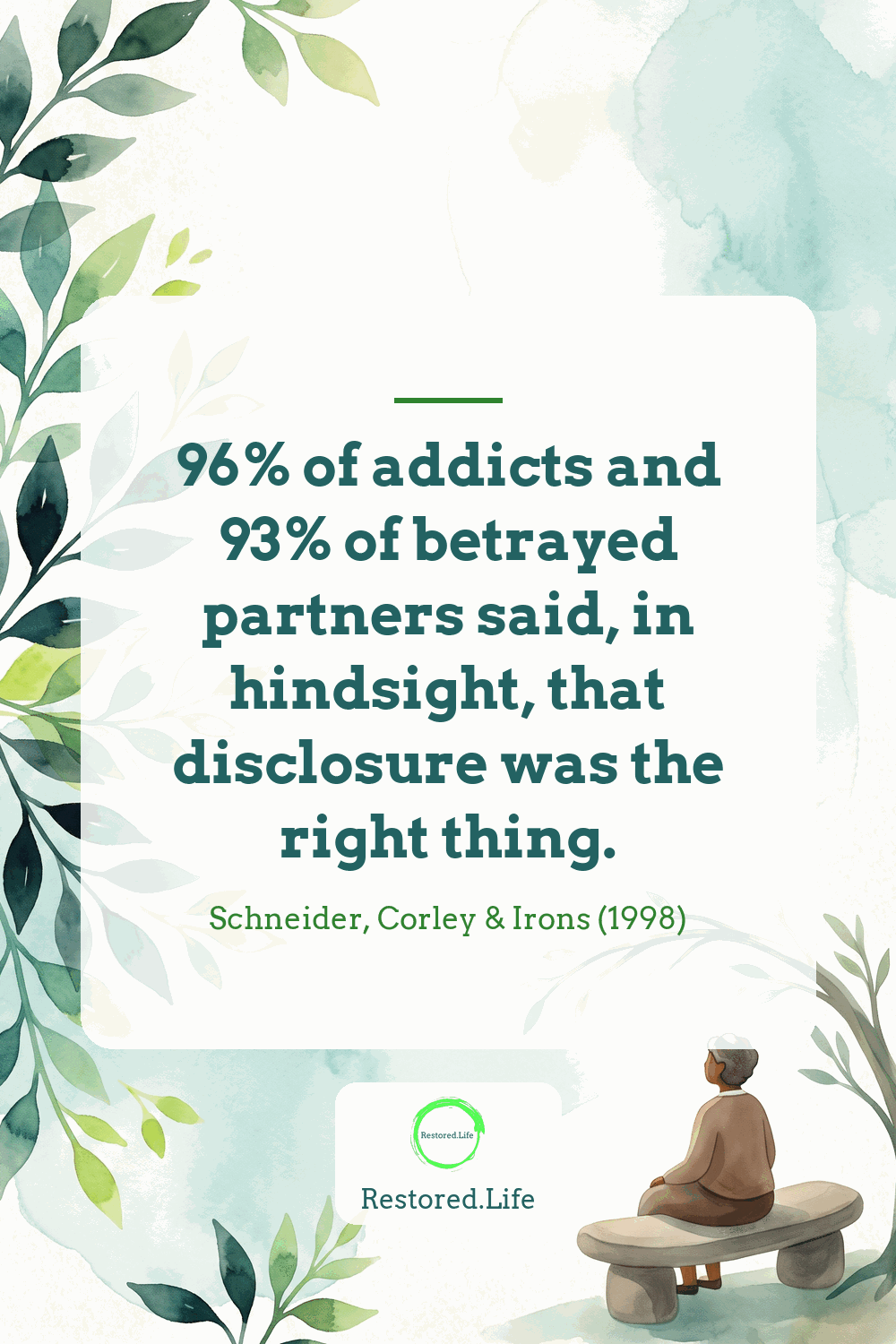
Because the research says people are glad they did it. In the landmark survey of recovering sex addicts and their partners, 96% of the addicts and 93% of the betrayed partners said that, in hindsight, disclosure had been the right course of action (Schneider, Corley & Irons, 1998). The truth is painful before it is freeing — but the people who have walked through it overwhelmingly affirm it.
How accurate are polygraph (“lie detector”) tests? Are they helpful in disclosure?

Cautiously, and only sometimes. Polygraphs are controversial: they detect the physiological arousal that can accompany lying, but strong emotions of any kind produce the same signals, so false positives are common — and it is unreasonable to expect a betrayer to stay perfectly calm while disclosing. A critical review of polygraph use in exactly this kind of setting found the evidence base weak and the practice contested (Meijer et al., 2008). Most U.S. states bar polygraph results from criminal court. In recovery, a treatment team may sometimes use one to support the completeness of a disclosure, but it is a limited tool, not a source of certainty.
Can you get closure after leaving the relationship?

Yes. Grief and forgiveness are both messy, painful, and necessary for closure — and forgiveness, in both Scripture and the research, is a process that heals the forgiver, reliably reducing depression and anxiety while increasing hope (Wade et al., 2014). It is never a demanded shortcut, never the same as reconciliation, and never a hall pass for the one who caused the harm. Many survivors also find healing in telling their story — knowing by experience, not just theory, that they are not alone.
What boundaries help while you or your partner is in recovery?

- Allocate time, energy, and money toward personal healing
- Abstain from sex for a specified period if that supports healing
- Detach from abusive or manipulative conversations
- Sleep or live in separate spaces if needed
- Explore temporary separation if needed
- Limit or pause contact for a period if safety requires it
Recommended books for betrayal trauma

- Facing Heartbreak: Steps to Recovery for Partners of Sex Addicts — Stefanie Carnes, Mari Lee & Anthony Rodriguez
- Healing Betrayal — Mari Lee
- Help Her Heal — Carol Juergensen Sheets
- Boundaries — Henry Cloud & John Townsend
- The Body Keeps the Score — Bessel van der Kolk
Ready to talk to someone?

Whether you are the betrayed partner or the one who broke trust, you don’t have to navigate disclosure alone. Our CSAT-supervised team provides betrayal trauma counseling, sex addiction and porn addiction recovery, and couples counseling — in person in Glendale, Arizona and by telehealth across Arizona and Washington.
Save and share
Pin or share these — someone you love may need them today.

References
- Corley, M. D., & Schneider, J. P. (2002). Disclosing secrets: Guidelines for therapists working with sex addicts and co-addicts. Sexual Addiction & Compulsivity, 9(1), 43–67. https://doi.org/10.1080/107201602317346638
- Meijer, E. H., Verschuere, B., Merckelbach, H., & Crombez, G. (2008). Sex offender management using the polygraph: A critical review. International Journal of Law and Psychiatry, 31(5), 423–429. https://doi.org/10.1016/j.ijlp.2008.08.007
- Schneider, J. P., Corley, M. D., & Irons, R. R. (1998). Surviving disclosure of infidelity: Results of an international survey of 164 recovering sex addicts and partners. Sexual Addiction & Compulsivity, 5(3), 189–217. https://doi.org/10.1080/10720169808400162
- Steffens, B. A., & Rennie, R. L. (2006). The traumatic nature of disclosure for wives of sexual addicts. Sexual Addiction & Compulsivity, 13(2–3), 247–267. https://doi.org/10.1080/10720160600870802
- Wade, N. G., Hoyt, W. T., Kidwell, J. E. M., & Worthington, E. L., Jr. (2014). Efficacy of psychotherapeutic interventions to promote forgiveness: A meta-analysis. Journal of Consulting and Clinical Psychology, 82(1), 154–170. https://doi.org/10.1037/a0035268
Method note: sources were identified via OpenAlex literature search and screened for retractions and editorial notices via Scite before citation. Scripture quotations are from the ESV. This page is educational and not a substitute for individualized clinical care. Prepared with AI assistance and reviewed by Restored Life Counseling’s clinical staff.