

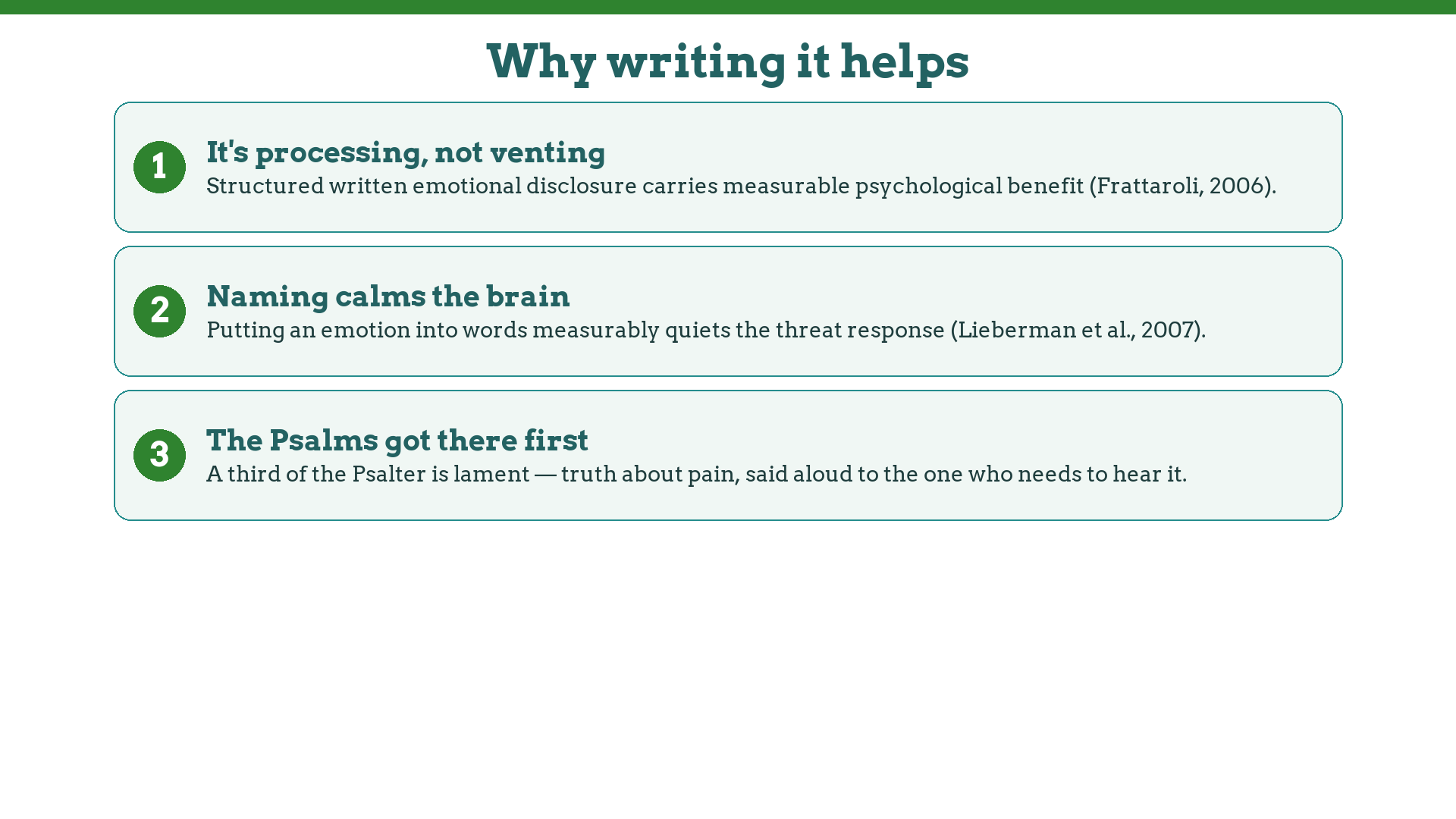
Roughly a third of the Psalms are laments — truth about pain, addressed out loud to the one who needs to hear it. An impact letter is lament with a structure. If you are the betrayed partner, it is your turn to be fully heard. This page explains what an impact letter is and why it heals; for the wider process, see navigating formal disclosure and betrayal trauma counseling.
What is an impact letter for betrayal trauma?

An impact letter is where the partner who was betrayed tells their spouse — in a structured, therapist-facilitated session — exactly how they have been affected by the betrayal. It typically comes after the betraying partner has read their formal disclosure letter. For once, the betrayed partner speaks without interruption, defense, or minimizing, and is simply heard.
Why does writing it help?
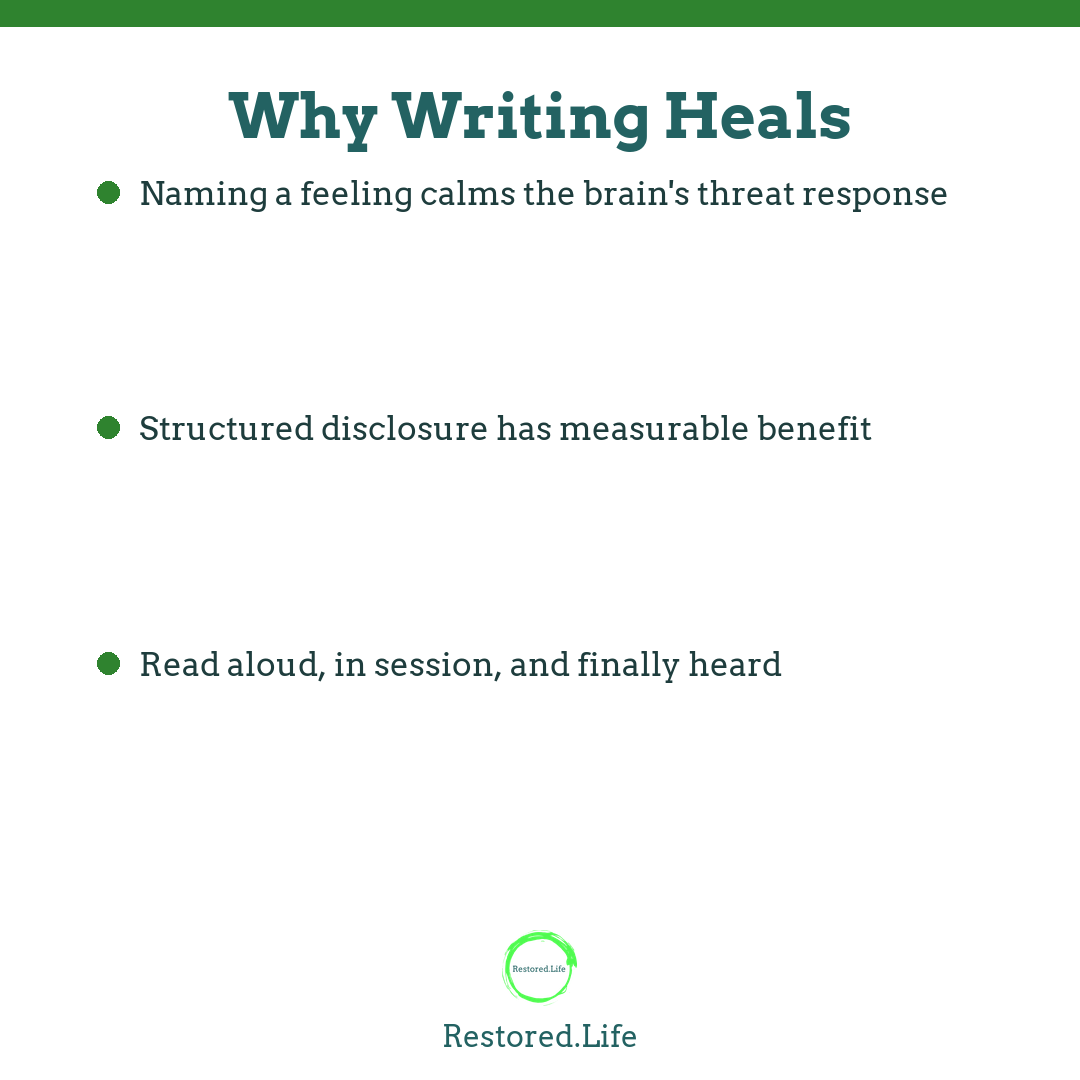
Because putting pain into words is not venting — it is processing. Structured written emotional disclosure carries measurable psychological benefit (Frattaroli, 2006), and the simple act of naming an emotion in words measurably calms the brain’s threat response (Lieberman et al., 2007). The Psalms understood this long before neuroscience measured it: God invites His people to bring Him the whole truth of their grief, and does not flinch.
What should the letter include?
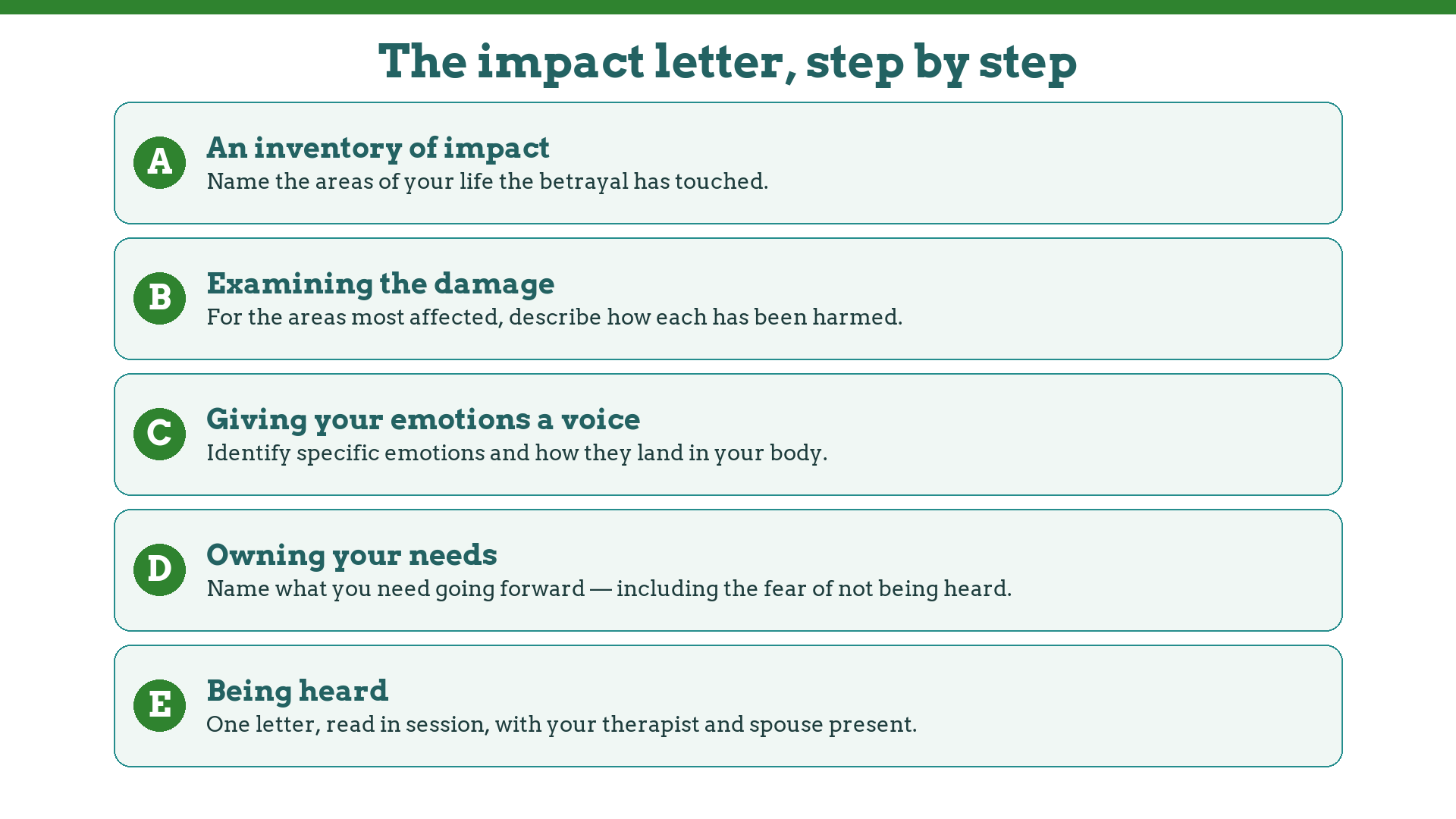
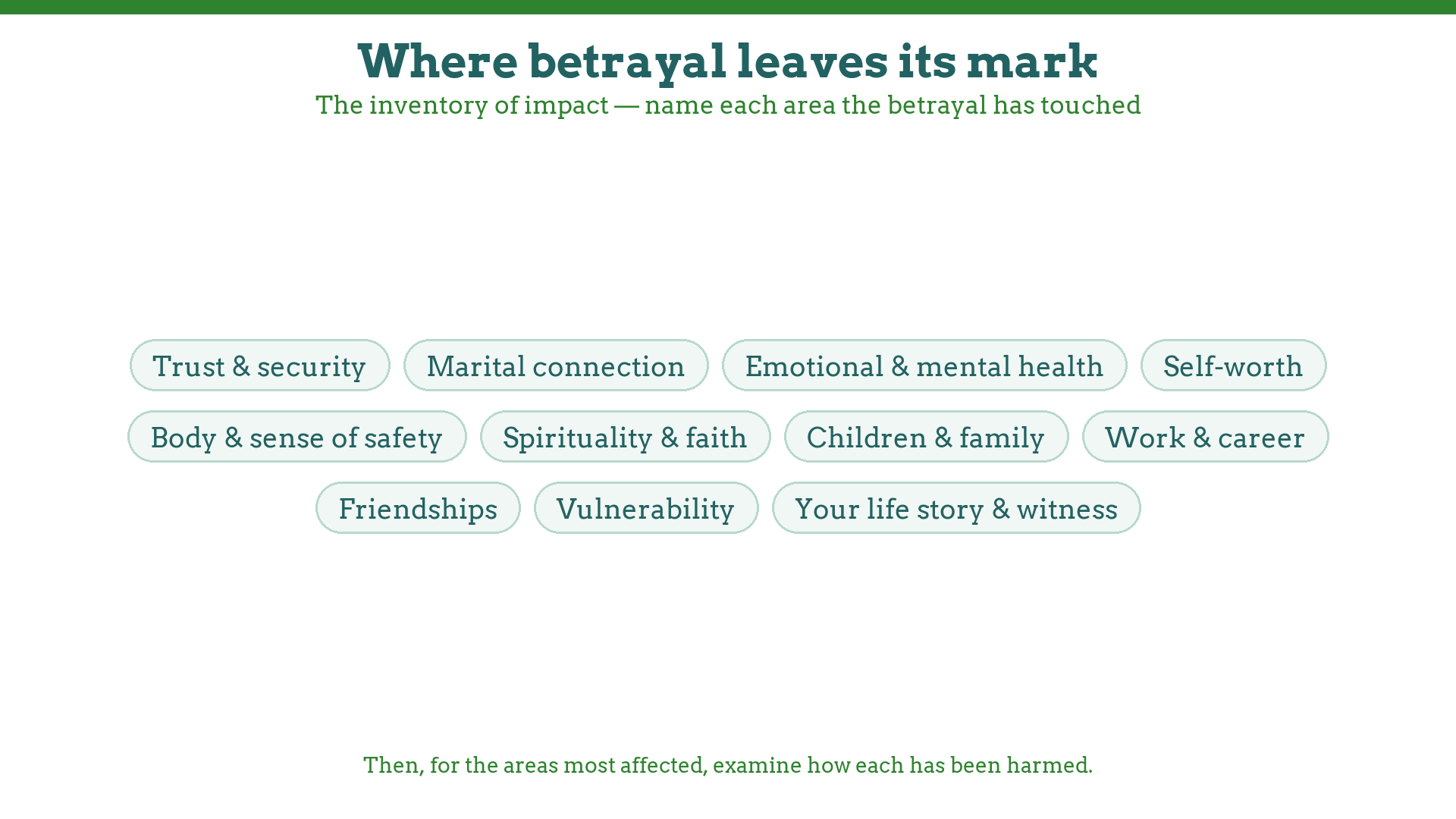
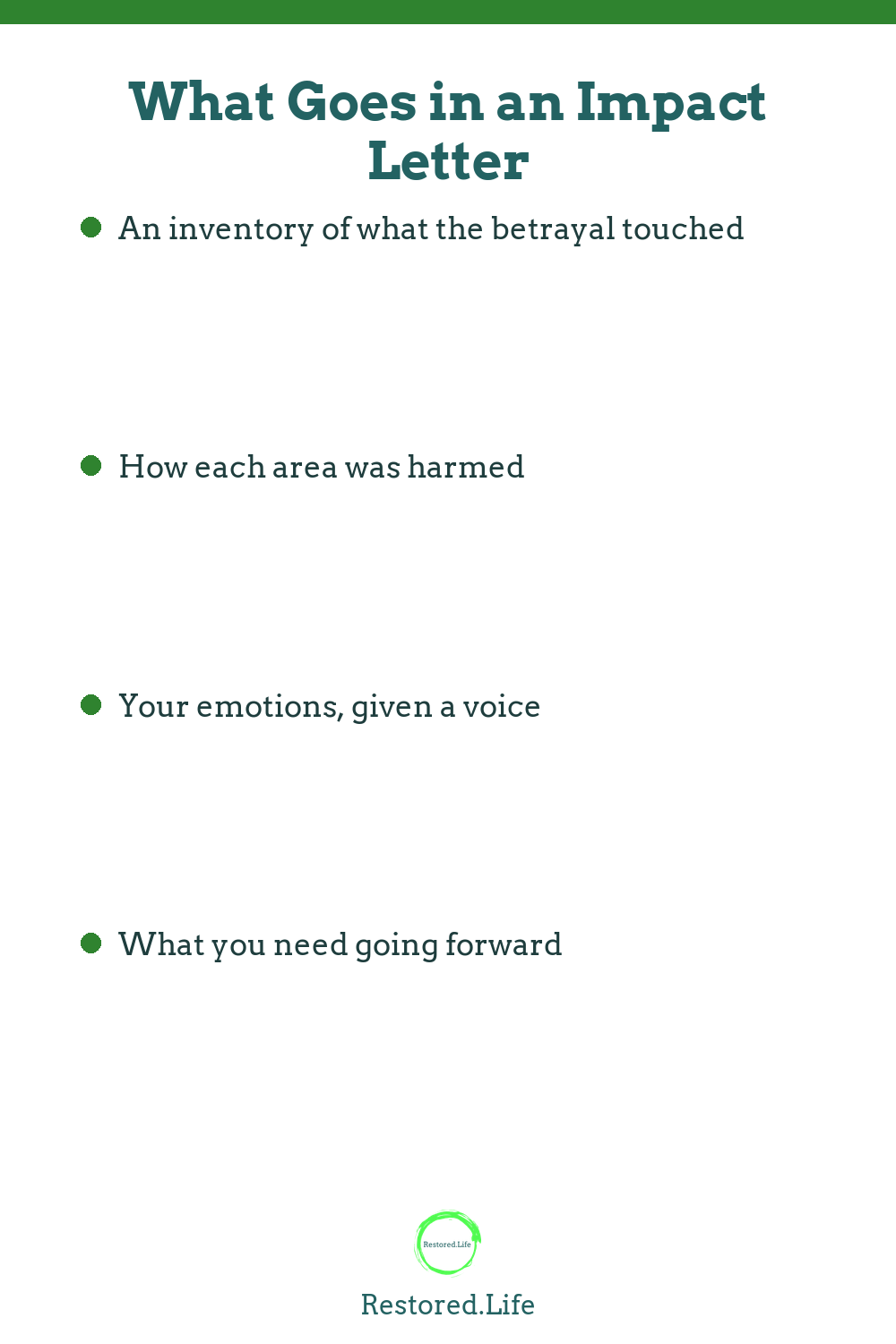
A. An inventory of impact. Name the areas of your life the betrayal has touched:
- Trust and security
- Marital connection, bond, and communication
- Emotional and mental health
- Self-worth
- Your body and sense of safety
- Spirituality and faith
- Children and family
- Work and career
- Friendships
- Vulnerability
- Your life story, witness, and testimony
B. Examining the damage. For the areas most affected, describe how each has been harmed.
C. Giving your emotions a voice. This is hard and essential. Identifying specific emotions — and how they land in your body — starts the healing inside you. Emotions are information: they tell you what was violated and why it matters (Lieberman et al., 2007).
D. Owning your needs. Name what you need going forward — including the fear that you might not be heard, or that blame will be turned back on you. Saying it anyway is part of healing.
E. Being heard. The pieces come together into one letter, read in session with your therapist and your spouse present. Writing it is a courageous step. Be proud of how far you have come.
Is an impact letter always helpful?

Often, yes — impact letters can bring real healing to betrayal recovery. But not for everyone or in every circumstance; your individual therapist helps you decide whether and when it fits your healing. It is a tool, not a requirement.
Are there risks to writing this letter?

Yes. Revisiting the betrayal can bring the feelings flooding back, and the betrayer may feel shame, guilt, or even anger as they hear it. Both partners are likely to feel intense emotion. That is why the letter is read in session, with a trained facilitator holding the space — not handed over at the kitchen table.
What is the impact of betrayal trauma?
Betrayal trauma can produce the symptoms of post-traumatic stress — flashbacks, nightmares, impaired sleep, depression, anxiety, difficulty trusting, and dissociation. In the landmark study of wives of sexual addicts, most met the symptom criteria for PTSD after discovery (Steffens & Rennie, 2006). Your symptoms are a normal response to a profound relational injury — not a character flaw.
What is betrayal recovery, and how long does it take?

Recovery begins once the betrayal is fully in the open. Some couples stay together and pursue betrayal counseling; some do not, and still heal individually — healing is not contingent on the relationship’s survival. Timelines vary widely, from months to years. Patience, compassion, self-care, and honest reflection all matter along the way. And forgiveness, when it comes, is a process that heals the one who forgives (Wade et al., 2014) — in God’s timing, never coerced, and distinct from reconciliation.
How do you move forward?

By communicating needs clearly and, together, writing out your hopes for a healthier future. “Speak the truth in love” (Ephesians 4:15) is the whole assignment — the truth of the impact, and the love that wants a way forward. If the relationship is repairable and both partners are willing, trust can be rebuilt on that honest foundation.
Ready to be heard?

An impact letter is powerful, and it is best written with support. Our CSAT-supervised team walks betrayed partners through this step within betrayal trauma counseling — in person in Glendale, Arizona and by telehealth across Arizona and Washington.
Save and share
Pin or share these — someone you love may need them today.


References
- Frattaroli, J. (2006). Experimental disclosure and its moderators: A meta-analysis. Psychological Bulletin, 132(6), 823–865. https://doi.org/10.1037/0033-2909.132.6.823
- Lieberman, M. D., Eisenberger, N. I., Crockett, M. J., Tom, S. M., Pfeifer, J. H., & Way, B. M. (2007). Putting feelings into words: Affect labeling disrupts amygdala activity in response to affective stimuli. Psychological Science, 18(5), 421–428. https://doi.org/10.1111/j.1467-9280.2007.01916.x
- Steffens, B. A., & Rennie, R. L. (2006). The traumatic nature of disclosure for wives of sexual addicts. Sexual Addiction & Compulsivity, 13(2–3), 247–267. https://doi.org/10.1080/10720160600870802
- Wade, N. G., Hoyt, W. T., Kidwell, J. E. M., & Worthington, E. L., Jr. (2014). Efficacy of psychotherapeutic interventions to promote forgiveness: A meta-analysis. Journal of Consulting and Clinical Psychology, 82(1), 154–170. https://doi.org/10.1037/a0035268
Method note: sources were identified via OpenAlex literature search and screened for retractions and editorial notices via Scite before citation. Scripture quotations are from the ESV. This page is educational and not a substitute for individualized clinical care. Prepared with AI assistance and reviewed by Restored Life Counseling’s clinical staff.