

Reviewed by Emilie Michael, PMHNP-BC, FNP-C — Restored Life’s psychiatric nurse practitioner
Quick Answers
What is psychiatric medication management? Psychiatric medication management is the ongoing clinical practice of evaluating symptoms, prescribing psychotropic medication when it is warranted, and monitoring its effects over time. This is one instrument in the care of a whole person — body, mind, and soul — coordinated with therapy and, where appropriate, the local church.
Should Christians take mental-health medication? Yes — it can be a wise and faithful choice. Christians have long understood that medicine which genuinely helps is one of God’s good gifts to address the physical damage the Fall did to the body and brain (Hodges, 2020). Medication is not a substitute for faith, repentance, or community; it is a stewardship of the body that often frees a person to pursue all three.
When should a Christian be referred for medication? When symptoms — severe depression, panic, mania, psychosis, intrusive trauma, or suicidality — create what we call a neurological ceiling: a physiological state so loud that the person cannot yet do the relational and spiritual work in front of them. Combination treatment (medication plus psychotherapy) outperforms either alone for depression (Cuijpers et al., 2020).
How do medication and relationship fit together? Interpersonal neurobiology holds that the brain heals in safe relationships. Medication can quiet an overactive threat system — lowering amygdala reactivity (Maron et al., 2015) — which widens a person’s window of tolerance so the deeper, relational healing of counseling can take hold.
“Am I a Failure for Needing a Pill?” — What You’re Really Searching For
If you are reading this, there is a reasonable chance you typed something into a search bar that you would never say out loud in your small group.
Is it a sin to take antidepressants? Does medication mean my faith is weak? If I need a pill to feel okay, is the joy of the Lord really my strength? Will the meds change who I am? What do I even tell my pastor?
We want to begin by saying something plainly: those are good questions, and you are not faithless for asking them. They are the questions of a person who takes both their body and their God seriously. The very fact that you are wrestling — rather than numbly complying or proudly refusing — is itself a sign of a conscience that is alive.
You are also not alone, and you are not imagining the pressure you feel. Research on people of faith finds that strong religious conviction is statistically associated with more negative attitudes toward psychiatric medication (Zieger et al., 2017). In other words, the hesitation you feel in the pew is real and measurable, not a personal failing. And the internal version of that pressure — the quiet sentence “I am weak and unable to care for myself” — is exactly the self-stigma that researchers have documented driving people to hide their medication, skip doses, and suffer in silence (Kranke et al., 2011).
Many of the people who walk into Restored Life describe the same scene. They have prayed. They have repented of everything they can think of. They have memorized verses, served others, confessed sin, fasted, and asked their elders to lay hands on them. And still they wake at 3 a.m. with a heart hammering for no reason, or drag through a gray week where even loving their children feels like lifting a car. The shame is not really about the symptom. The shame is the conclusion they have drawn from the symptom: that something this physical must mean something is spiritually wrong with me.
That conclusion is the thing we most want to examine with you. Because it is not actually a biblical conclusion. It is a cultural one, and it has caused a great deal of unnecessary suffering.
Consider what the lived experience actually is. People do not generally resist medication because they have weighed the pharmacology and found it wanting. They resist because medication has become symbolic — a verdict about identity rather than a tool for a problem. Qualitative research with people deciding whether to take psychiatric medication shows that the decision is rarely a simple yes/no about efficacy; it is a deeply personal negotiation about meaning, control, and self-understanding, one that goes far better inside an honest, ongoing relationship with a prescriber than in a sterile fifteen-minute appointment (Swarbrick & Roe, 2011).
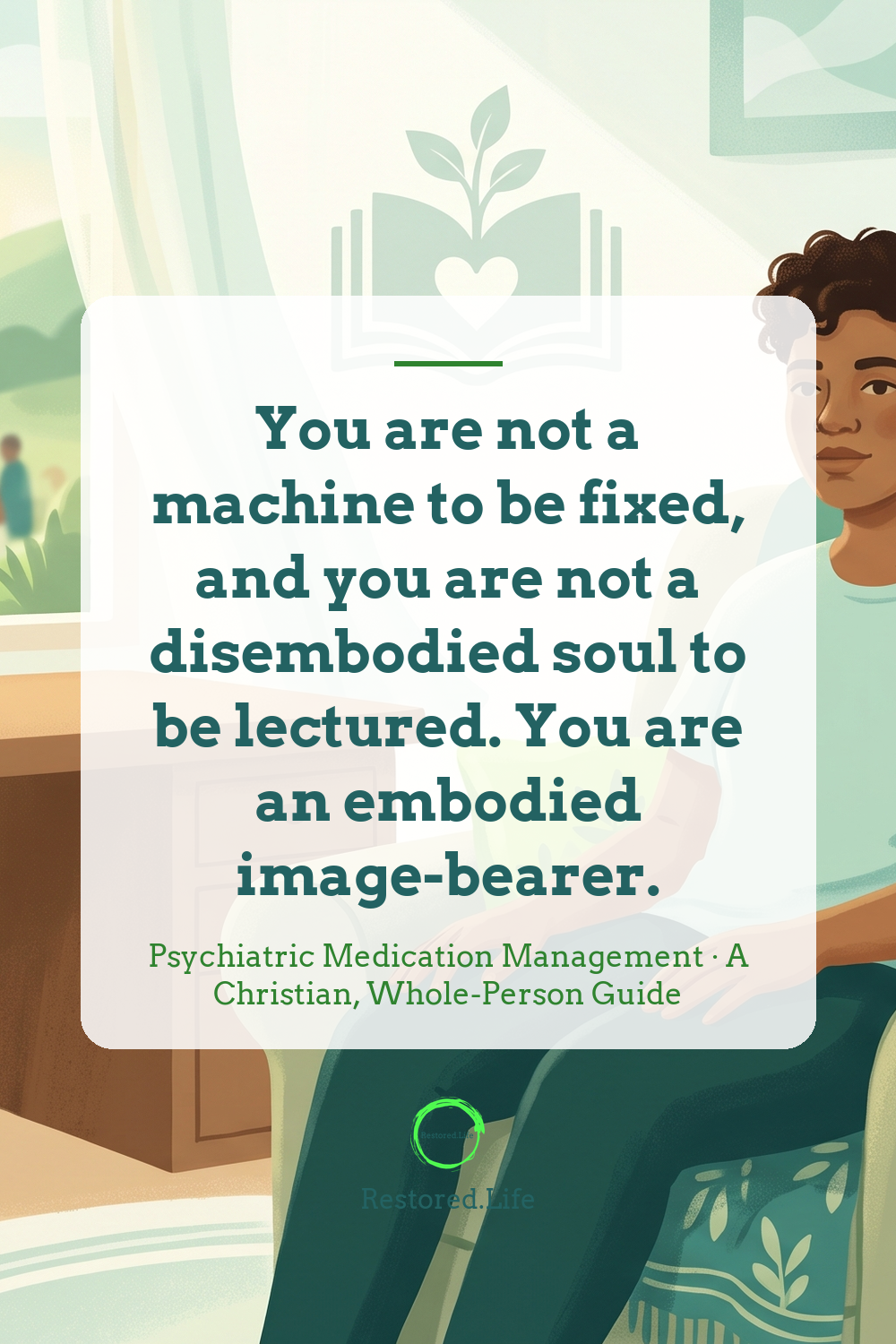
So here is the promise of this guide. We are going to take the science seriously, take the Scriptures seriously, and refuse to pit them against each other. We will tell you what medication can and cannot do. We will tell you when we think it is wise and when we think it is being over-reached for. We will show you the actual decision-making process our clinicians and interns use. And we will do all of it inside a single conviction: that you are not a machine to be fixed, and you are not a disembodied soul to be lectured. You are an embodied image-bearer, and the gospel has something to say to all of you.
What an unmedicated week might feel like
It helps to say the quiet part out loud, because naming it loosens its grip. The thing that drives most people to search for this topic is not a tidy “symptom.” It is a texture of life that has become unbearable in ways that are hard to confess.
It is lying awake at 3 a.m. with a heart pounding at a threat you cannot name, then dragging through the next day hollowed out. It is the gray flatness where you go through the motions of loving your spouse and your children and feel almost nothing, and then hate yourself for feeling nothing. It is the intrusive thought that loops no matter how many times you pray it away. It is the panic that ambushes you in the grocery store aisle for no reason a sane person could point to. It is the exhaustion of performing “fine” at church while everything inside is static and noise.
And layered on top of all of it is the second affliction — the meaning you have assigned to the first. A real Christian wouldn’t feel this way. If I had enough faith, prayed enough, repented enough, this would lift. My body is betraying me and it must be my fault. That second layer is often heavier than the first. We want to lift it off you, at least enough to think clearly.
If any of those sentences felt like they were written about you, please hear this: the heaviness is real, it is not a verdict on your soul, and there is more help available than you have been led to believe. You are allowed to want relief. Wanting your suffering to ease is not a lack of faith; even the Lord Jesus, in the garden, asked for the cup to pass.
“Wait — what even is a med-management appointment?”
Part of the fear is simple unfamiliarity, so let us demystify the logistics. People often confuse two different roles. A therapist or counselor (like our clinicians at Restored Life) meets with you regularly, usually for an hour, to do the relational and spiritual work of understanding your story, your patterns, your heart, and your healing. A prescriber — a psychiatrist, psychiatric nurse practitioner, or sometimes your primary-care physician — evaluates whether medication is warranted, starts it carefully, and monitors it in shorter, more focused visits. Medication management is that second activity: the ongoing evaluate-prescribe-monitor cycle.
The crucial point — and the whole burden of this guide — is that those two roles are meant to work together, not in competition. The most effective care is not “pick one”; it is a coordinated partnership in which the people treating your mind and the people treating your soul are actually talking to each other (Archer et al., 2012). When we refer you to a prescriber, we are not closing your file. We are widening the team.
What the Science Actually Shows About Medication, Therapy, and the Brain
Before we get to theology, let us be honest scientists. One of the ways the church has lost credibility on this subject is by speaking confidently about brains while knowing very little about them. We would rather earn the right to our theological claims by first telling you the truth about the evidence — including where the evidence is genuinely uncertain.
Medication and therapy are partners, not rivals
The single most robust finding in this entire literature is also the most pastorally useful: for depression, the combination of psychotherapy and medication tends to outperform either treatment delivered alone. A network meta-analysis pooling decades of randomized trials found combination treatment superior to either monotherapy for adults with depression (Cuijpers et al., 2020). An earlier meta-analysis of eighteen randomized studies found that adding medication to psychotherapy produced a meaningful additional benefit over psychotherapy alone (Cuijpers et al., 2009). And the benefit is not merely symptom-score arithmetic: combined treatment improves quality of life — relationships, work, the texture of a person’s days — more than either approach by itself (IsHak et al., 2011).
This matters because the cultural script — and, sadly, some Christian scripts — frame the choice as medication versus the real work. The evidence says the opposite. Medication and the “real work” of structured therapy are not competitors fighting over the same territory. They are two hands doing different jobs. Structured psychotherapies such as interpersonal therapy have strong independent support for depression (Cuijpers et al., 2011); medication frequently makes a person able to do that therapy. To pit them against each other is to misunderstand both.

What medication actually does to the brain (and what it doesn’t)
Here is where careful language matters most. The popular “chemical imbalance” slogan oversold a simple story, and the church should not repeat oversold stories in either direction. So what does the imaging literature actually show?
Antidepressants — particularly SSRIs — measurably change how the brain processes emotion, and they do so early. Short-term treatment with escitalopram reduces reactivity in the amygdala and medial frontal regions during emotional processing tasks (Maron et al., 2015). More strikingly, an early reduction in the brain’s negative emotional bias — within the first week or two, often before the person consciously feels better — predicts who will ultimately respond to the medication (Godlewska et al., 2016). The best current account is not that SSRIs pour happiness into a deficient tank, but that they gradually retune the brain’s threat-and-negativity filter, after which lived experience and relationships do the rest of the work.
This is profoundly different from the caricature that medication “changes who you are.” The mechanism the evidence describes is a quieting of a malfunctioning alarm, not a personality transplant. In conditions like panic disorder, that alarm system shows measurably abnormal, even non-conscious, threat processing in the amygdala and surrounding circuitry (Korgaonkar et al., 2021). When the alarm is shrieking, a person cannot hear much else — including, often, the still small voice they are desperate to attend to.
But intellectual honesty requires the caveat, and we will not bury it. Medication is not uniformly or instantly benign. In some people — particularly those high in trait neuroticism — the first days of SSRI treatment can transiently increase fear reactivity before it decreases, which mirrors the early agitation and anxiety some patients report when starting (Di Simplicio et al., 2013). This is precisely why careful titration, close monitoring, and an honest prescriber relationship are not optional niceties. They are the difference between medication that heals and medication that harms.
The relationship is part of the medicine
Perhaps the most important finding for a counseling clinic is that medication does not work in a relational vacuum. Whether a person actually benefits from a prescription depends enormously on whether they take it as prescribed, and whether they take it depends on the quality of the relationship with the prescriber. The strength of the therapeutic alliance and the patient’s insight independently predict medication adherence (Misdrahi et al., 2011). Non-adherence, in turn, is driven less by the chemistry than by stigma, poor insight, and fragmented care (Phan, 2016).
The alliance is not packaging around the “real” treatment; it is an active ingredient that can be deliberately harnessed to improve outcomes (Arnow & Steidtmann, 2014). This is true across conditions: in bipolar disorder, interventions that strengthen the treatment relationship and address adherence improve clinical outcomes (Crowe et al., 2012); in ADHD, sustained benefit depends on the harder relational problem of keeping people engaged with treatment over time, not merely on the pharmacology (Charach et al., 2013).
Read that again, because it is good news. The science itself says the relationship matters — that you are not a passive recipient of chemistry but a participant in your own care, and that being known by the people treating you actually changes how well the treatment works. That is not a soft religious add-on we are smuggling in. It is in the data. And it happens to be exactly what we would expect if human beings were made for relationship in the first place.
Trauma, attachment, and the “window of tolerance”
There is one more piece of the science that deserves its own moment, because it reframes what medication is for in trauma and attachment-wounded people — which describes a great many of the clients we see.
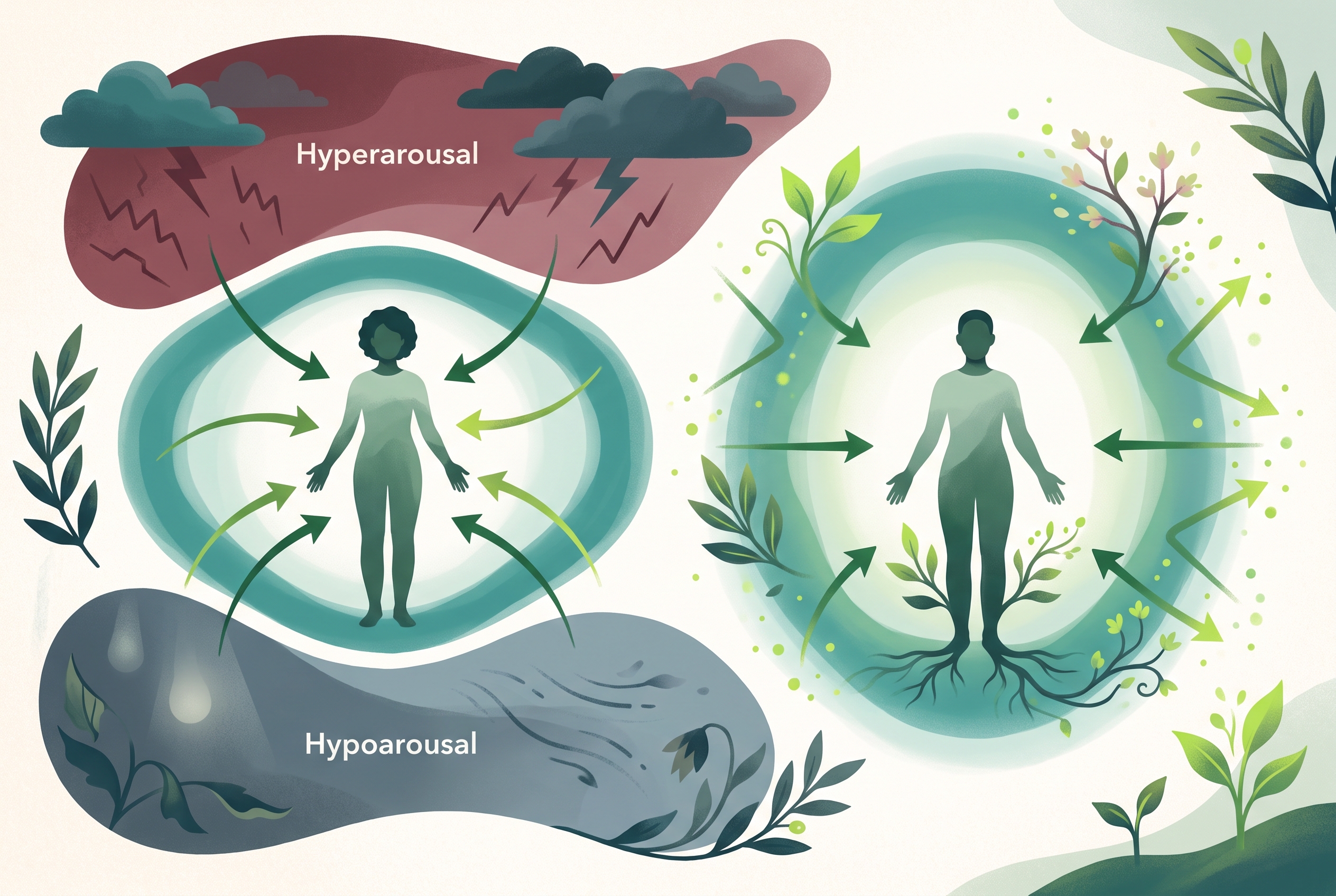
Interpersonal neurobiology (IPNB), a clinical framework associated with Daniel Siegel, describes a “window of tolerance”: the zone of nervous-system arousal within which a person can stay present, think clearly, and connect with others. (We use IPNB here as an explanatory teaching model, not as a cited empirical finding — the specific brain-imaging claims below carry their own peer-reviewed citations.) Push above the window and you get hyperarousal — panic, rage, flooding. Drop below it and you get hypoarousal — numbness, shutdown, dissociation. Trauma narrows that window, sometimes to a sliver, so that small triggers throw a person into states where no learning, no relationship, and no spiritual reflection can happen. The brain’s threat circuitry, in conditions like panic disorder, shows measurably abnormal reactivity — even at a non-conscious level (Korgaonkar et al., 2021).
Here is the integration that matters: medication’s role in this frame is not to manufacture peace but to widen the window. By turning down an over-reactive alarm system (Maron et al., 2015), the right medication can give a traumatized person enough regulatory room to stay present in the counseling relationship long enough for the actual healing — which, the IPNB account insists, happens in safe relationship — to occur. This is why we so often describe medication, for trauma survivors, as the thing that “quiets the noise” so the relational work can begin. It is not a competitor to relational and spiritual healing; it is frequently the precondition that makes such healing accessible at all.
A plain-language tour of the major medication classes
Clients deserve to understand, in ordinary words, what the common categories of psychiatric medication actually are. This is not a prescribing manual — only a licensed medical provider can decide what is right for you — but a map so the conversation is less frightening. We follow the survey of modern classes in Hodges’ medical desk reference (Hodges, 2020).
SSRIs (selective serotonin reuptake inhibitors) — sertraline, escitalopram, fluoxetine, paroxetine and others — are the usual first-line treatment for depression and several anxiety disorders. They are generally well tolerated. We add a note of scientific honesty that the church should not skip: the simple “low serotonin causes depression” story that SSRIs were marketed on has been seriously challenged in recent years, and the truthful statement is that these medicines reliably help many people even though the full mechanism is not settled (Hodges, 2020). What the imaging does show is that they retune the brain’s negative-emotion filter, often early (Godlewska et al., 2016; Maron et al., 2015). SNRIs (serotonin-norepinephrine reuptake inhibitors) — duloxetine, venlafaxine — act on two neurotransmitter systems and are a common second-line option when an SSRI is not enough (Hodges, 2020). Mood stabilizers — above all lithium, the roughly sixty-year “gold standard” for bipolar disorder, effective for a majority of patients when carefully dosed within its narrow safe range — are foundational, not optional, for bipolar I. Anticonvulsants such as carbamazepine serve when lithium is not tolerated (Hodges, 2020). Antipsychotics, especially the newer “atypical” (second-generation) agents, treat schizophrenia and bipolar disorder and sometimes augment antidepressants in stubborn depression (Hodges, 2020). For the conditions with the strongest biological grounding, these are the difference between stability and crisis. Anti-anxiety medicines divide into two very different kinds. Benzodiazepines (alprazolam, diazepam) work fast but carry real dependence risk and are best used briefly and carefully; buspirone works more slowly but without the same abuse potential, and is often paired with cognitive behavioral therapy for generalized anxiety (Hodges, 2020). Stimulants (methylphenidate- and amphetamine-based) are the first-line and strongly evidence-supported pharmacological treatment for ADHD — though their sustained benefit depends heavily on the harder work of keeping a person engaged with treatment over time (Charach et al., 2013). * Targeted and newer agents round out the map: prazosin, a blood-pressure drug repurposed to reduce the nightmares of PTSD; ketamine/esketamine for treatment-resistant depression, acting within hours rather than weeks; and transcranial magnetic stimulation (TMS), a non-drug option for resistant depression with no systemic side effects (Hodges, 2020).
You do not need to memorize any of this. The reason we lay it out is simpler than the names suggest: there is a wide toolbox, the tools do different jobs, and finding the right one is a process of careful trial and adjustment with a prescriber who knows you — not a single verdict handed down once. If the first medication is not right, that is information, not failure.
What medication can’t do (the honest limits)
A guide that only sold you on medication would be doing the same dishonest thing in the other direction. So here is the ceiling, stated plainly. Medication can quiet an overactive threat system; it cannot give you a reason to live. It can lift the gray filter off your perception; it cannot reconcile you to an estranged child or grant you the forgiveness of God. It can make you able to do the work of grief, repentance, and rebuilding; it cannot do that work for you.
This is not a knock on medication — it is simply a true account of its job description. The neuroscience itself points to the limit: an SSRI retunes the brain’s negativity filter (Godlewska et al., 2016), but the content a person then perceives more clearly — their relationships, their losses, their hope or hopelessness — is not supplied by the drug. That is why the combined-treatment finding is so important: medication plus the meaning-making, relational work of therapy heals more than medication alone (Cuijpers et al., 2020), because each is doing a job the other cannot. A tuned instrument still needs a musician, and the musician still needs something worth playing.
There is also a humbler limit: medication does not work the same for everyone, and finding the right fit can take patience through trial, adjustment, and the occasional disappointment (Hodges, 2020). We say this not to discourage you but to inoculate you against the false expectation that sets people up to quit too soon. Slow is normal. Adjustment is normal. Partnership across that process is the whole point.
Creation, Fall, Redemption: Where Brain Chemistry Fits in God’s Story
Now we can do theology — not as a retreat from the science, but as the larger story that makes sense of it. At Restored Life we read every clinical question through three movements of the biblical narrative: Creation, Fall, and Redemption. Where a question lands in that story determines how we answer it. Brain chemistry is not an exception to the gospel; it is one of the places the gospel reaches.

You are an embodied soul, not a ghost in a machine
Start with creation. Scripture does not present the human being as a soul that merely rents a body, nor as a body that merely secretes a mind. It presents a unity. The same person who is “fearfully and wonderfully made” (Ps 139:14) is made as a body — dust enlivened by the breath of God (Gen 2:7). The theologian Anthony Hoekema argued at length that the human person is a profound body-soul unity: body and soul so intertwined that what touches one touches the other, such that we must speak of the whole person standing before God rather than a soul piloting a machine (Hoekema, 1994).
This is RLC’s position, and we want to state it explicitly rather than leave it implied: the brain is part of the “you” that God made and loves. It is not a morally neutral lump of meat beneath the “real” spiritual you. Nor is it the whole of you, as the materialist insists. It is genuine, God-made hardware on which your embodied life runs. The wisdom literature already knew the traffic runs both ways between inner and outer person — that the state of the heart measurably affects the health of the body, and bodily affliction presses on the spirit (Prov 17:22; cf. the broader heart-body teaching of Proverbs). David’s own account of unconfessed sin is relentlessly physical: wasting bones, sapped strength, a body groaning all day long (Ps 32:3–4). The Bible is not squeamish about the body the way some of its readers are.
Two narratives anchor this conviction for us. The first is Elijah under the broom tree (1 Kgs 19:3–9). Here is a prophet who has just witnessed fire fall from heaven, and days later he is suicidal — “It is enough; now, O LORD, take away my life.” And how does God first minister to his despairing prophet? Not with a rebuke. Not even, at first, with a sermon. God sends an angel who lets him sleep, then feeds him, then lets him sleep and eat again, before a word of correction or commission is spoken. The God of Scripture treats an exhausted, depleted body as a real factor in a soul’s collapse — and addresses the body first. If the Almighty does not despise the role of food and rest in restoring a broken servant, neither should we despise the role of legitimate medicine.
The second is Gethsemane. The sinless Son of God, in genuine anguish, sweats what Luke the physician describes as great drops like blood, and is strengthened by an angel (Luke 22:43–44). Christ’s suffering was not less real for being embodied; his agony had a physiology. We follow a Savior who took on a body that could be exhausted, grieved, and pressed to the breaking point. The incarnation forbids us from treating the body as beneath the dignity of redemption.
A picture our counselors often use — and we offer it as a teaching picture, not a doctrine — is the brain as an instrument and the person as the musician. Imagine a gifted pianist sitting down at a piano with three broken keys and strings out of tune. The musician’s skill is intact; the music that comes out is still distorted, because the instrument cannot render what the musician intends. Tuning the piano does not make the musician; it lets the musician be heard. Medication, at its best, tunes the instrument. It does not manufacture your soul, your faith, or your love. It can, however, remove some of the physical static that has been garbling them (Hodges, 2020). Hold the picture loosely — you are not literally a pianist haunting a piano — but let it do its work: your spirit and your synapses are not enemies.

The Fall reached all the way down — including into your neurons
The second movement is the Fall. When sin entered the world, it did not stay politely in the moral compartment. “The whole creation has been groaning together in the pains of childbirth” (Rom 8:22), and our bodies groan with it as we “wait eagerly for… the redemption of our bodies” (Rom 8:23). Thorns and thistles, disease and death, decay and disorder — the Fall is physical. And a brain is a physical organ.
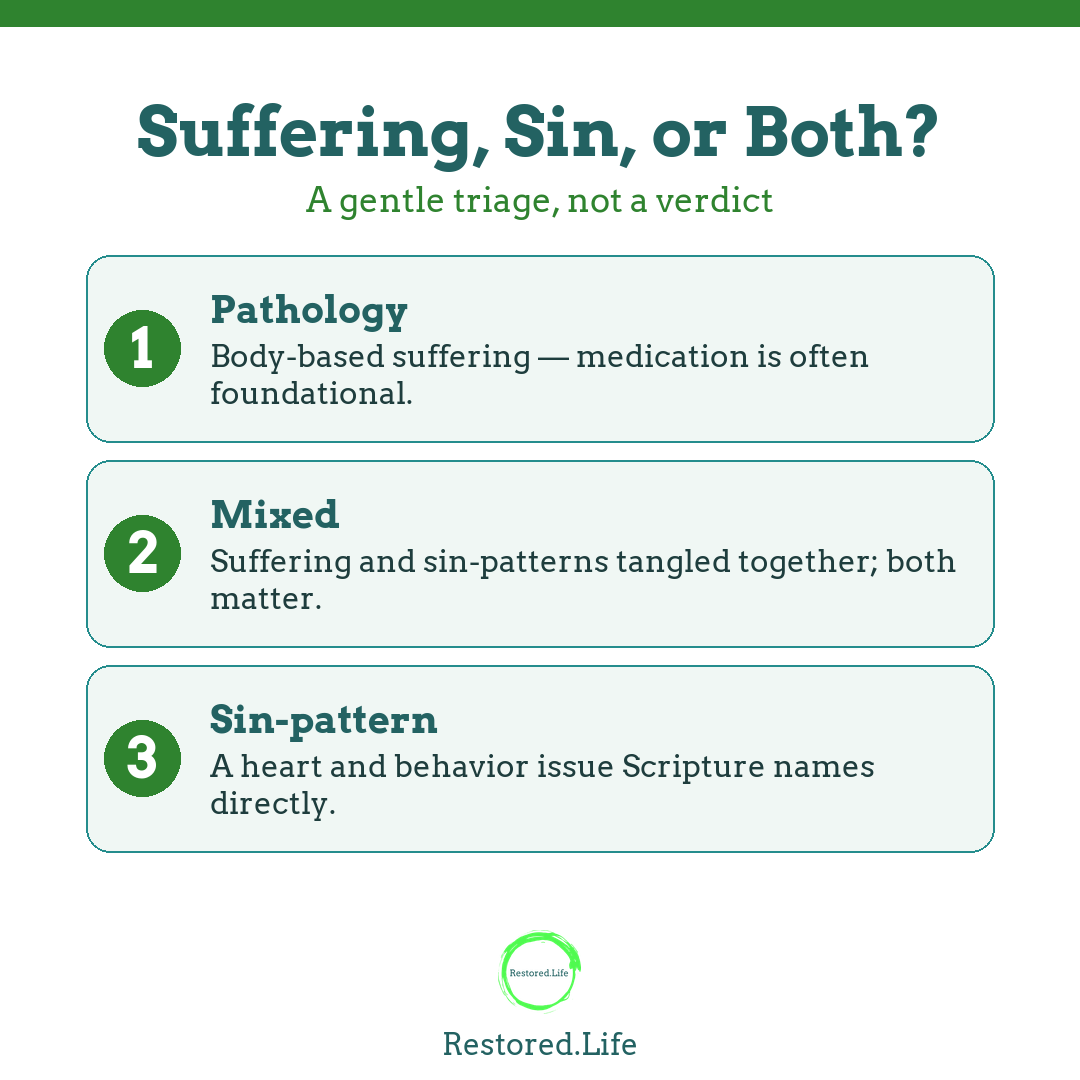
This is the theological hinge of the whole conversation, so we will be precise. Some of what looks like a “mental health problem” is, biblically, a suffering — an affliction that has come upon a person, like the man born blind whose condition Jesus explicitly refused to pin on anyone’s sin (John 9:1–3). Some of it is genuinely sin — a heart turned the wrong way, which counseling and repentance must address. And a great deal of it is a tangle of both, where suffering and sin feed each other. The pastoral malpractice of the last century has run in both directions: secular medicine collapsing everything into disease, and a slice of the church collapsing everything into sin. Charles Hodges — a physician and biblical counselor — captures the corrective in three deceptively simple rules drawn from his medical practice: never call sin a disease, never call a disease sin, and always look for the pathological evidence before you decide (Hodges, 2020).
That third rule is humility with teeth. Hodges catalogs case after case where what looked like a spiritual or behavioral problem turned out to have a straightforwardly physical cause — a thyroid pumping out hormone fifty percent above normal and producing textbook “anxiety,” an iron deficiency producing bizarre behavior, an autoimmune encephalitis mimicking psychiatric illness so completely that the patient was nearly institutionalized (Hodges, 2020). The counselor who rushes to diagnose the heart before ruling out the thyroid is not being more spiritual. He is being less careful than the gospel requires.
Redemption includes your body — and uses ordinary means
The third movement is Redemption — and here is where God’s ordinary means enter. God redeems his people, and in the present age he very often does it through ordinary means. He feeds the hungry through farmers, heals the sick through physicians, and stills the storm in a soul, sometimes, through a tablet taken at bedtime.
The conviction that makes this coherent is simple: God grants real, usable knowledge about his creation to believers and unbelievers alike, “for he makes his sun rise on the evil and on the good” (Matt 5:45). A pharmacologist need not be a Christian to discover something true about how a molecule interacts with a receptor; that truth is God’s truth, on loan to a fallen world. RLC accepts the mechanically valid findings of secular medicine as genuine gifts of God, while still filtering the interpretive frameworks — the materialist story that says you are nothing but your neurons — through Scripture (Hodges, 2020). We take the medicine and leave the metaphysics.
Stewardship is the word that ties it together. If God has provided a means that can genuinely relieve suffering, then refusing it out of a false spirituality is not faith — it is a failure to steward the body he gave you (1 Cor 6:19–20). And the inverse is also true: reaching for a chemical to silence a conscience that ought to be heard is its own kind of unfaithfulness. Wisdom — not a reflex in either direction — is the biblical category, and a thoughtful Christian treatment of medication frames it exactly so: as a question of wisdom and stewardship rather than a test of faith (Jones et al., 2021). “Trust in the LORD with all your heart, and do not lean on your own understanding… It will be healing to your flesh” (Prov 3:5–8). Trusting God and taking the medicine he providentially provided are not two competing acts. For many of our clients, they are the same act.
Your worth was never in your brain’s performance
One more theological thread holds the whole garment together, and it matters most for the people this subject frightens. In the biblical account, your value as a human being is grounded in the image of God you bear — not in your cognitive performance, your emotional stability, or your productivity (Gen 1:27). You were an image-bearer before your first symptom and you remain one in your worst week. Hoekema’s whole anthropology presses this point: the dignity of the human person is conferred by God and rooted in our createdness, not earned by our functioning (Hoekema, 1994).
This reframes the entire emotional stakes of the medication question. If your worth rode on your brain working correctly, then needing medication would indeed be a kind of demotion — evidence that you had fallen below the threshold of acceptability. But your worth never rode there. A believer with treatment-resistant depression is not a second-class image-bearer. A saint with bipolar disorder taking lithium for life is not less beloved than one who has never needed a prescription. The man in late-stage dementia who no longer remembers the gospel is still held by the God who remembers him. The image is not erased by the illness, and it is not restored by the cure. It was given, and it is kept, by grace.
So set down, if you can, the equation that says my value \= how well my mind is working. It was never true. On your clearest day and your foggiest day, your standing before God is exactly the same: a child, bought at a price, fearfully and wonderfully made, and not for sale. Medication might help your mind work better. It cannot make you one ounce more loved than you already are — and neither can the lack of it make you any less.
The Restored Life View: Medication as Stewardship of the Embodied Soul
We can now gather the threads into the actual framework our clinicians operate by. We call it, internally, a stewardship model of psychiatric medication. It rests on four commitments.
Commitment 1: Triage before treatment — the sin / suffering / weakness distinction
Before anyone reaches for a prescription pad or a rebuke, we ask what kind of thing we are dealing with. Following Hodges’ three rules, we sort presenting problems along a spectrum: is this primarily a pathology (a body-based suffering, like hypothyroid-driven anxiety or a manic episode in bipolar I), primarily a sin pattern (a heart and behavior issue, like the habituated drunkenness Scripture names in Eph 5:18), or — most commonly — a tangle requiring both medical and spiritual care (Hodges, 2020)?
This triage is not about assigning blame. It is about not bringing the wrong tool to the job. You cannot rebuke a tumor into remission, and you cannot medicate an unforgiving heart into peace. Some conditions sit clearly toward the pathology pole — schizophrenia and bipolar I disorder have the strongest neurobiological grounding of any psychiatric conditions, and for them medication is not optional and counselors must never encourage discontinuation (Hodges, 2020). Others — much of what gets labeled adjustment difficulty or ordinary grief — may resolve with time, support, and the means of grace, and do not need a lifelong prescription. Wise care begins by telling them apart.

Commitment 2: The brain is hardware God made, not the obstacle to grace
Our second commitment flows from the body-soul unity described above. We refuse the two reductions. Against the materialist, we deny that you are only your brain; against the over-spiritualizer, we deny that your brain is irrelevant to your soul’s struggle. The body and the mind-soul are unified in their response to God: sin disorders both, and grace restores both. Psychiatric medication legitimately addresses the physical pole of an embodied person without thereby denying the spiritual pole (Hoekema, 1994). The “hardware/musician” picture is our teaching shorthand for exactly this — useful at the bedside, but always subordinate to the doctrine of the whole person it illustrates (Hodges, 2020).
Commitment 3: Medication serves relationship and worship, it does not replace them
Third — and this is where our clinical model and the neuroscience shake hands — we understand medication’s highest purpose as clearing the way for the things that actually heal a person: safe relationship, honest community, and communion with God. Interpersonal neurobiology describes how the brain integrates and heals within attuned relationships. When a person’s threat system is chronically screaming — when the amygdala is hyper-reactive and the nervous system is locked in survival (Korgaonkar et al., 2021) — that relational healing cannot get a foothold. Medication that lowers the volume of the alarm (Maron et al., 2015) widens the person’s “window of tolerance,” making them able to stay present in the room with a counselor, a spouse, a congregation, and a God who is near.
This reframes the whole question of what medication is for. We are not trying to medicate you into a permanently chemical contentment. We are trying, where it helps, to turn down the static so that you can hear — so you can sit through a counseling session without dissociating, stay at the dinner table without panic, get the sleep that makes repentance and joy even possible. The goal is never a quieter slave; it is a freer worshiper.
Commitment 4: Wise stewardship means taking it and tapering it under care
Finally, stewardship cuts in every direction. It can be unwise to refuse a medication that would lift a treatable suffering; it can also be unwise to stay on one reflexively, or to stop one abruptly. Coming off an antidepressant, when it is time, is its own clinical act requiring a slow, physician-supervised taper to avoid discontinuation symptoms — not a heroic cold-turkey gesture of faith (Hodges, 2020). The point throughout is the same: medication is a tool under wise authority, held with open hands, neither idolized nor despised.
Commitment 5: The local church is part of the treatment plan
There is one more commitment that distinguishes how Restored Life approaches this from a purely clinical practice. We believe the local church is not an afterthought to mental-health care but one of its God-ordained settings. Human beings heal in relationship — interpersonal neurobiology says so in the language of neural integration, and Scripture said it first in the language of the body of Christ, where the members “have the same care for one another” and “if one member suffers, all suffer together” (1 Cor 12:25–26). A congregation that knows how to weep with those who weep is, quite literally, a healing environment for a dysregulated nervous system.
This is why we work, with your permission, to keep your care from fragmenting across disconnected silos — the very fragmentation that the evidence identifies as a driver of treatment failure (Phan, 2016). The ideal we aim at is a person held within a coordinated web: a prescriber managing the medication, a counselor doing the relational and spiritual work, and a church community providing the ordinary, durable belonging that no fifty-minute appointment can supply. Medication can quiet the alarm; the church, at its best, is where a quieted person is then known.

“But Isn’t This Just Masking the Real (Spiritual) Problem?”
We have made our case. Now we owe you the strongest version of the objection, because a guide that only quotes its friends is not worth your trust. There is a serious Christian critique of psychiatric medication, and it deserves a serious answer — not a caricature.
The objection, at its best. A thoughtful biblical-counseling critic might say something like this: Modern psychiatry has medicalized the human condition. It takes ordinary, meaningful human experiences — grief, fear, sorrow over a broken world, even conviction of sin — relabels them as “disorders,” and offers a chemical to make the discomfort go away. In doing so it can short-circuit the very work God intends the discomfort to provoke. The pill that quiets your anxiety might also quiet the godly sorrow that “produces a repentance that leads to salvation” (2 Cor 7:10). Worse, it teaches people to locate their hope in a prescription rather than in Christ. Is the church not simply baptizing a secular escape from the sanctifying power of suffering?
We take that seriously, and we concede the parts that are true. Psychiatry has over-medicalized ordinary life; not every sadness is major depressive disorder, and Hodges himself argues that a large fraction of what gets the “depression” label is better understood as normal grief that needs companioning, not medicating (Hodges, 2020). The diagnostic categories are human constructs that describe behavior without always identifying a pathology, and some of them rest on thin biological ground — a point a careful Christian appraisal of psychopathology makes at length (McRay et al., 2016). A guide that pretended otherwise would be lying to you.
But the objection proves too much, and here is where it fails. First, it assumes that relieving a physical symptom necessarily silences the spiritual work — and that is simply not how the embodied soul operates. A person drowning in a panic attack is not, in that moment, doing deep heart-work; they are surviving. Lower the physiological flood and you do not remove the spiritual work — you make it possible. The combined-treatment evidence points exactly here: medication and the relational, meaning-making work of therapy produce more healing together than the spiritual-only or chemical-only approach does alone (Cuijpers et al., 2020; IsHak et al., 2011). Medication is not an alternative to sanctification’s hard road; for many it is what gets them onto the road.
Second, the objection misreads what the medication is doing to the self. The fear beneath “isn’t this just masking it?” is usually the fear that the pill will dishonestly paper over reality — produce a false, drugged contentment. But the mechanism the evidence describes is not the manufacture of fake happiness; it is the retuning of a negatively-biased threat filter that was itself distorting reality (Godlewska et al., 2016). The depressed brain is not seeing clearly and being numbed; it is seeing through a dark filter and being helped to see more accurately. That is closer to cleaning a smudged lens than to drugging a witness.
Third — and we say this gently to our own tribe — the “you’re masking the spiritual problem” charge has a body count. It is the theology behind the self-stigma that makes believers hide their medication and stop taking it (Kranke et al., 2011), and it correlates with exactly the religiously-driven resistance that keeps suffering people from treatment that works (Zieger et al., 2017). A counselor is responsible not only for the truth of a claim but for its fruit in a fragile person’s life.
A second objection — “you’re teaching people to trust a pill instead of God.” This one cuts closer, because idolatry is a real and biblical danger. Could medication become a functional savior, a way of outsourcing to chemistry the peace that is meant to be found in Christ?
Yes — it could, and sometimes it does. We will not pretend otherwise. A person can absolutely make an idol of relief, medicate every uncomfortable feeling God means to use, and quietly relocate their hope from the Lord to the pharmacy. That is a genuine spiritual failure mode, and part of a counselor’s job is to watch for it. But notice that anything good can be idolized — food, sleep, marriage, even ministry — and we do not respond to the idolatry of food by commanding people to stop eating. We respond by reordering loves, not by forbidding gifts. The same is true here. Scripture’s remedy for anxious dependence on lesser things is not abstention from the things but supremacy of Christ over them (Matt 6:25–34; Phil 4:6–7). A diabetic who takes insulin “instead of trusting God” has a heart problem; a diabetic who takes insulin as a gift from the God they trust has rightly ordered the same act. The medication is not the issue. The location of one’s hope is.
And there is a quiet irony worth naming: the same loud nervous system that the critic worries medication will “comfort away” is often the very thing preventing a person from resting in God at all. When the threat system is screaming (Korgaonkar et al., 2021), “do not be anxious” can feel less like an invitation and more like a sentence one is failing to keep. Quiet the false alarm, and for many people the command becomes obeyable for the first time in years. Medication, rightly used, is not a rival to “casting your cares on him” — it can be what finally makes the casting possible.
We will, however, grant the critic one more genuine point — the one with teeth. There is a real risk in the early going. For some people, starting an SSRI transiently increases agitation and fear before it helps (Di Simplicio et al., 2013), and a person poorly monitored in that window can be harmed. The answer to that risk, though, is not abstention; it is better care — close follow-up, honest informed consent, and a real relationship with the prescriber (Misdrahi et al., 2011). Which brings us to the practical question everyone actually came here to ask: so how do you decide, and what does it look like?
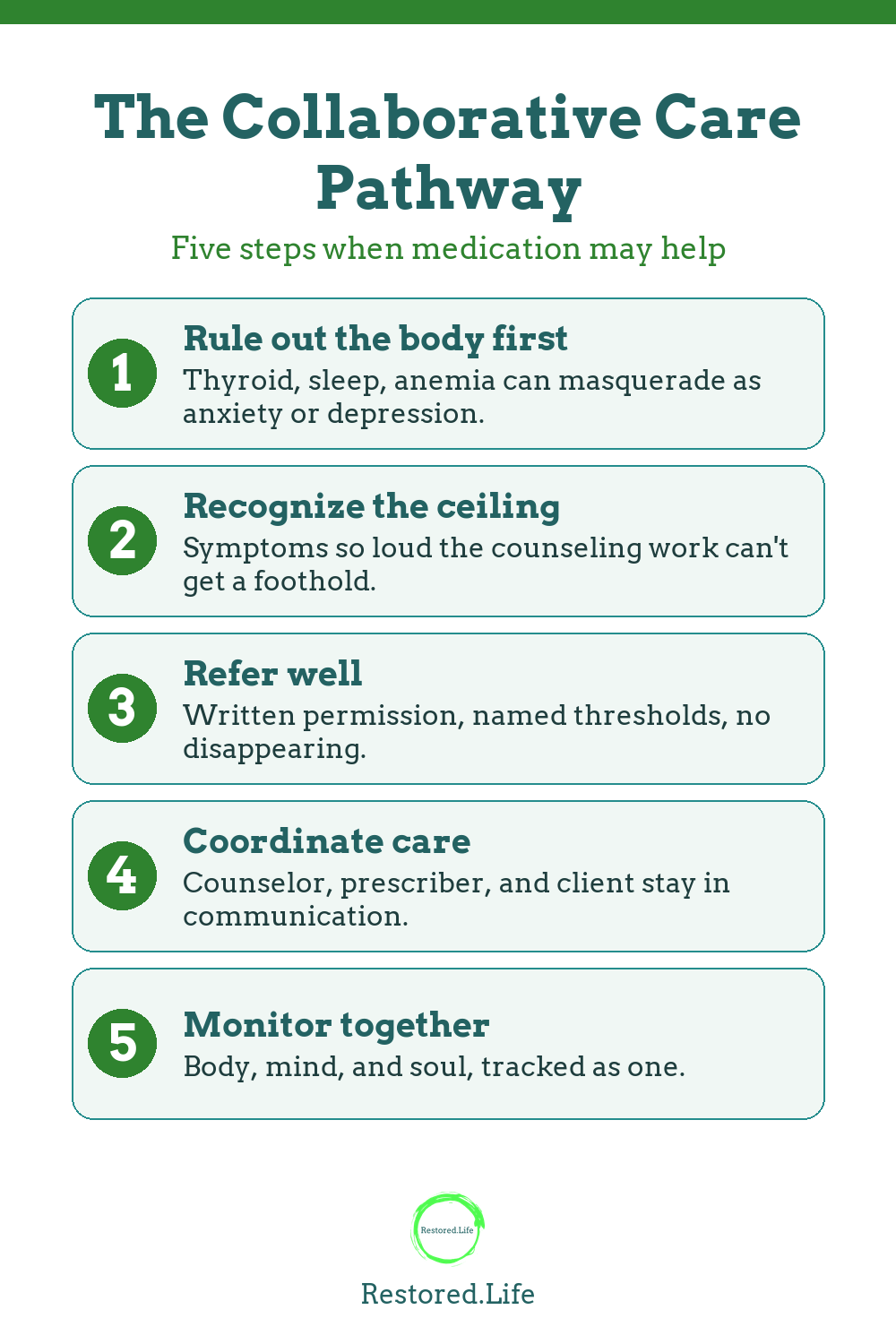
When and How We Refer: The Collaborative Care Pathway
Here is the actual machinery — the decision process our clinicians and interns use. We are showing you our work on purpose. A family deciding about medication deserves to see the reasoning, not just receive a verdict.
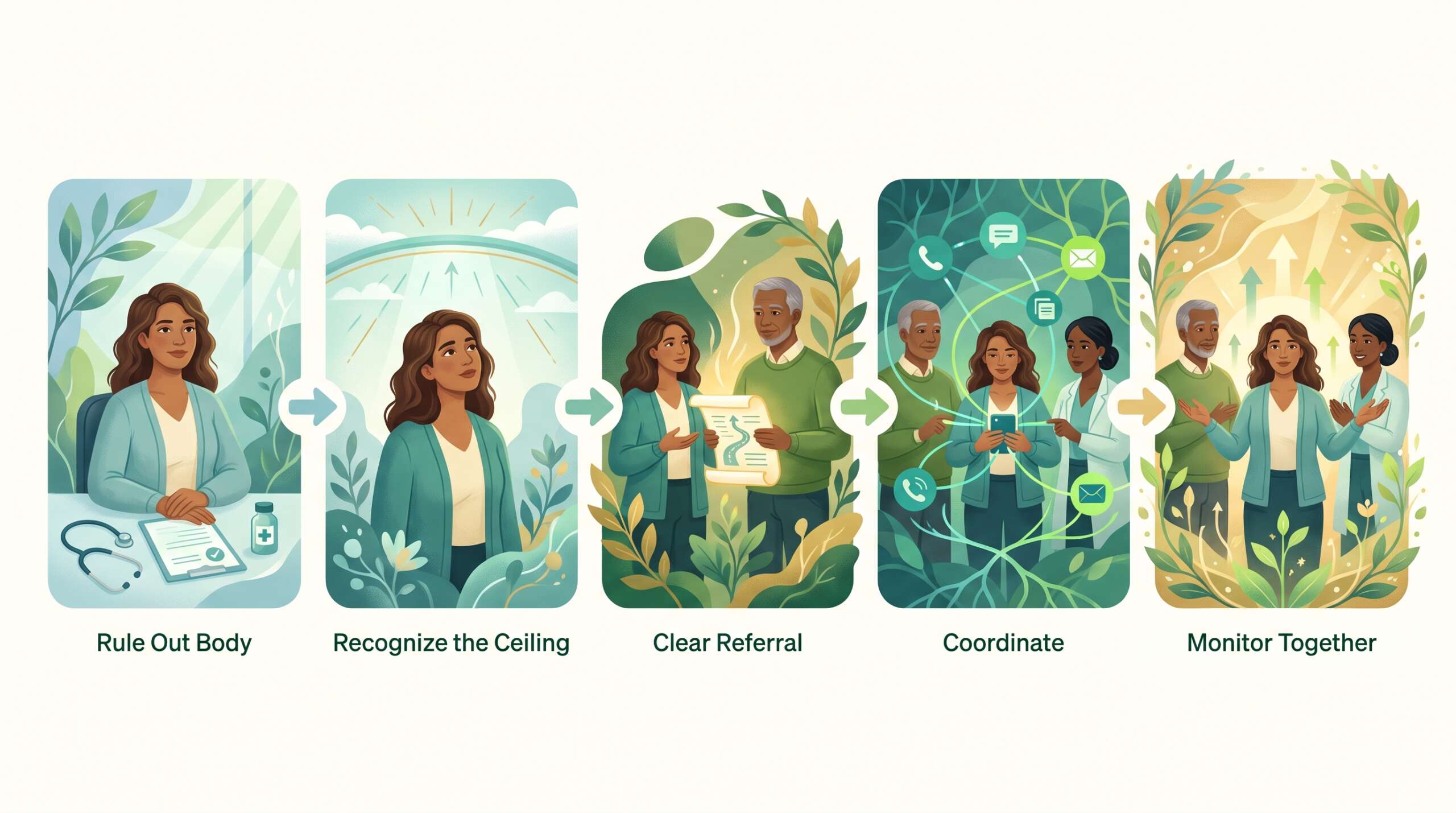
Step 1 — Rule out the body first
Before any heart-level conclusion and before any referral for psychiatric medication, we ask whether a medical condition is driving the symptoms. Hodges’ third rule — always look for the pathological evidence — operationalizes here as a real medical workup. Thyroid disorder, anemia, sleep apnea, medication side effects, and a dozen other physical conditions can masquerade as anxiety, depression, or even dementia (Hodges, 2020). The first referral is often not to a psychiatrist at all, but to a primary-care physician for labs.
Step 2 — Recognize the “neurological ceiling”
We refer for a psychiatric medication evaluation when symptoms have created what we call a neurological ceiling: the person is so physiologically overwhelmed that they cannot yet engage the counseling work in front of them. Concretely, this includes:
Severe or persistent depression that has not lifted despite real circumstantial and spiritual change, especially with sleep and appetite collapse or anhedonia that blunts every relationship. Panic and severe anxiety that has crossed from manageable vigilance into a body locked in fight-or-flight, where the alarm system itself is the obstacle (Korgaonkar et al., 2021). Any suspicion of bipolar I or psychosis — these are non-negotiable medical referrals where medication is foundational and counselors must never encourage stopping it (Hodges, 2020). Intrusive trauma symptoms — nightmares, flashbacks, hyperarousal — that keep a person outside their window of tolerance.
Step 3 — Use a clear referral protocol
Referral is a clinical act with its own discipline. Drawing on Martha Peace’s framework as presented in Hodges, our counselors obtain written permission to coordinate, name the emergency thresholds in advance, avoid “co-counseling” tug-of-war with the prescriber, and stay present to the client through the transition rather than disappearing (Hodges, 2020). For intake and ongoing assessment we lean on structured Christian assessment approaches — the kind of hospitable, story-first initial consultation modeled in Greggo’s START framework (Greggo, 2022\) — so that the decision to refer is grounded in a real understanding of the whole person, not a symptom checklist.
Step 4 — Coordinate care; do not fragment it
This is where the evidence most strongly vindicates our model. The collaborative care model — in which the therapist, the prescriber, and the medical team actually communicate and share a plan — consistently outperforms fragmented, siloed “usual care.” The landmark Cochrane review found collaborative care improves outcomes for both depression and anxiety (Archer et al., 2012). It works specifically for anxiety disorders in primary care (Muntingh et al., 2016), for youth behavioral health (Asarnow et al., 2015), and even for the hard cases of depression tangled with chronic physical illness like diabetes (Atlantis et al., 2014; Huang et al., 2013). Fragmentation is one of the documented drivers of medication failure (Phan, 2016); coordination is its antidote. Our standing commitment is to function as one of those coordinated partners, with your permission, for as long as you are in our care.
Step 5 — Monitor body, mind, and soul together
Once a client is on medication, monitoring is not the prescriber’s job alone. In the counseling room we watch for the early-agitation window (Di Simplicio et al., 2013), track whether the medication is actually widening the window of tolerance or merely flattening affect, and keep adherence honest by keeping the relationship honest (Misdrahi et al., 2011; Arnow & Steidtmann, 2014). And when the season is right, we support a careful, physician-led taper rather than an abrupt stop (Hodges, 2020). Throughout, we are asking three questions at once: Is the body steadier? Is the mind clearer? Is the soul freer to love God and people? When the answer to all three is trending yes, the medication is doing its proper, humble work.
Condition-by-condition: where medication usually fits
Every person is different, and nothing below replaces a clinician’s judgment about you. But families repeatedly ask us, “Is this the kind of thing medication is even for?” Here is how our clinicians generally locate the most common presentations along the stewardship spectrum, drawing on Hodges’ condition-by-condition treatment (Hodges, 2020).
| Presentation | Where it usually sits | Typical role of medication |
|---|---|---|
| Bipolar I disorder | Strongly pathological | Foundational and non-negotiable. Mood stabilizers (lithium first) are essential; counselors must never encourage stopping. Counseling supports stability and the relational fallout. |
| Schizophrenia / psychosis | Strongly pathological | Foundational. Antipsychotics are the basis of care; the counselor’s role is stabilization, support, and dignity, never discontinuation. |
| Severe / treatment-resistant depression | Often pathological | Frequently warranted, ideally combined with therapy (Cuijpers et al., 2020); resistant cases may consider ketamine or TMS (Hodges, 2020). |
| Panic disorder / severe anxiety | Mixed | Helpful when the alarm system itself blocks all other work (Korgaonkar et al., 2021); SSRIs or, briefly, anxiolytics, paired with CBT (Hodges, 2020). |
| PTSD | Mixed (real brain changes) | Adjunctive: prazosin for nightmares, SSRIs for intrusive symptoms, alongside trauma-focused counseling (Hodges, 2020). |
| OCD | Mixed (locked neural loops) | Often helpful alongside exposure-based work and counseling from a Biblical worldview that re-trains the response to intrusive thoughts (Hodges, 2020). |
| Postpartum mood disorders | Ranges widely | Baby blues resolve; postpartum depression is treatable and often warrants medication; postpartum psychosis is a psychiatric emergency (Hodges, 2020). |
| ADHD | Real executive-function deficits | Stimulants are first-line and effective; pair with structure and skills, and attend to long-term engagement (Charach et al., 2013). |
| Eating disorders (esp. anorexia) | Medical danger first | Below critical weight thresholds, medical stabilization outranks counseling access; this is a referral, not a discussion (Hodges, 2020). |
| Ordinary grief / adjustment | Usually suffering, not disease | Often needs companioning, time, and the means of grace more than a prescription (Hodges, 2020). |
| Substance-driven patterns | Often sin-tangled | Scripture’s category of drunkenness applies; medical detox may still be medically necessary and is not optional where withdrawal is dangerous (Hodges, 2020). |
Common questions Christians ask
Most of what follows simply gathers, in plain Q\&A form, what we have already argued — so a worried reader can find their exact question fast.
“How long will I have to be on medication?” It depends entirely on the condition. Some people take a medication for a defined season — through an acute depression, say — and taper off under a physician’s care once they are stable (Hodges, 2020). Others, particularly with bipolar I or schizophrenia, may need lifelong medication the way a person with diabetes needs insulin, and that is not a spiritual deficiency. Coming off should always be a planned, supervised taper, never an abrupt act of willpower (Hodges, 2020).
“Will medication change who I am or numb me out?” The honest answer from the evidence is that medication, working properly, sharpens rather than erases the self: it lowers a hyperactive threat response (Maron et al., 2015) and lifts a negatively-distorted filter (Godlewska et al., 2016) so that you — your actual affections and judgments — can operate again. If a medication leaves you flat or not-yourself, that is important feedback for your prescriber, not the goal; the dose or the drug may be wrong.
“Can I still do real Christian counseling if I’m on antidepressants?” Yes — and the data says you may do it better, because combined treatment outperforms either alone (Cuijpers et al., 2020) and a steadier nervous system can stay present for the relational work (Arnow & Steidtmann, 2014).
“What should I tell my pastor?” As much as you are comfortable sharing — and we would gently encourage honesty, because secrecy is part of what makes the shame grow (Kranke et al., 2011). A healthy church should receive “I’m being treated for depression, and I’d value your prayers” exactly as it would receive news of any other medical treatment. Where your church is part of the care, with your permission, the coordination only helps (Archer et al., 2012).
“How do I know if I need medication or just more therapy / more faith?” That is precisely the discernment our triage exists to serve, and it is rarely a solo decision. The presence of a “neurological ceiling,” a failed response to genuine spiritual and circumstantial change, and any red-flag symptom (mania, psychosis, suicidality, severe functional collapse) all push toward a medical evaluation (Hodges, 2020). When in doubt, get the evaluation; a “no” from a physician costs little, and a missed “yes” can cost a great deal.
What the pathway looks like in practice
Let us put the five steps together in a single, composite picture (a representative scenario, not a real client). Imagine a woman in her late thirties who comes to Restored Life because she “should be able to handle this” and can’t. She is a faithful church member, exhausted, weeping in sessions, sleeping poorly, snapping at her kids, and quietly convinced God is disappointed in her.
Step 1, rule out the body. Before we settle on any account of her heart, we encourage a medical workup. It turns out her thyroid is borderline and her sleep is wrecked — both real physiological contributors that no amount of repentance would fix (Hodges, 2020). Step 2, recognize the ceiling. Even with those addressed, her mood does not lift; the anhedonia and 3 a.m. dread persist past every circumstantial and spiritual change. That failure-to-lift is itself data: we are likely looking at a depression with a strong physiological component, a genuine neurological ceiling. Step 3, refer well. We obtain her written permission to coordinate, name the emergency thresholds aloud, and walk her — not abandon her — to a prescriber, framing it as widening the team rather than failing the counseling (Hodges, 2020).
Step 4, coordinate. The prescriber starts an SSRI; we stay in the loop with the client’s consent, so the medication and the counseling pull the same direction rather than working blind to each other — the coordinated model the evidence consistently favors (Archer et al., 2012; Muntingh et al., 2016). Step 5, monitor body, mind, and soul. In the counseling room over the next weeks we watch for the early-agitation window (Di Simplicio et al., 2013), keep adherence honest by keeping the relationship honest (Misdrahi et al., 2011), and — as the static drops — finally do the deeper work the noise had been blocking: the grief she never grieved, the lie about God’s disappointment, the rebuilding of rhythms of rest and worship. Months later, stable, she and her prescriber plan a careful taper, or she stays on a maintenance dose; either way it is a decision made together, with open hands.
Walking the Road Together: Your Next Step
Let us return to where we started — to the questions you might have been ashamed to ask out loud.
Is it a sin to take psychiatric medication? No. For many people it is an act of wisdom and stewardship of the body God made and called good. Does it mean my faith is weak? No more than wearing glasses means your faith is weak, or insulin, or a cast on a broken arm. Will it change who I am? The evidence says medication, at its best, quiets a malfunctioning alarm so that the real you can be heard — it tunes the instrument; it does not replace the musician. Should I be afraid? You should be careful, monitored, and known by the people treating you — and inside that kind of care, you can set the fear down.
We hold two things together that the culture keeps trying to tear apart. You are a body, fearfully and wonderfully made, sometimes broken in ways that medicine can genuinely help. And you are a soul, made for God, whom no pill can satisfy and no diagnosis can define. The gospel is good news for both. Medication, where it is wise, is a common-grace gift for the first; it was never meant to be, and cannot be, a substitute for the second.
If you are wrestling with where you fall on this — whether the heaviness you carry needs a physician, a counselor, your church, or all three — that discernment is exactly the kind of thing we do alongside you. You do not have to sort it out alone, and you do not have to be sure before you reach out. Bring the whole tangle. We will help you tell the suffering from the sin from the simple, treatable static — and we will walk the road with you whichever way it leads.
Remember the shape of everything we have said. The science is not the enemy of your faith: medication and the relational work of counseling heal more together than either does alone, and what medication does is quiet a malfunctioning alarm so the real you can be heard. The Scriptures are not embarrassed by your body: the God who fed and rested Elijah before he ever corrected him is not disappointed that you are dust. And your worth was never riding on your brain’s performance in the first place — you were a beloved image-bearer before your first symptom, and you are no less one now. Between the materialist who says you are only a brain and the over-spiritualizer who says your brain does not matter, we keep insisting on the harder, kinder truth: you are a whole person, body and soul, and the gospel is good news for all of you.
So if you have been carrying the second, heavier affliction — the verdict that needing help is a failure of faith — consider laying it down here. Needing care is not weakness; it is the ordinary condition of every human being who has ever lived, dignified by a Savior who Himself was strengthened by an angel in His darkest hour. Whatever the right next step turns out to be for you — a doctor’s evaluation, a counselor’s room, a conversation with your pastor, or simply the courage to stop hiding — it can begin with a single, unheroic act: reaching out. When you are ready, we are here, and we will take the whole of you seriously, because the One who made you does.
Share
Pin or share these — someone you love may need them today.
References
APA 7th edition, alphabetical by first author. Internal book sources link to their CAQR evaluation file; external peer-reviewed sources link to their DOI.
Archer, J., Bower, P., Gilbody, S., Lovell, K., Richards, D., Gask, L., Dickens, C., & Coventry, P. (2012). Collaborative care for depression and anxiety problems. Cochrane Database of Systematic Reviews, (10), CD006525.
Arnow, B. A., & Steidtmann, D. (2014). Harnessing the potential of the therapeutic alliance. World Psychiatry, 13(3), 238–240.
Asarnow, J. R., Rozenman, M., Wiblin, J., & Zeltzer, L. (2015). Integrated medical-behavioral care compared with usual primary care for child and adolescent behavioral health: A meta-analysis. JAMA Pediatrics, 169(10), 929–937.
Atlantis, E., Fahey, P., & Foster, J. (2014). Collaborative care for comorbid depression and diabetes: A systematic review and meta-analysis. BMJ Open, 4(4), e004706.
Charach, A., Fernandez, R., & Bélanger, S. A. (2013). Enhancing ADHD medication adherence: Challenges and opportunities. Current Psychiatry Reports, 15(7), 371\.
Crowe, M., Wilson, L., & Inder, M. (2012). Patients’ reports of the factors influencing medication adherence in bipolar disorder. Australian & New Zealand Journal of Psychiatry, 45(11), 932–937.
Cuijpers, P., van Straten, A., Warmerdam, L., & Andersson, G. (2009). Psychotherapy versus the combination of psychotherapy and pharmacotherapy in the treatment of depression: A meta-analysis. Depression and Anxiety, 26(3), 279–288.
Cuijpers, P., Geraedts, A. S., van Oppen, P., Andersson, G., Markowitz, J. C., & van Straten, A. (2011). Interpersonal psychotherapy for depression: A meta-analysis. American Journal of Psychiatry, 168(6), 581–592.
Cuijpers, P., Noma, H., Karyotaki, E., Vinkers, C. H., Cipriani, A., & Furukawa, T. A. (2020). A network meta-analysis of the effects of psychotherapies, pharmacotherapies and their combination in the treatment of adult depression. World Psychiatry, 19(1), 92–107.
Di Simplicio, M., Norbury, R., & Harmer, C. J. (2013). Short-term antidepressant administration reduces negative self-referential processing in the medial prefrontal cortex in subjects at risk for depression. Psychological Medicine, 43(8), 1611–1622.
Godlewska, B. R., Browning, M., Norbury, R., Cowen, P. J., & Harmer, C. J. (2016). Early changes in emotional processing as a marker of clinical response to SSRI treatment in depression. Translational Psychiatry, 6(11), e957.
Greggo, S. P. (2022). Assessment for counseling in Christian perspective. IVP Academic.
Hodges, C. D. (2020). The Christian counselor’s medical desk reference (2nd ed.). Faith Biblical Counseling Ministries.
Hoekema, A. A. (1994). Created in God’s image. Eerdmans.
Huang, Y., Wei, X., Wu, T., Chen, R., & Guo, A. (2013). Collaborative care for patients with depression and diabetes mellitus: A systematic review and meta-analysis. BMC Psychiatry, 13, 260\.
IsHak, W. W., Ha, K., Kapitanski, N., Bagot, K., Fathy, H., Swanson, B., Vilhauer, J., Balayan, K., Bolotaulo, N. I., & Rapaport, M. H. (2011). The impact of psychotherapy, pharmacotherapy, and their combination on quality of life in depression. Harvard Review of Psychiatry, 19(6), 277–289.
Jones, R. D., Kellen, K. L., & Green, R. (2021). The gospel for disordered lives: An introduction to Christ-centered biblical counseling. B\&H Academic.
Korgaonkar, M. S., Tran, J., Felmingham, K. L., Williams, L. M., & Bryant, R. A. (2021). Neural correlates of emotional processing in panic disorder. NeuroImage: Clinical, 32, 102902\.
Kranke, D., Floersch, J., Kranke, B., & Munson, M. R. (2011). A qualitative investigation of self-stigma among adolescents taking psychiatric medication. Psychiatric Services, 62(8), 893–899.
Maron, E., Wall, M. B., Norbury, R., Cowen, P., Murphy, S. E., Harmer, C. J., & Nutt, D. (2015). Effect of short-term escitalopram treatment on neural activation during emotional processing. Journal of Psychopharmacology, 30(1), 33–39.
McRay, B. W., Yarhouse, M. A., & Butman, R. E. (2016). Modern psychopathologies: A comprehensive Christian appraisal (2nd ed.). IVP Academic.
Misdrahi, D., Petit, M., Blanc, O., Bayle, F., & Llorca, P.-M. (2011). The influence of therapeutic alliance and insight on medication adherence in schizophrenia. Nordic Journal of Psychiatry, 66(1), 49–54.
Muntingh, A. D. T., van der Feltz-Cornelis, C. M., van Marwijk, H. W. J., Spinhoven, P., & van Balkom, A. J. L. M. (2016). Collaborative care for anxiety disorders in primary care: A systematic review and meta-analysis. BMC Family Practice, 17, 62\.
Phan, S. V. (2016). Medication adherence in patients with schizophrenia. International Journal of Psychiatry in Medicine, 51(2), 211–219.
Swarbrick, M., & Roe, D. (2011). Experiences and motives relative to psychiatric medication choice. Psychiatric Rehabilitation Journal, 35(1), 45–50.
Zieger, A., Mungee, A., Schomerus, G., Ta, T. M. T., Dettling, M., Angermeyer, M. C., & Hahn, E. (2017). Attitude toward psychiatrists and psychiatric medication: A survey from five metropolitan cities in India. Indian Journal of Psychiatry, 59(3), 341–348.
Companion outputs: `Psychiatric_Med_Management_Supervision_Document.md` (intern/associate clinical supervision layer) and `Psychiatric_Med_Management_Visual_Assets.md` (brand-color multimedia brief). Pre-review: `Psychiatric_Med_Management_Pre_Review.md`.