

Reduce conflict. Improve communication. Increase intimacy and connection. Dream together.
Marriage was designed — which is why it can be repaired

Before marriage was a legal status or a lifestyle choice, it was a design: “a man shall leave his father and his mother and hold fast to his wife, and they shall become one flesh” (Genesis 2:24). Design is good news for a struggling couple, because designed things can be restored according to their design — you are not improvising repairs on an accident.
The research keeps confirming how load-bearing that design is. A meta-analysis of 93 studies found marital quality and personal well-being reliably linked, with the effect strengthening over time (Proulx et al., 2007) — and it’s the quality of the relationship, not just being married, that carries the benefit (Holt-Lunstad et al., 2008). Relationships even shape how long we live: across 148 studies, stronger social relationships predicted a 50% increase in survival (Holt-Lunstad et al., 2010). “Two are better than one… a threefold cord is not quickly broken” (Ecclesiastes 4:9–12) turns out to be measurable.
So no — wanting help for your marriage isn’t dramatic. It’s stewardship of the most important human covenant you’ll ever make.
Couples counseling works
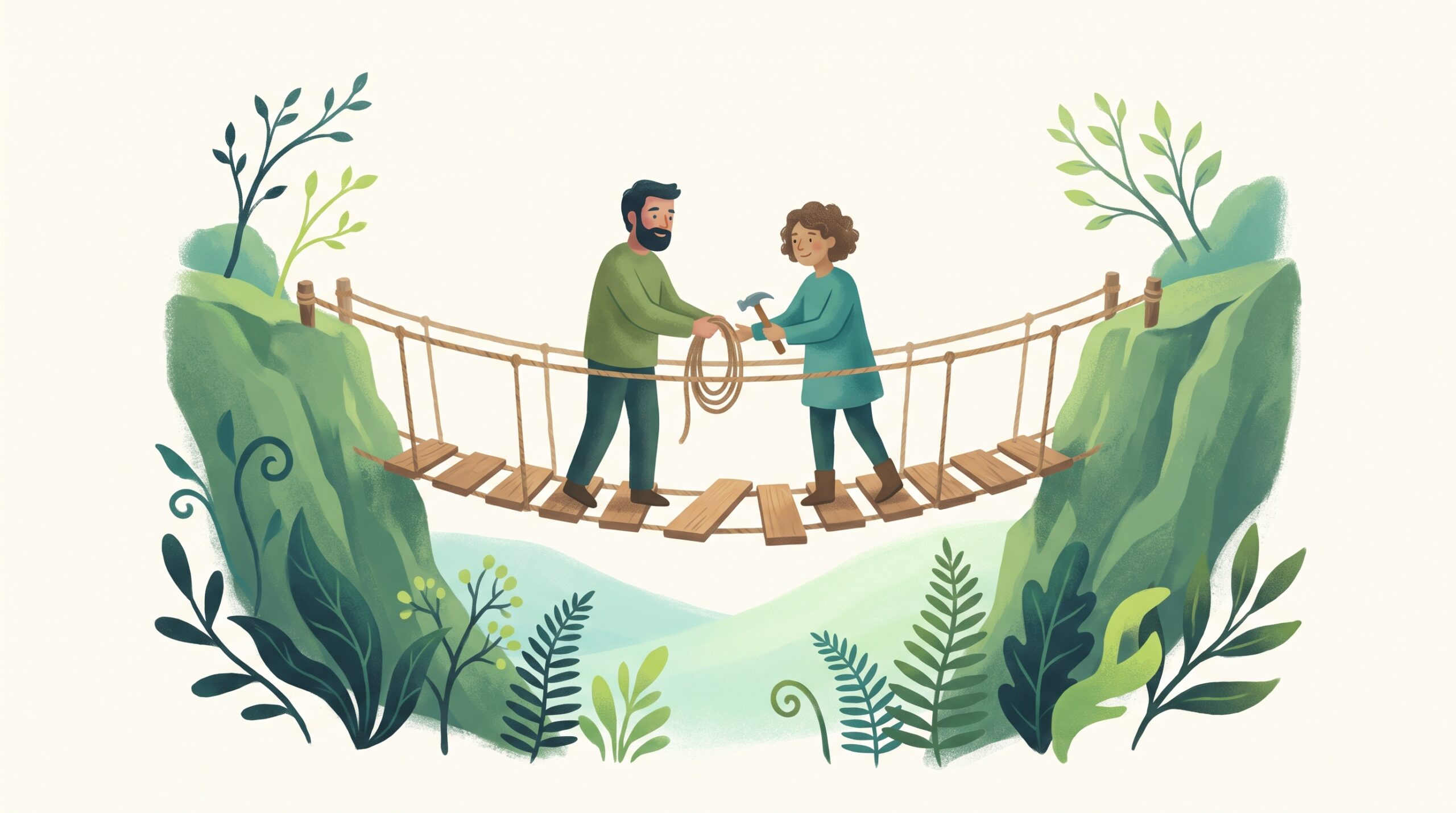
Couple therapy is not just “talking with a referee.” Systematic reviews conclude that couple therapy is effective for relationship distress and for a range of adult problems that live inside relationships — including depression and anxiety with a relational component (Carr, 2014). Meta-analytic reviews of the two most-studied approaches, behavioral couples therapy and emotionally focused therapy, find both produce meaningful improvement in couple distress — after treatment, the average couple treated with BCT fares better than 83% of untreated couples, and with EFT better than 89% (Byrne et al., 2004; Johnson et al., 1999).
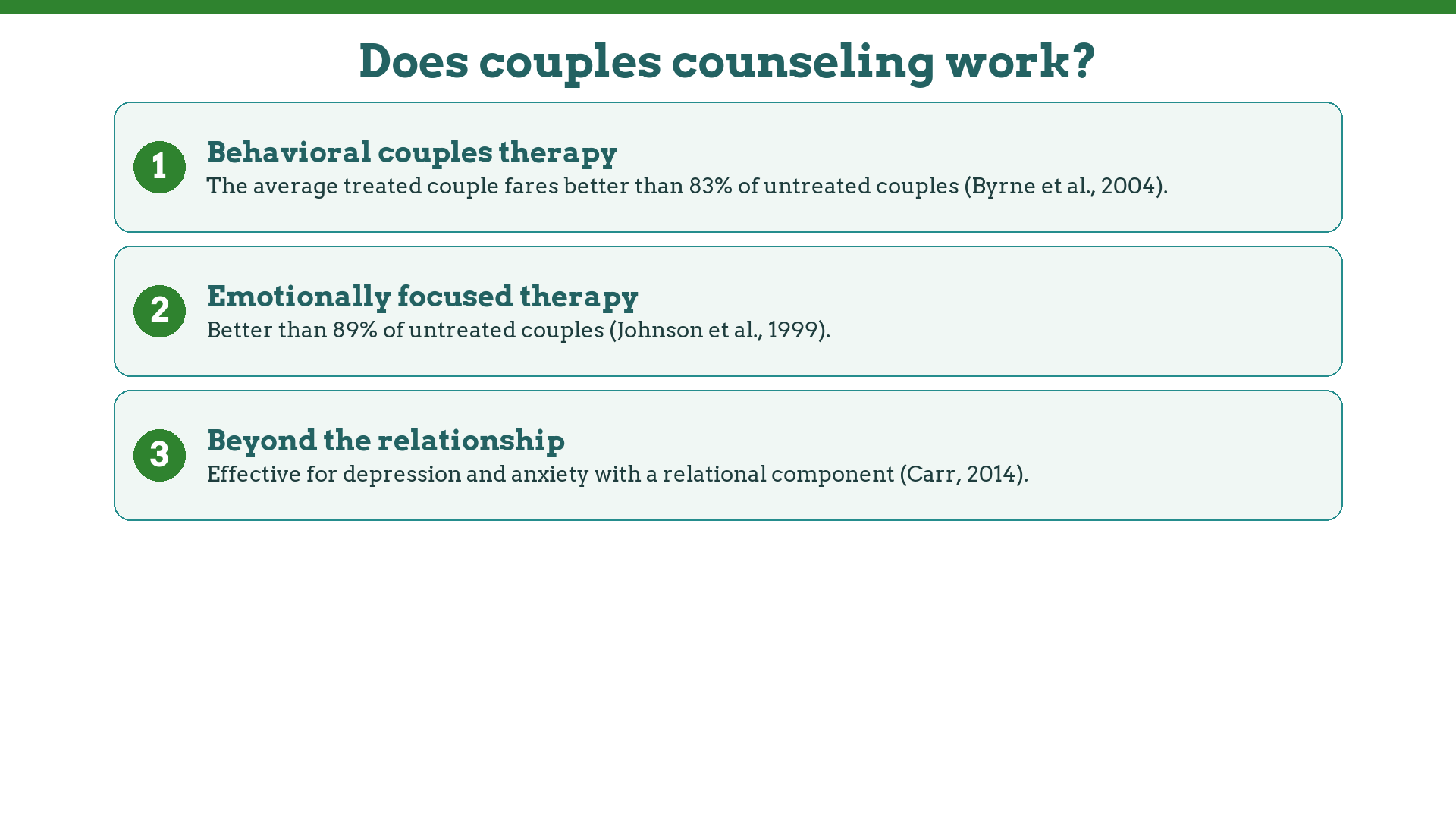
How we work: emotion, pattern, and skill

Our couples work draws primarily on Emotionally Focused Therapy (EFT) and the Gottman Method — two structured, extensively studied models — woven together with our own SEEDS Cycle tool for mapping the pattern two people get caught in.
EFT treats distress as a problem of attachment: the fights are rarely about the dishes; they’re about whether you can reach each other when it matters (Johnson, 2007). That should sound familiar to readers of Genesis — the first recorded marital conflict was two people hiding and blame-shifting when reaching for each other felt unsafe (Genesis 3:7–13). Research on EFT finds that the quality of the bond couples build in therapy — not how distressed they started — best predicts success (Johnson & Talitman, 1997). Communication skills matter, but they aren’t the whole story: longitudinal research shows communication and satisfaction influence each other in both directions (Lavner et al., 2016) — which is why we work on the heart of the pattern, not just the scripts. Scripture’s counsel is the same: “out of the abundance of the heart the mouth speaks” (Luke 6:45). Change the heart’s position, and the words follow.
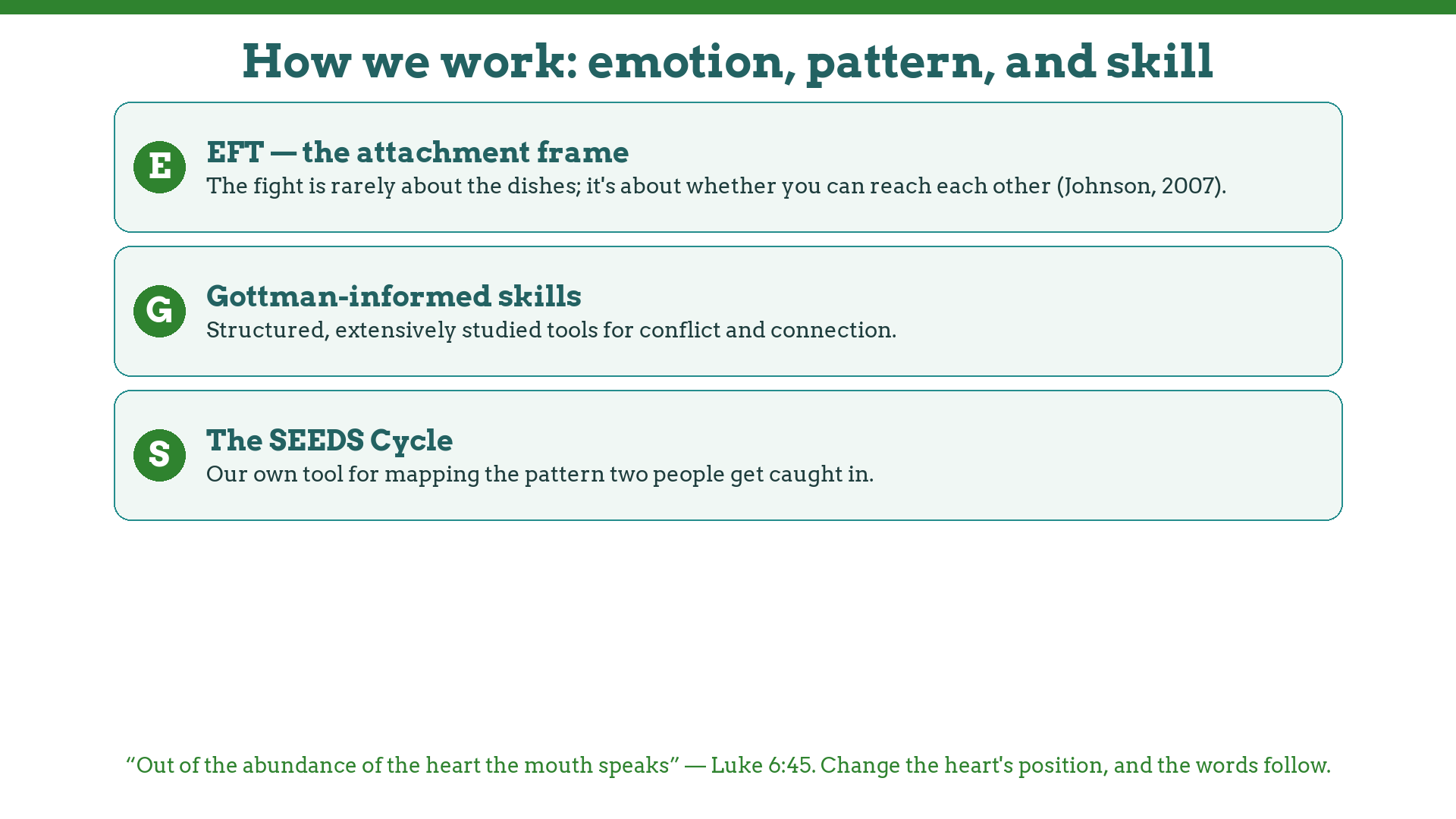
When addiction or betrayal is part of the story

This is where Restored Life is genuinely different. Many couples come to us carrying more than ordinary conflict: a discovered affair, a porn or sex addiction, trust in pieces. Behavioral couples therapy has meta-analytic support in addiction treatment — working with the couple outperforms individual-only treatment on both relationship satisfaction and use outcomes (Powers et al., 2008). And when trust has been broken, forgiveness — as a structured process, never a demand — has its own evidence base: forgiveness interventions reliably reduce depression and anxiety while increasing hope (Wade et al., 2014).
Our in-house model coordinates individual and couples work across two or three of our therapists — the addicted or offending partner’s recovery, the betrayed partner’s healing, and the couple’s repair — one team, one plan. See betrayal trauma counseling and infidelity counseling for how we structure that care.
Intimacy and sexual struggles

The Bible is not embarrassed by marital sexuality — an entire book celebrates it — and neither are we. Sexual struggles are treatable and nothing to be ashamed of bringing to counseling: a systematic review and meta-analysis found psychological interventions effective for sexual dysfunctions (Frühauf et al., 2013). We address intimacy directly, respectfully, and in the context of your convictions.
Starting strong: premarital counseling and relationship education

You don’t have to wait for trouble — wise builders count the cost before they build (Luke 14:28). A meta-analytic study of marriage and relationship education programs finds meaningful effects on relationship quality and communication (Hawkins et al., 2011). Read more in our guide to premarital counseling.
Counseling that honors the covenant

We are a Christian practice, and for couples that changes the frame of everything above: your marriage is a covenant before God, not a contract of mutual convenience — which means the goal of counseling is not merely less conflict but real love: patient, kind, keeping no record of wrongs (1 Corinthians 13:4–5). The research supports the integration: religiously and spiritually integrated psychotherapy performs at least as well as standard approaches (Smith et al., 2007; Captari et al., 2018), and healthy shared faith practice is associated with better well-being (Koenig, 2012). We bring prayer, forgiveness, and covenant theology alongside EFT and Gottman-informed clinical work — at the depth you invite, because grace never coerces. Couples who don’t share our faith are fully welcome and receive the same excellent clinical care.
Couples counseling in Glendale, AZ — and online

We provide couples counseling in person in Glendale, Arizona (17230 N 59th Ave, inside Faith Bible Church — serving Glendale, Peoria, and the north Phoenix Valley) and by telehealth across Arizona and Washington. We accept most major insurance plans and offer a sliding scale with price ranges that fit real budgets. Want a simple starting point? Try our free tool Things to Try to Improve Relationships, or take the free Personal Challenges Survey — it includes a relationship-distress screen.
Start today

The best time to work on your marriage was years ago. The second-best time is now.
Save and share
Pin or share these — someone you love may need them today.
References
- Byrne, M., Carr, A., & Clark, M. (2004). The efficacy of behavioral couples therapy and emotionally focused therapy for couple distress. Contemporary Family Therapy, 26(4), 361–387. https://doi.org/10.1007/s10591-004-0642-9
- Captari, L. E., Hook, J. N., Hoyt, W., Davis, D. E., McElroy-Heltzel, S. E., & Worthington, E. L., Jr. (2018). Integrating clients’ religion and spirituality within psychotherapy: A comprehensive meta-analysis. Journal of Clinical Psychology, 74(11), 1938–1951. https://doi.org/10.1002/jclp.22681
- Carr, A. (2014). The evidence base for couple therapy, family therapy and systemic interventions for adult-focused problems. Journal of Family Therapy, 36(2), 158–194. https://doi.org/10.1111/1467-6427.12033
- Frühauf, S., Gerger, H., Schmidt, H. M., Munder, T., & Barth, J. (2013). Efficacy of psychological interventions for sexual dysfunction: A systematic review and meta-analysis. Archives of Sexual Behavior, 42(6), 915–933. https://doi.org/10.1007/s10508-012-0062-0
- Hawkins, A. J., Stanley, S. M., Blanchard, V. L., & Albright, M. (2011). Exploring programmatic moderators of the effectiveness of marriage and relationship education programs: A meta-analytic study. Behavior Therapy, 43(1), 77–87. https://doi.org/10.1016/j.beth.2010.12.006
- Holt-Lunstad, J., Birmingham, W., & Jones, B. Q. (2008). Is there something unique about marriage? The relative impact of marital status, relationship quality, and network social support on ambulatory blood pressure and mental health. Annals of Behavioral Medicine, 35(2), 239–244. https://doi.org/10.1007/s12160-008-9018-y
- Holt-Lunstad, J., Smith, T. B., & Layton, J. B. (2010). Social relationships and mortality risk: A meta-analytic review. PLoS Medicine, 7(7), e1000316. https://doi.org/10.1371/journal.pmed.1000316
- Johnson, S. M. (2007). The contribution of emotionally focused couples therapy. Journal of Contemporary Psychotherapy, 37(1), 47–52. https://doi.org/10.1007/s10879-006-9034-9
- Johnson, S. M., Hunsley, J., Greenberg, L., & Schindler, D. (1999). Emotionally focused couples therapy: Status and challenges. Clinical Psychology: Science and Practice, 6(1), 67–79. https://doi.org/10.1093/clipsy.6.1.67
- Johnson, S. M., & Talitman, E. (1997). Predictors of success in emotionally focused marital therapy. Journal of Marital and Family Therapy, 23(2), 135–152. https://doi.org/10.1111/j.1752-0606.1997.tb00239.x
- Koenig, H. G. (2012). Religion, spirituality, and health: The research and clinical implications. ISRN Psychiatry, 2012, 278730. https://doi.org/10.5402/2012/278730
- Lavner, J. A., Karney, B. R., & Bradbury, T. N. (2016). Does couples’ communication predict marital satisfaction, or does marital satisfaction predict communication? Journal of Marriage and Family, 78(3), 680–694. https://doi.org/10.1111/jomf.12301
- Powers, M. B., Vedel, E., & Emmelkamp, P. M. G. (2008). Behavioral couples therapy (BCT) for alcohol and drug use disorders: A meta-analysis. Clinical Psychology Review, 28(6), 952–962. https://doi.org/10.1016/j.cpr.2008.02.002
- Proulx, C. M., Helms, H. M., & Buehler, C. (2007). Marital quality and personal well-being: A meta-analysis. Journal of Marriage and Family, 69(3), 576–593. https://doi.org/10.1111/j.1741-3737.2007.00393.x
- Smith, T. B., Bartz, J., & Richards, P. S. (2007). Outcomes of religious and spiritual adaptations to psychotherapy: A meta-analytic review. Psychotherapy Research, 17(6), 643–655. https://doi.org/10.1080/10503300701250347
- Wade, N. G., Hoyt, W. T., Kidwell, J. E. M., & Worthington, E. L., Jr. (2014). Efficacy of psychotherapeutic interventions to promote forgiveness: A meta-analysis. Journal of Consulting and Clinical Psychology, 82(1), 154–170. https://doi.org/10.1037/a0035268
Method note: sources were identified via OpenAlex and Scite literature search and screened for retractions and editorial notices via Scite before citation; one EFT-related study carrying an editorial notice was excluded. Scripture quotations are from the ESV. This page was prepared with AI assistance and reviewed by Restored Life Counseling’s clinical staff.
Related: the Relationship Challenges Survey