

Process the pain without shame. Regain your footing. Heal — whatever your marriage decides.
Scripture names this wound
“It is not an enemy who taunts me — then I could bear it… But it is you, a man, my equal, my companion, my familiar friend. We used to take sweet counsel together; within God’s house we walked in the throng” (Psalm 55:12–14). Long before psychology had a word for it, the Bible had a psalm for it: the deepest human wound is not inflicted by an enemy but by the one who shared your table, your bed, your faith. And God did not exempt Himself — Jesus was betrayed with a kiss, by a friend, at close range (Luke 22:47–48). Whatever you are carrying into this page, you are not carrying it before a God who doesn’t understand.
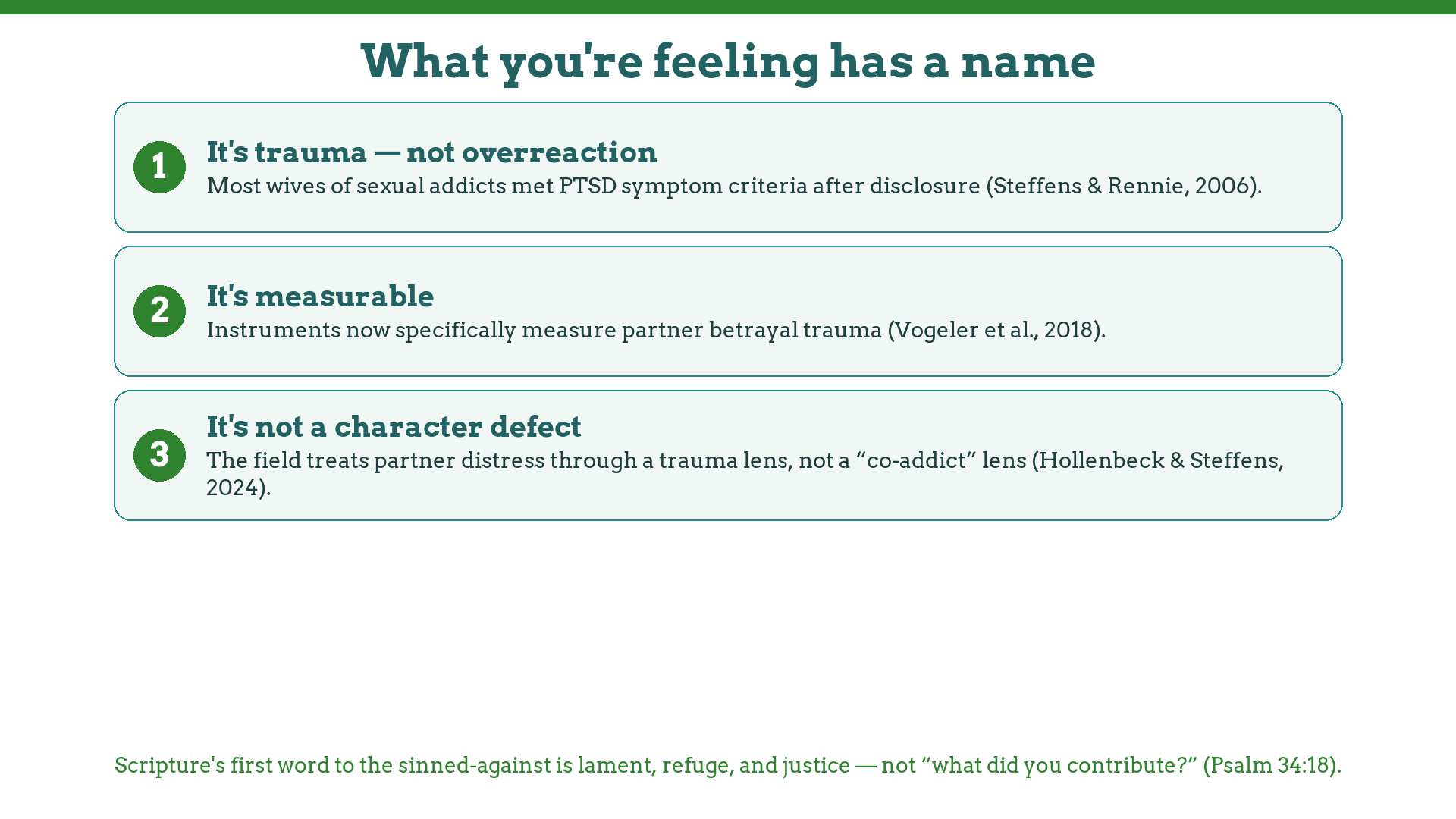
What you’re feeling has a name

If you discovered your partner’s sexual betrayal — an affair, a hidden porn or sex addiction, a secret life — and you can’t sleep, can’t stop checking, can’t stop replaying it, you are not crazy and you are not overreacting. In the landmark study of wives of sexual addicts, most met the symptom criteria for posttraumatic stress disorder following disclosure (Steffens & Rennie, 2006) — and instruments developed since specifically measure this trauma in partners (Vogeler et al., 2018). Newer research with female partners documents the same profound disruption to well-being, safety, and identity (Seyed Aghamiri et al., 2024), and clinical work with sexually betrayed partners increasingly treats betrayal anger and distress through a trauma lens rather than a “co-addict” lens — your symptoms are a normal response to a profound relational injury, not a character defect (Hollenbeck & Steffens, 2024).
That trauma lens is also the biblical one: Scripture’s category for you is the one sinned against — and its first word to the sinned-against is not “what did you contribute?” but lament, refuge, and justice (Psalm 34:18).
We wrote more about this in our most-read article: FAQ about therapeutic disclosure.
Why betrayal wounds so deeply
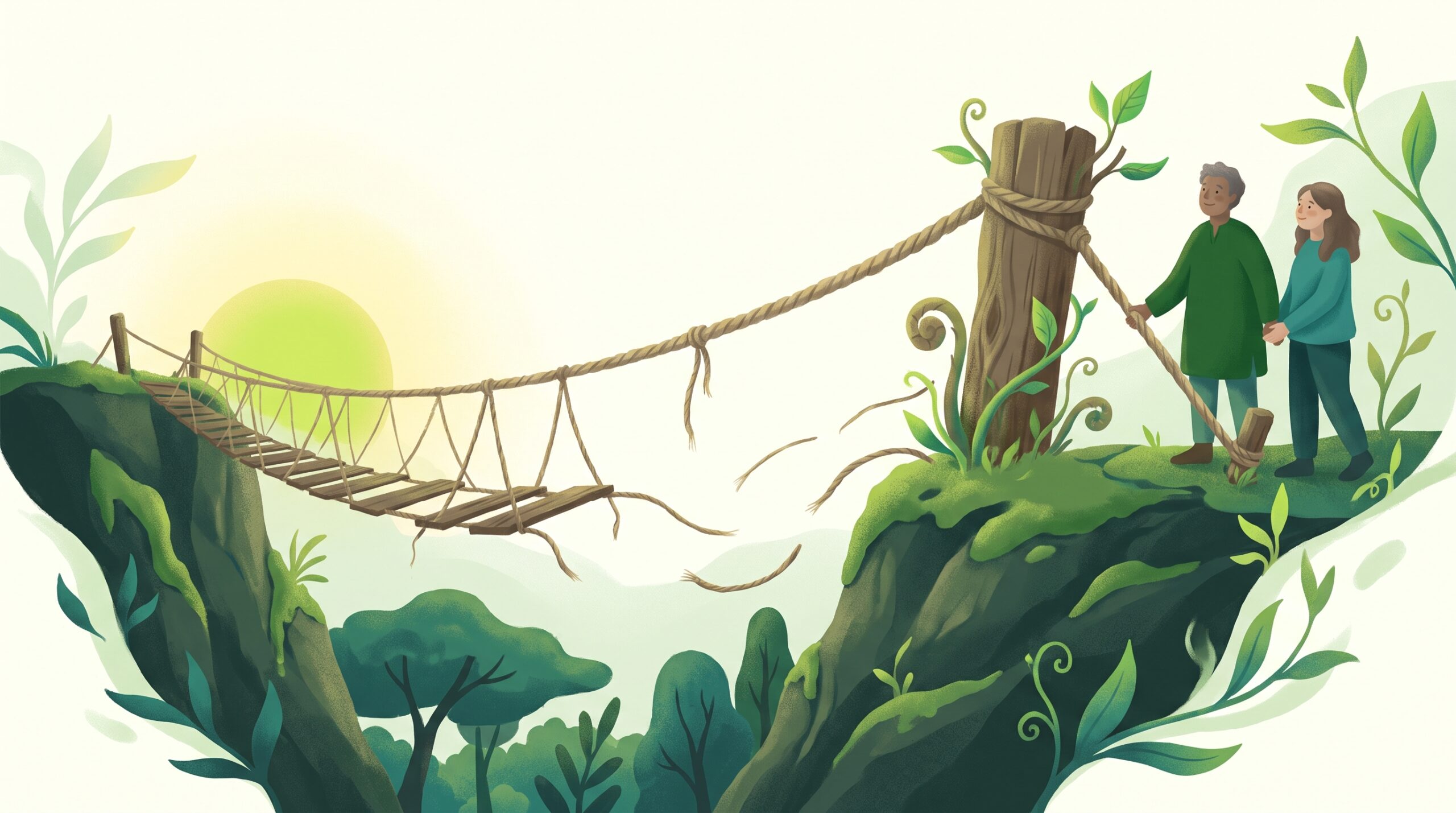
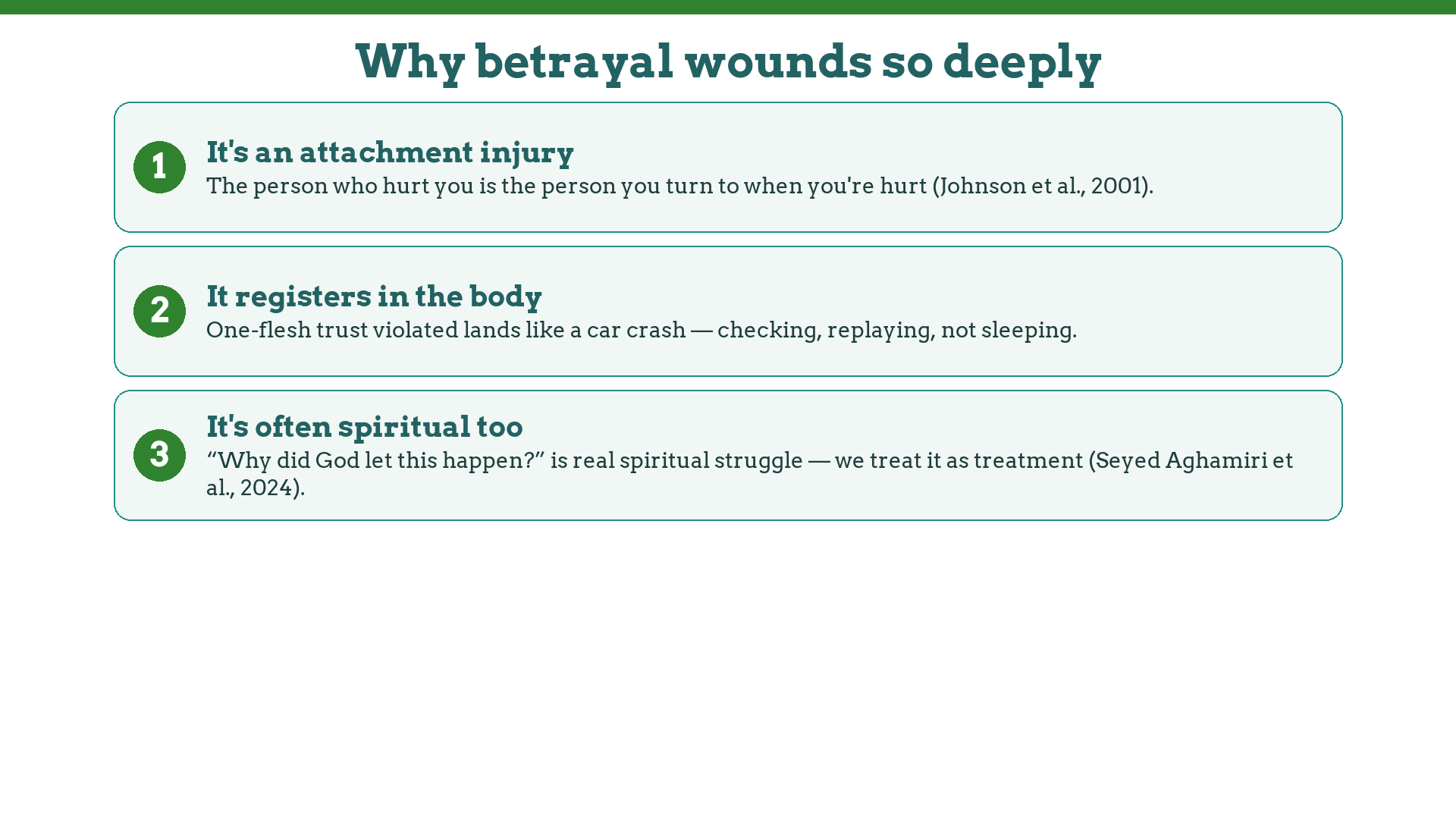
God made marriage to be one-flesh trust — “naked and unashamed” (Genesis 2:24–25) — which is precisely why its violation registers in the body like a car crash. Betrayal trauma is an attachment wound: the person who hurt you is the person you turn to when you’re hurt. That’s why it destabilizes everything. In couple-therapy research this is called an attachment injury — a moment of abandonment or betrayal that becomes the lens for the whole relationship (Johnson et al., 2001) — and Emotionally Focused Therapy, one of the best-validated couple approaches (Johnson et al., 1999), has a specific clinical process for healing the attachment injury of marital infidelity (Schade & Sandberg, 2012).
For many of our clients the wound is also spiritual — and the research documents it: female partners of sexual addicts report real spiritual struggle after discovery — anger at God, shaken trust, “why did God let this happen?” (Seyed Aghamiri et al., 2024). We treat those questions as treatment, not small talk. The Psalms of lament exist because God invites His people to bring Him exactly this — accusation, grief, and all — and psalm after psalm of lament models how.
How betrayal trauma counseling works here

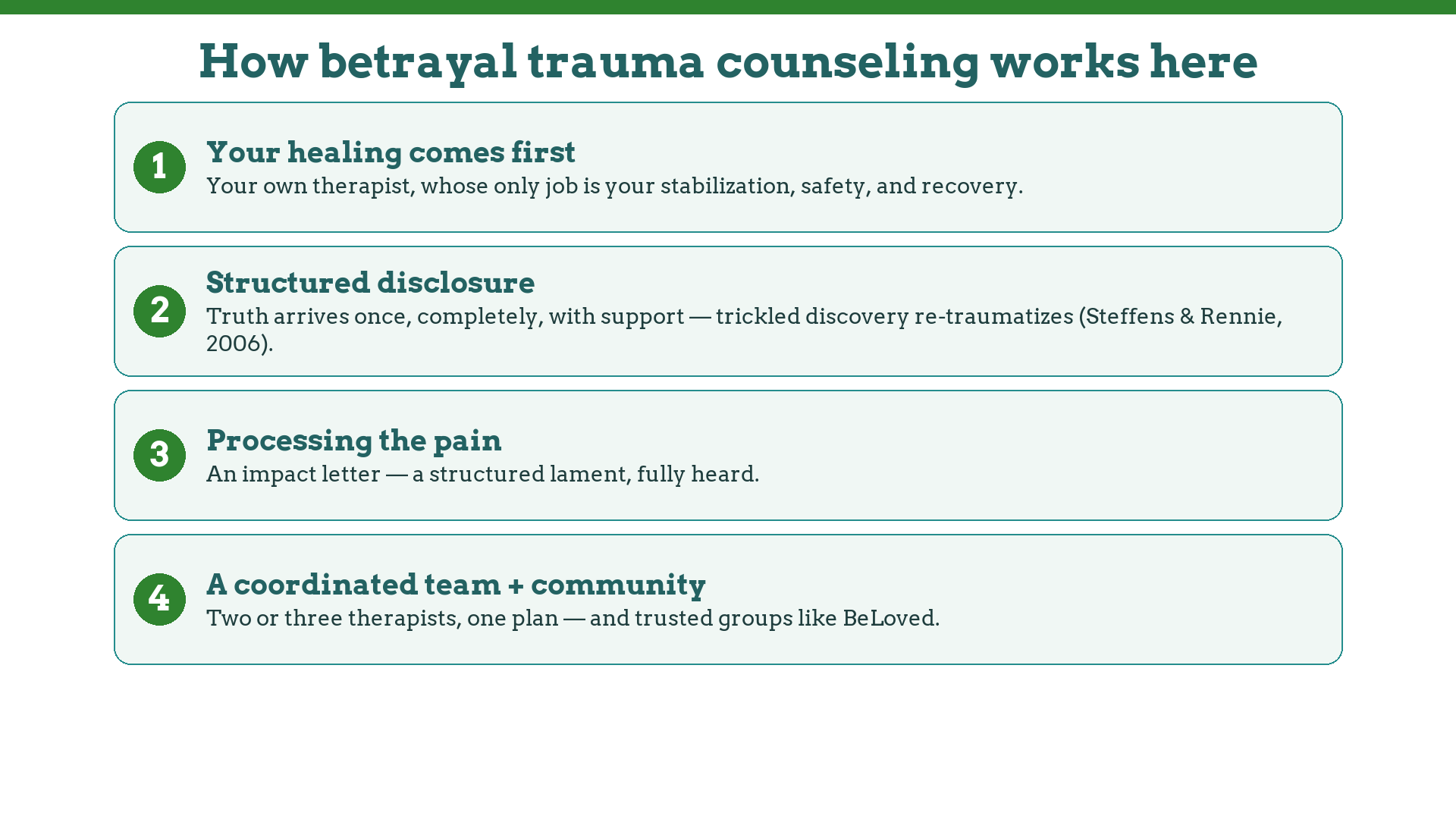
- Your healing comes first. You get your own therapist, whose only job is your stabilization, safety, and recovery — regardless of what happens to the relationship. You bear the image of God in your own right; you are not an accessory to someone else’s recovery.
- Structured, therapist-guided disclosure. Trickled-out discoveries re-traumatize — the research on disclosure is why we insist truth arrive once, completely, with support in the room (Steffens & Rennie, 2006). “Speak the truth in love” (Ephesians 4:15) is a clinical protocol here, not a plaque. (Start with our disclosure FAQ.)
- Processing the pain. Many partners find an impact letter a powerful step in being fully heard — a structured lament, addressed to the person who needs to hear it.
- A coordinated team. When the couple works toward repair, our in-house model coordinates two or three therapists — your individual work, your partner’s recovery work (see sex addiction and porn addiction), and couples work — one team, one plan.
- Community. You should not carry this alone (Galatians 6:2). We refer to trusted groups, including the BeLoved Women program for spouses through Revive 40.
Can the relationship recover?

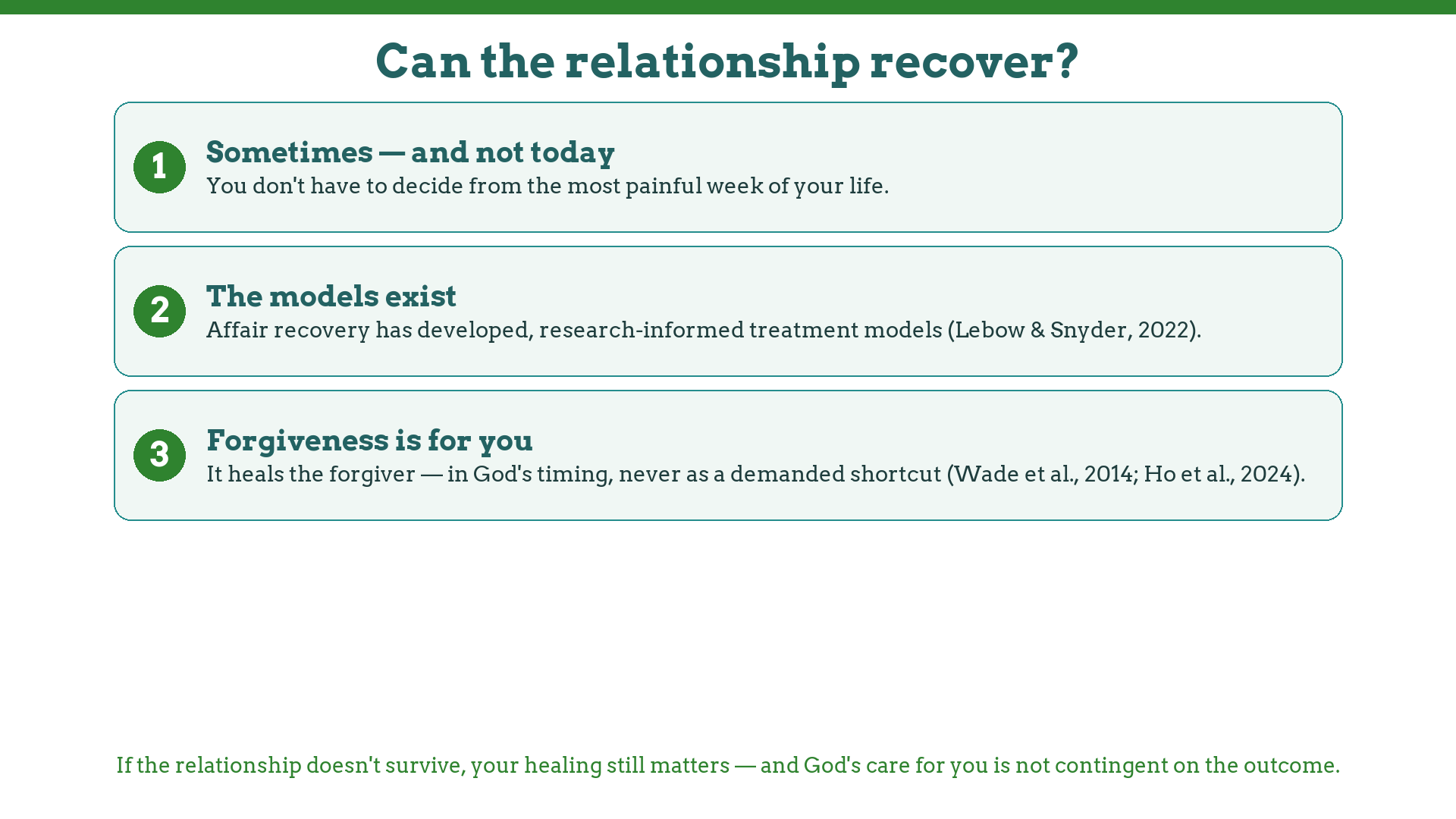
Sometimes — and the decision doesn’t have to be made today. Leading reviews of couple therapy identify affair recovery as an area with developed, research-informed treatment models (Lebow & Snyder, 2022), and couples who complete infidelity-focused couple therapy improve at rates comparable to distressed couples without infidelity (Atkins et al., 2010).
A word about forgiveness, because someone has probably already pressured you with it. Biblical forgiveness is never a demanded shortcut, and it is not reconciliation, and it is not pretending. It is a process — one the research says heals the forgiver: a meta-analysis of forgiveness interventions found they reliably reduce depression and anxiety while increasing hope (Wade et al., 2014), and a multisite randomized trial of the REACH forgiveness model confirmed reduced depression and anxiety symptoms (Ho et al., 2024). Forgiveness is for you, in God’s timing — not a hall pass for the one who hurt you.
And if the relationship does not survive the betrayal, your healing still matters, and God’s care for you is not contingent on the outcome. We’ll walk with you either way. If you’re weighing that question, our article Is it even possible to recover from the ultimate betrayal? is a good place to start.
Counseling where your faith is a resource, not a casualty

Many of our clients arrive having been told to “just forgive and move on” — counsel that added hurt instead of healing. We are a Christian practice, and that shapes everything above: lament is biblical, boundaries are biblical, truth-telling is biblical, and grace is never coercive. The evidence says this integration helps: religiously and spiritually integrated psychotherapy performs at least as well as standard approaches (Smith et al., 2007), with added benefit for spiritual well-being (Captari et al., 2018) — so your faith can be a resource in your healing rather than a casualty of the betrayal.
Betrayal trauma counseling in Glendale, AZ — and online

We provide betrayal trauma counseling in person in Glendale, Arizona (17230 N 59th Ave, inside Faith Bible Church — serving Glendale, Peoria, and the north Phoenix Valley) and by telehealth across Arizona and Washington. Our team is supervised by a CSAT (Certified Sex Addiction Therapist) with specific training in partner betrayal trauma. We accept most major insurance plans and offer a sliding scale with price ranges.
Start today

You didn’t choose this wound. You can choose your healing. “He heals the brokenhearted and binds up their wounds” (Psalm 147:3) — and He often does it through people trained for exactly this.
Save and share
Pin or share these — someone you love may need them today.
References
- Atkins, D. C., Marín, R. A., Lo, T. T. Y., Klann, N., & Hahlweg, K. (2010). Outcomes of couples with infidelity in a community-based sample of couple therapy. Journal of Family Psychology, 24(2), 212–216. https://doi.org/10.1037/a0018789
- Captari, L. E., Hook, J. N., Hoyt, W., Davis, D. E., McElroy-Heltzel, S. E., & Worthington, E. L., Jr. (2018). Integrating clients’ religion and spirituality within psychotherapy: A comprehensive meta-analysis. Journal of Clinical Psychology, 74(11), 1938–1951. https://doi.org/10.1002/jclp.22681
- Ho, M. Y., Worthington, E. L., Cowden, R. G., Bechara, A. O., Chen, Z. J., et al. (2024). International REACH forgiveness intervention: A multisite randomised controlled trial. BMJ Public Health, 2(1), e000072. https://doi.org/10.1136/bmjph-2023-000072
- Hollenbeck, C. M., & Steffens, B. (2024). Betrayal trauma anger: Clinical implications for therapeutic treatment based on the sexually betrayed partner’s experience. Journal of Sex & Marital Therapy. https://doi.org/10.1080/0092623x.2024.2306940
- Johnson, S. M., Makinen, J. A., & Millikin, J. W. (2001). Attachment injuries in couple relationships: A new perspective on impasses in couples therapy. Journal of Marital and Family Therapy, 27(2), 145–155. https://doi.org/10.1111/j.1752-0606.2001.tb01152.x
- Johnson, S. M., Hunsley, J., Greenberg, L., & Schindler, D. (1999). Emotionally focused couples therapy: Status and challenges. Clinical Psychology: Science and Practice, 6(1), 67–79. https://doi.org/10.1093/clipsy.6.1.67
- Lebow, J. L., & Snyder, D. K. (2022). Couple therapy in the 2020s: Current status and emerging developments. Family Process, 61(4), 1359–1385. https://doi.org/10.1111/famp.12824
- Schade, L. C., & Sandberg, J. G. (2012). Healing the attachment injury of marital infidelity using emotionally focused couples therapy: A case illustration. American Journal of Family Therapy, 40(5), 434–444. https://doi.org/10.1080/01926187.2011.631374
- Seyed Aghamiri, F., Luetz, J. M., & Hills, K. (2024). The lived experiences and well-being of female partners following discovery or disclosure of their male partner’s sexual betrayal. Sexuality Research and Social Policy. https://doi.org/10.1007/s13178-024-01043-x
- Seyed Aghamiri, F., Luetz, J. M., & Hills, K. (2024). Why did God let this happen? Assessing the spiritual impacts of sexual addiction on intimate female partners. Sexuality & Culture. https://doi.org/10.1007/s12119-024-10221-3
- Smith, T. B., Bartz, J., & Richards, P. S. (2007). Outcomes of religious and spiritual adaptations to psychotherapy: A meta-analytic review. Psychotherapy Research, 17(6), 643–655. https://doi.org/10.1080/10503300701250347
- Steffens, B. A., & Rennie, R. L. (2006). The traumatic nature of disclosure for wives of sexual addicts. Sexual Addiction & Compulsivity, 13(2–3), 247–267. https://doi.org/10.1080/10720160600870802
- Vogeler, H. A., Fischer, L., Sudweeks, R. R., & Skinner, K. B. (2018). An examination of the factor structure of the Trauma Inventory for Partners of Sex Addicts (TIPSA). Sexual Addiction & Compulsivity, 25(1), 46–64. https://doi.org/10.1080/10720162.2018.1452086
- Wade, N. G., Hoyt, W. T., Kidwell, J. E. M., & Worthington, E. L., Jr. (2014). Efficacy of psychotherapeutic interventions to promote forgiveness: A meta-analysis. Journal of Consulting and Clinical Psychology, 82(1), 154–170. https://doi.org/10.1037/a0035268
Method note: sources were identified via OpenAlex and Scite literature search and screened for retractions and editorial notices via Scite before citation. Scripture quotations are from the ESV. This page was prepared with AI assistance and reviewed by Restored Life Counseling’s clinical staff.