

When life is overwhelming, most of us do one of two things with our emotions. We bury them, telling ourselves a faithful person should not feel this way. Or we let them run the show, and the fear or anger or grief becomes the loudest voice in the room. Neither one brings the feeling to God. Both leave us alone with it.
The Psalms offer a third way. In this one book, God has given us the whole range of human emotion, put into words, and prayed back to Him. Grief, rage, terror, guilt, loneliness, betrayal, longing, and even the desire to see enemies fall, none of it is edited out. Every emotion a person can feel is here, expressed honestly and yet directed upward, to God, in a way that keeps faith and feeling in the same breath. The Psalms do not ask you to calm down before you pray. They teach you how to pray while you are still shaking.
There is a reason this works, and it is not only spiritual. Naming a painful emotion in specific words begins to loosen its grip on us. Brain imaging studies find that the simple act of putting feelings into words quiets the brain’s emotional alarm centers (Lieberman et al., 2007), and decades of research on expressive writing show that giving honest language to a painful experience measurably improves both emotional and physical health (Pennebaker & Beall, 1986).
The practice

You will need a blank sheet of paper, a pen, and a Bible. Set aside enough unhurried time that you are not rushing. This is not a reading assignment. It is prayer with a pen in your hand.
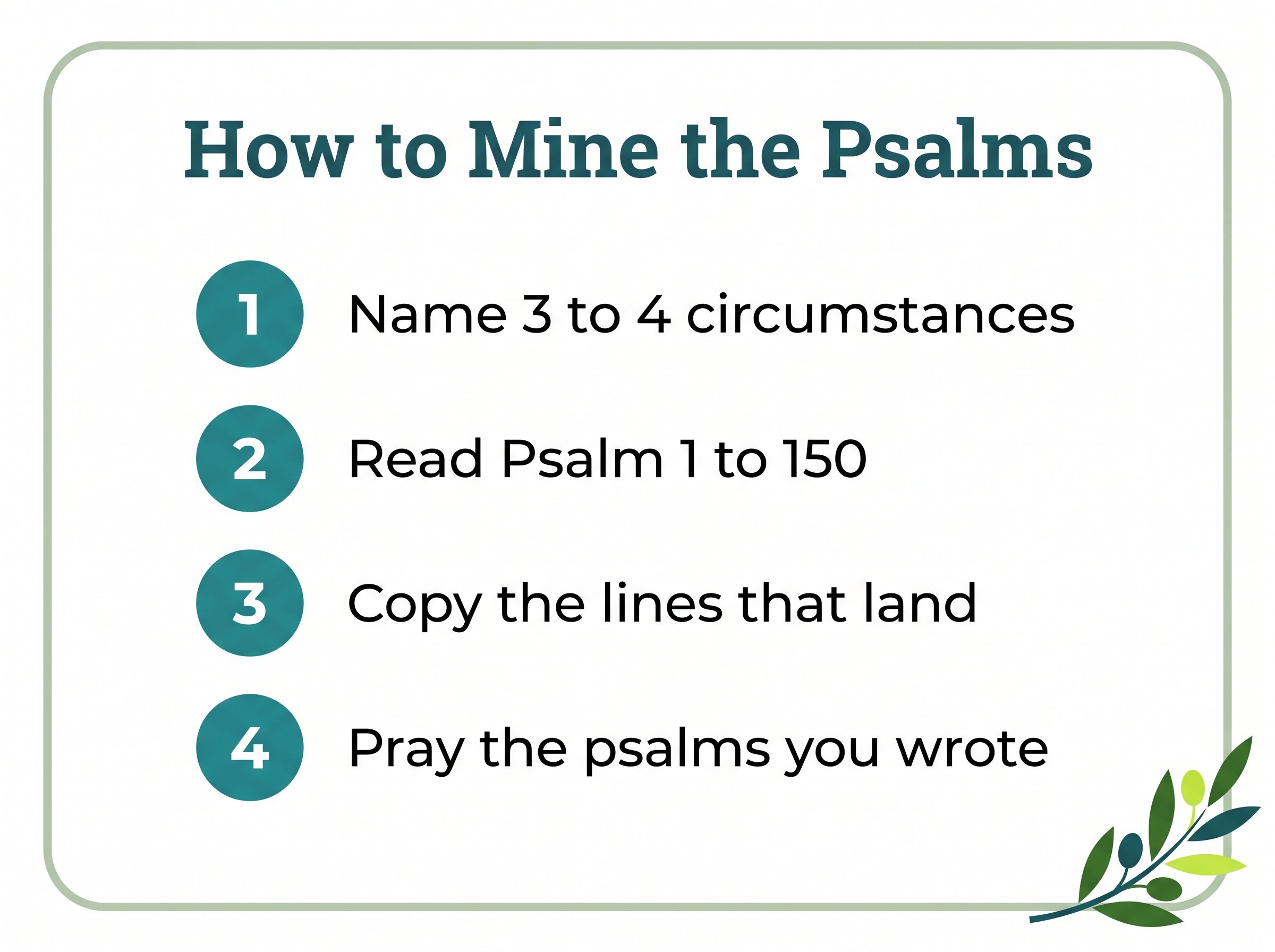
Step one. Name the circumstances. At the top of the page, write out three or four of the situations weighing on you right now. Keep them concrete and personal. Not “stress,” but “my daughter will not speak to me.” Not “money,” but “I do not know how we make rent next month.” Space them across the top of the page like headings on a spreadsheet, one column for each. Leave the rest of the page open underneath them.
Step two. Start reading, slowly, from the beginning. Open to Psalm 1 and begin to read, working your way toward Psalm 150. You are not trying to finish. You are listening. Read at the pace of prayer, letting the lines pass through you rather than past you.
Step three. Copy the lines that land. When a line or a phrase resonates with one of your situations, when it says the thing you have not been able to say, stop and copy it out by hand under that heading. You do not have to explain why. If a verse speaks to more than one column, write it under both. Some columns will fill quickly. Some will stay nearly empty for a long stretch and then fill all at once. Trust that. Keep going.
Step four. Read the psalm you have written. When you reach the end, or the end of your time, look at what has gathered under each heading. You will find that you have written three or four psalms of your own, personal and specific, built entirely from God’s own words, that express exactly what you are carrying, and express it in a way that is honest before God and still bent toward Him. This is your prayer.
How to use them
These personalized psalms are prayer guides, not one-time exercises. Keep the page. When you go to pray about that circumstance and the words will not come, read your psalm for it back to God, slowly, as your prayer. On the hard days it gives you language when you have none. On the better days it reminds you where you have already brought this, and to Whom.
Come back and mine again as circumstances change. A new season brings new columns, and the same Psalms will surrender different lines to you than they did before.

Do not carry it alone

The last step is not on the page. Choose two or three people who are walking with you through these challenges, and share your psalms with them. Not the whole world, just the few who have earned the right to hear the honest version. Let them read what you wrote. Let them pray these words back over you. Scripture makes this our calling, not merely our comfort: “Bear one another’s burdens, and so fulfill the law of Christ” (Galatians 6:2). We were built to carry each other, and the research bears the same truth out. Close, supportive relationships buffer the damage that stress does to the mind and body, so that a burden shared with trusted people weighs far less than the same burden carried alone (Cohen & Wills, 1985). What we name in the company of those who love us loses much of its power to isolate us, and the circumstance that felt like it was only yours becomes something carried together.
The Psalms were, after all, the prayer book of a whole people. They were never meant to be prayed alone.
Save and share
Pin or share these, someone you love may need them today.

How to use this with a counselor
This practice pairs naturally with counseling. It is good between-sessions work: a way to put the specific things weighing on you into words you can then talk through with someone trained to help you carry them. If mining the Psalms opens something you would rather not hold on your own, our team is here, in person in Glendale, AZ and online across Arizona and Washington.
If you are not sure where to begin, a few companion pieces walk alongside this one: Therapeutic Journaling, Things to Try to Improve Mood, and Things to Try to Overcome Chaos, and, if anxiety is part of what overwhelms you, it is never too late to reach out. Our free self-assessments can also help you name where you are right now.
A note on the research
- Cohen, S., & Wills, T. A. (1985). Stress, social support, and the buffering hypothesis. Psychological Bulletin, 98(2), 310-357. https://doi.org/10.1037/0033-2909.98.2.310
- Lieberman, M. D., Eisenberger, N. I., Crockett, M. J., Tom, S. M., Pfeifer, J. H., & Way, B. M. (2007). Putting feelings into words: Affect labeling disrupts amygdala activity in response to affective stimuli. Psychological Science, 18(5), 421-428. https://doi.org/10.1111/j.1467-9280.2007.01916.x
- Pennebaker, J. W., & Beall, S. K. (1986). Confronting a traumatic event: Toward an understanding of inhibition and disease. Journal of Abnormal Psychology, 95(3), 274-281. https://doi.org/10.1037/0021-843x.95.3.274