

The whole truth, told once, with help — because a marriage cannot heal around a lie.
Truth-telling is where healing starts

“Whoever conceals his transgressions will not prosper, but he who confesses and forsakes them will obtain mercy” (Proverbs 28:13). When a marriage has been shattered by sexual betrayal — an affair, a hidden pornography or sex addiction, a secret life — Scripture and clinical research converge on the same uncomfortable point: concealment keeps everyone sick, and structured truth-telling, painful as it is, is where real repair begins.
In recovery from betrayal trauma, infidelity, and sexual addiction, a formal disclosure process is widely considered the standard of care, and there are published clinical guidelines for how therapists should conduct it (Corley & Schneider, 2002). It usually comes after the couple has navigated an initial stabilization phase, and it is one of the hardest steps in recovery — therapists often compare it to re-breaking a bone that healed incorrectly: intensely painful in the moment, but structurally necessary for true healing.
Formal disclosure is not mandatory. But in the largest survey of recovering sex addicts and their partners, the overwhelming majority of both spouses — the one who told the truth and the one who had to hear it — later said disclosure had been the right thing (Schneider, Corley & Irons, 1998). It gives the betrayed partner the missing pieces of their own reality, ends the psychological damage of gaslighting, and establishes a baseline of truth from which trust can slowly be rebuilt. “You will know the truth, and the truth will set you free” (John 8:32) is not a decoration here; it is the treatment plan.
Why a formal disclosure — and why not “drip disclosure”

The natural instinct of someone caught in secret sin is to admit only what has already been discovered. The result is what clinicians call staggered or “drip” disclosure — truth arriving in painful installments, each one re-opening the wound. The research is blunt about the cost: disclosure and discovery are experienced by partners as genuinely traumatic — in the landmark study of wives of sexual addicts, most met the symptom criteria for posttraumatic stress disorder (Steffens & Rennie, 2006) — and repeated partial disclosures were common and corrosive in couples who tried to manage the truth piecemeal (Schneider et al., 1998). Secrets are not even kind to the one keeping them: the psychological burden of secrecy harms well-being long after the moment of concealment has passed (Slepian, Chun & Mason, 2017).
The Bible has been saying this all along. “Take no part in the unfruitful works of darkness, but instead expose them… when anything is exposed by the light, it becomes visible” (Ephesians 5:11, 13). “If we walk in the light, as he is in the light, we have fellowship with one another” (1 John 1:7). Formal disclosure is not punishment. It is ending the lie — completely, once, with clinical support in the room — so that the betrayed partner can make fully informed decisions about their own future. That agency matters theologically: the betrayed spouse bears the image of God in their own right, and a decision to stay, or to go, made inside someone else’s fiction is not a free decision at all.
When disclosure should wait

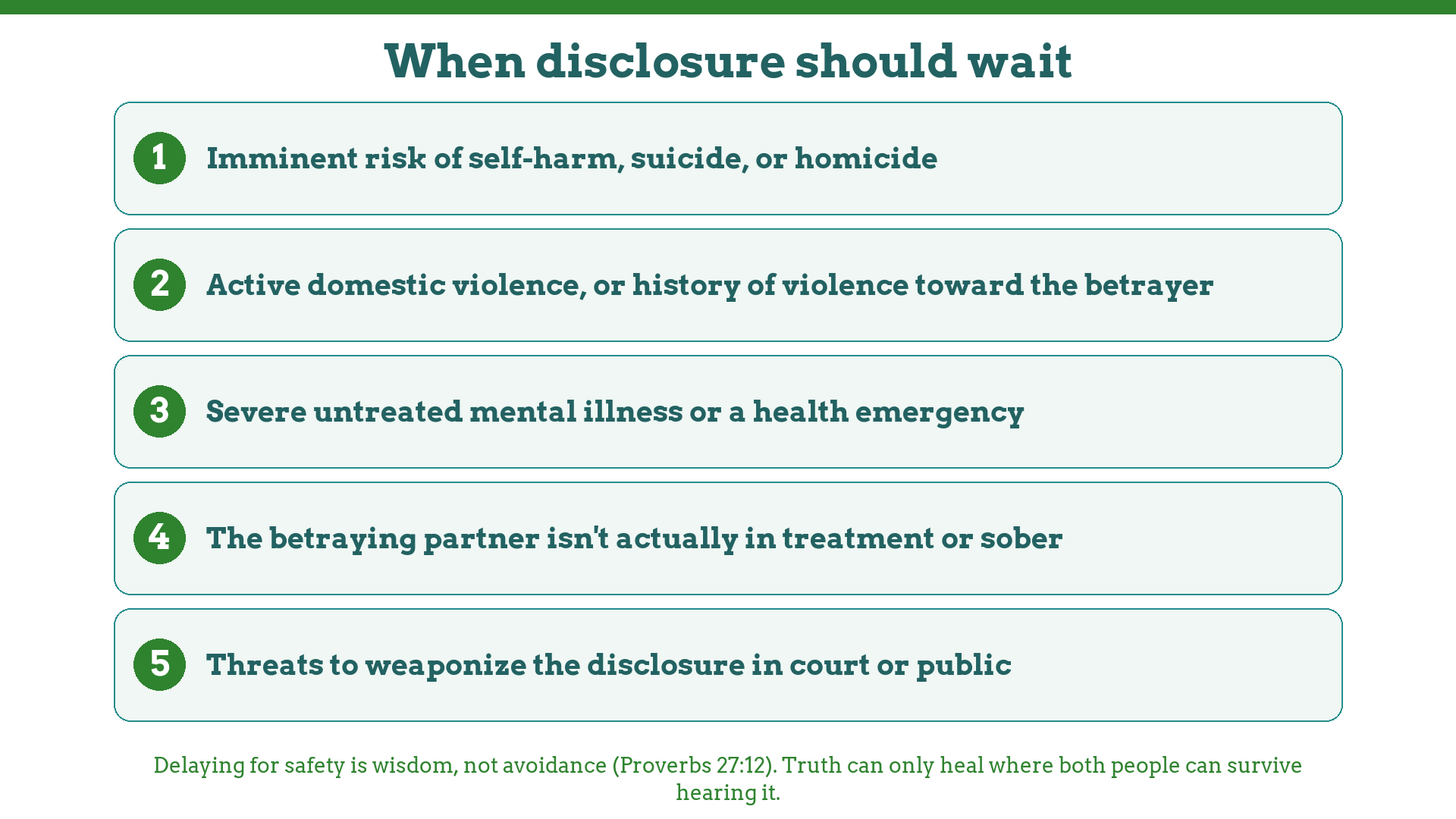
“A time to keep silence, and a time to speak” (Ecclesiastes 3:7). A formal disclosure should never be a spontaneous event, and it is not clinically appropriate in every situation. A treatment team will typically delay or cancel a formal disclosure if any of the following are present:
- Imminent risk of self-harm, suicide, or homicide.
- Active domestic violence, or a history of physical violence toward the betraying partner.
- Severe, untreated mental illness or a health emergency in either partner.
- The betraying partner is not actively engaged in treatment or sobriety.
- Threats to weaponize the disclosure — using the documents in public exposure, media, or custody and court battles.
Delaying disclosure for safety is wisdom, not avoidance (Proverbs 27:12). The goal is truth that heals, and truth can only heal in conditions where both people can survive hearing it.
Counting the cost together: informed consent and the BRAIN framework

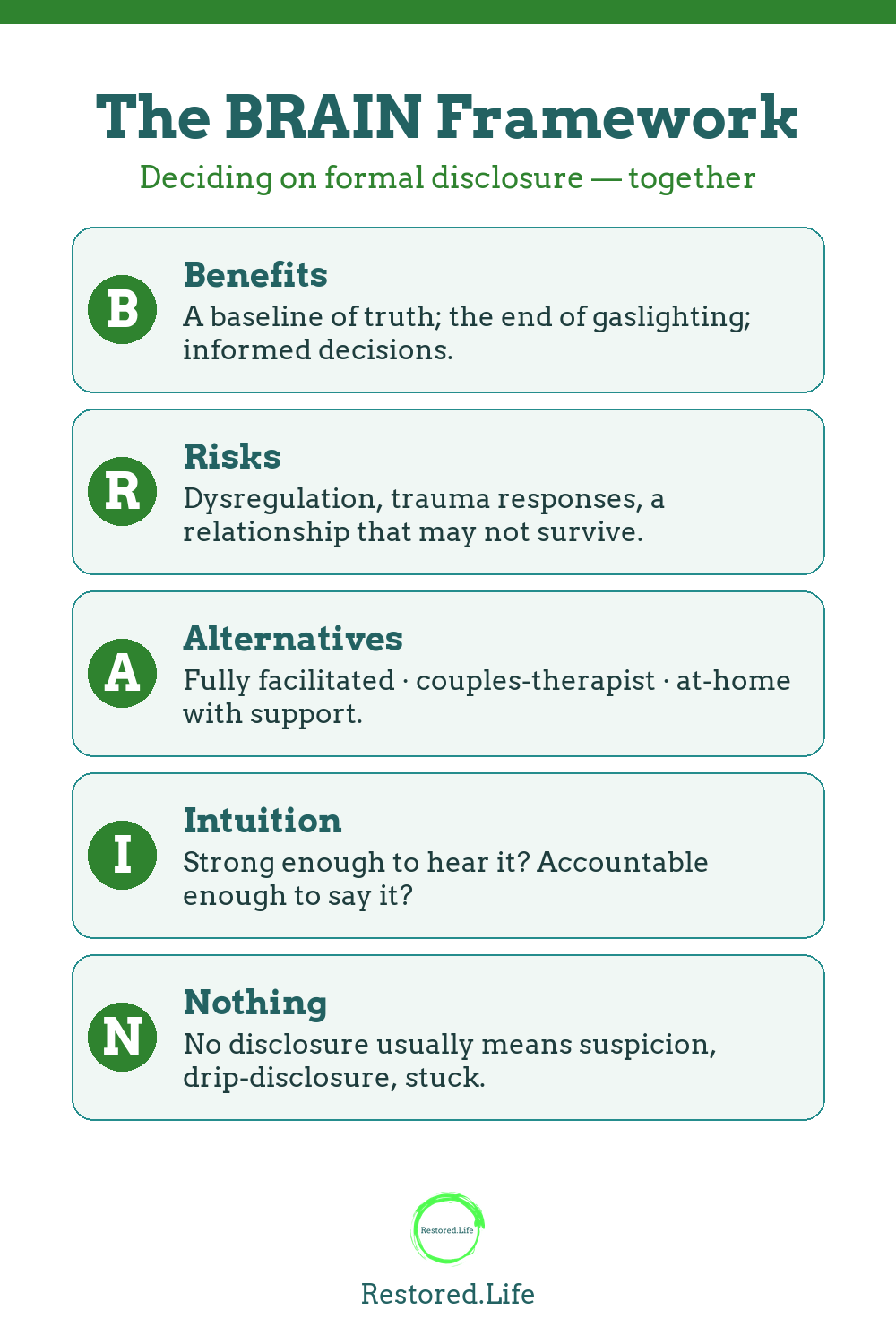
Jesus told would-be disciples to count the cost before building the tower (Luke 14:28). Couples preparing for disclosure do the same. With their treatment team, they work through the BRAIN framework to establish genuine informed consent:
- B — Benefits. A baseline of truth; the end of gaslighting; the betrayed partner’s ability to make fully informed decisions; a foundation on which trust might eventually be rebuilt.
- R — Risks. Severe emotional dysregulation; trauma responses; the real possibility that the relationship does not survive the disclosed truth; “pain shopping” if the process isn’t strictly controlled.
- A — Alternatives. The disclosure environment is a real decision: fully facilitated (conjoint) with both partners’ individual therapists present — the gold standard with the highest level of clinical support; couples-therapist facilitated; or an at-home disclosure, with support people rigorously pre-arranged for the immediate aftermath.
- I — Intuition. Does the betrayed partner feel strong enough? Does the betraying partner seem genuinely accountable — or still defensive?
- N — Nothing. What happens if there is no formal disclosure? Usually: a relationship stuck in suspicion, drip-disclosure, and unresolved trauma, where true reconciliation stays impossible.
Both partners then sign consent forms acknowledging the realities of the process: formal disclosure carries no guarantees of future honesty, ongoing sobriety, or the relationship’s survival; therapists are mandated reporters if the disclosure reveals child abuse, elder abuse, or child sexual abuse material; and the betrayed partner will not take home a copy of the disclosure letter — a guardrail against pain shopping and legal misuse.
The three letters

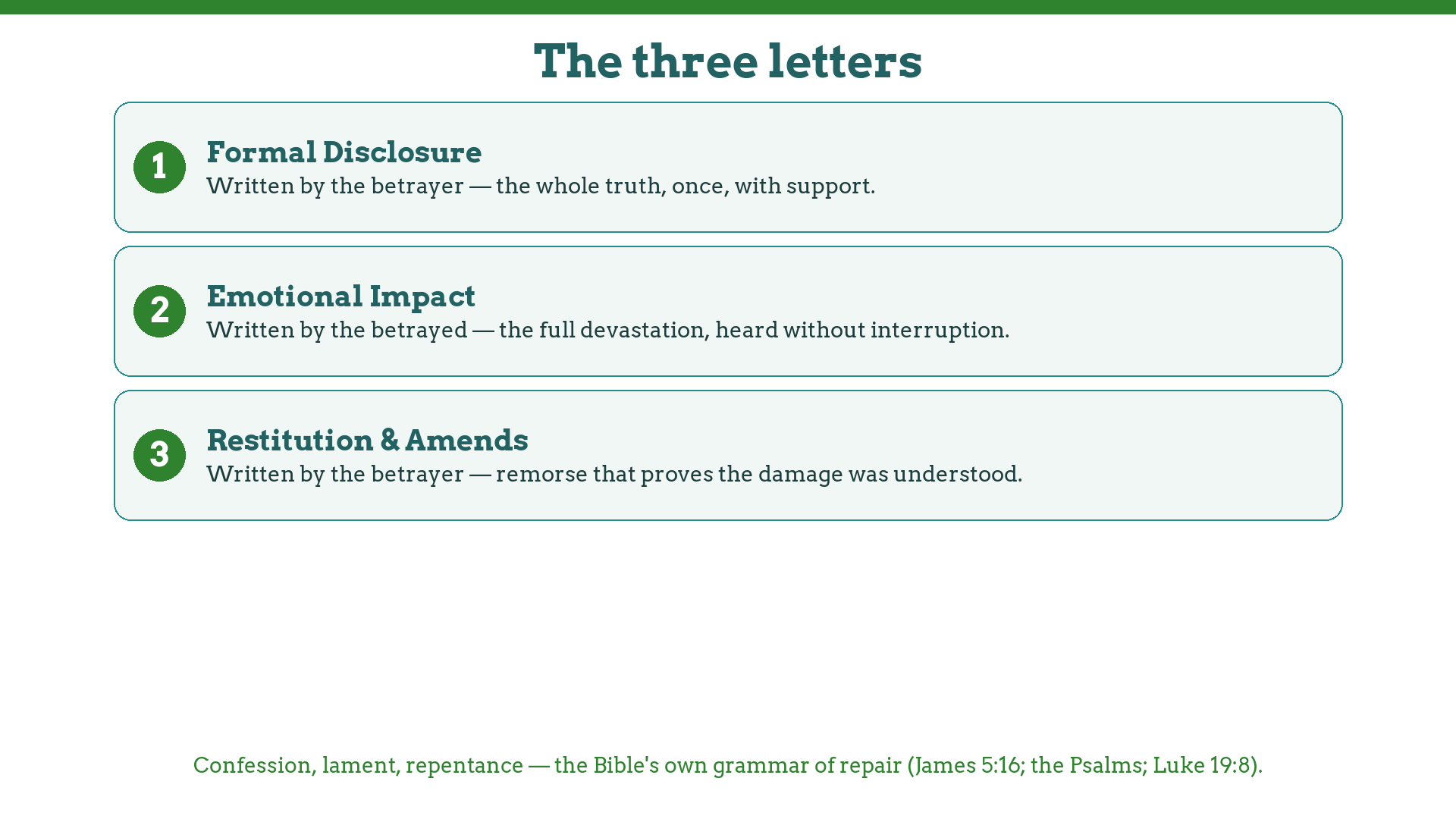
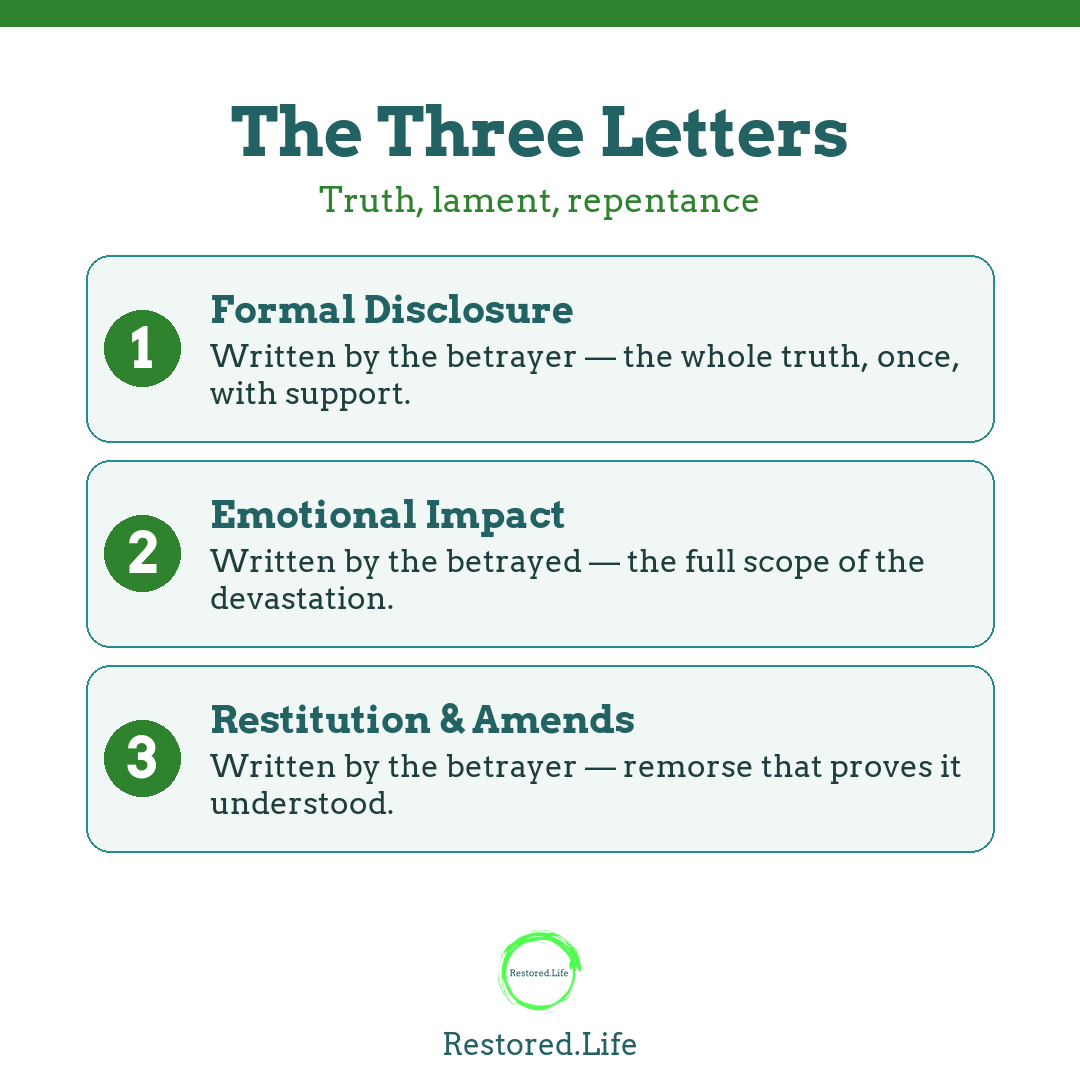
The process is built around three structured letter readings, spaced over time: the Formal Disclosure Letter (written by the betrayer), the Emotional Impact Letter (written by the betrayed partner), and the Emotional Restitution — or Amends — Letter (written by the betrayer). That arc closely mirrors what infidelity researchers have found couples need — a structured movement through impact, meaning-making, and moving forward (Gordon, Baucom & Snyder, 2004) — and it mirrors the Bible’s own grammar of repair: confession (James 5:16), lament (the Psalms), then repentance expressed in concrete amends (Luke 19:8).
The “three hot days” and the ground rules
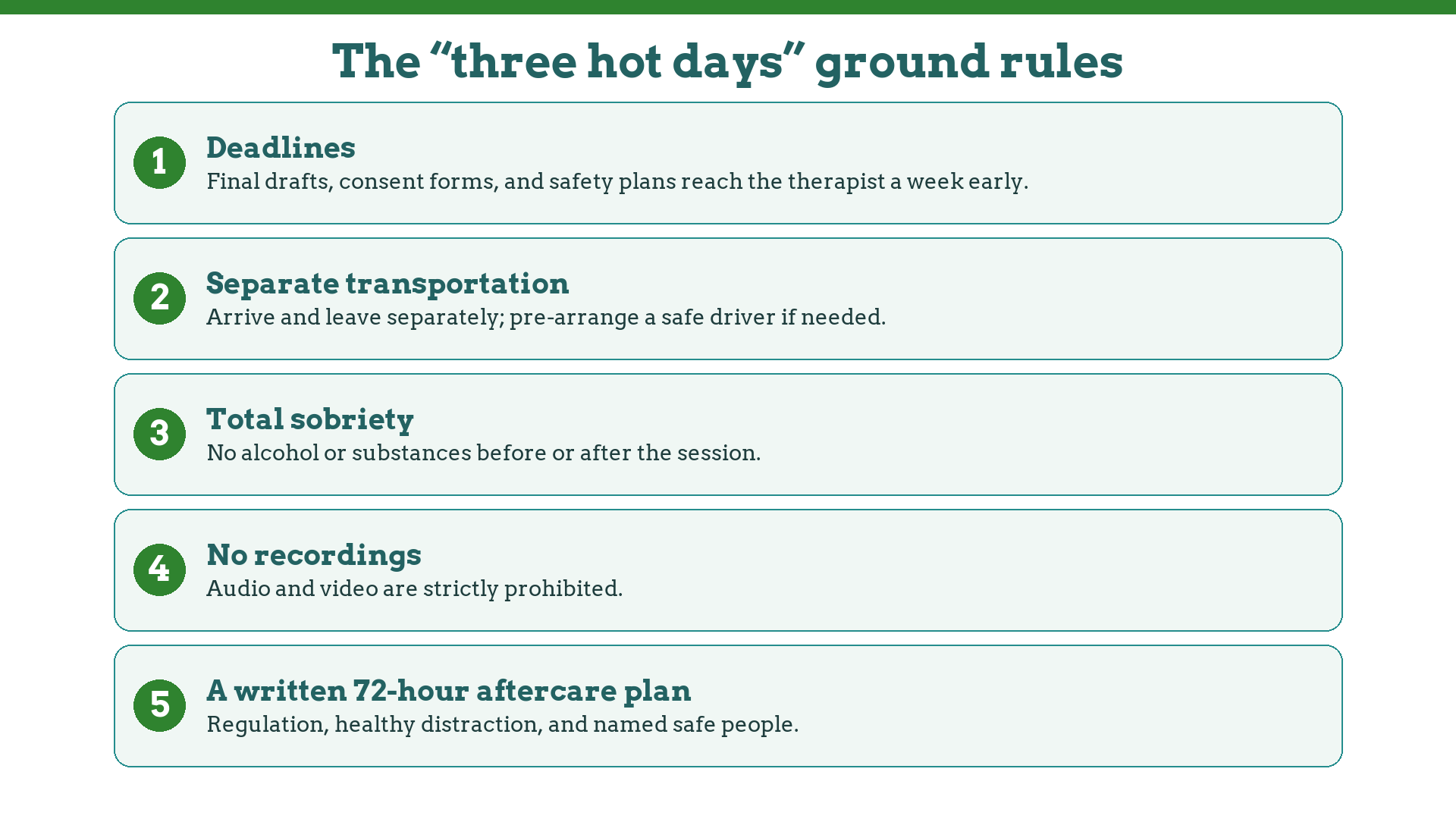
The day of any letter reading and the 72 hours that follow are colloquially known as the “three hot days.” To navigate them, a rigid structure applies to all three sessions:
- Deadlines. Final drafts, consent forms, and safety plans reach the facilitating therapist at least one week before the reading.
- Separate transportation. Partners arrive and leave separately; anyone too anxious to drive pre-arranges a safe driver.
- Sobriety. No alcohol or substance use before or after the session.
- No recordings. Audio or video recording is strictly prohibited.
- A written safety plan. Each partner documents a 72-hour aftercare plan: nervous-system regulation, healthy distraction, and named safe people — sponsors, therapists, trusted friends — to contact.
A typical session runs two to three hours with a consistent agenda: ground rules; a brief breakout for each partner to regulate with their individual therapist; the letter reading; a second breakout; clarifying questions (pre-planned and filtered in advance); a final breakout; a private therapist conference; and a closing conversation about immediate safety and next steps.
Writing the disclosure: rigorous honesty with guardrails

When David finally stopped concealing, his confession named what he had done without a single excuse (Psalm 51:3–4). The formal disclosure letter demands the same posture — rigorous honesty inside careful boundaries. It is not the place for apologies, emotional explanations, or minimizing.
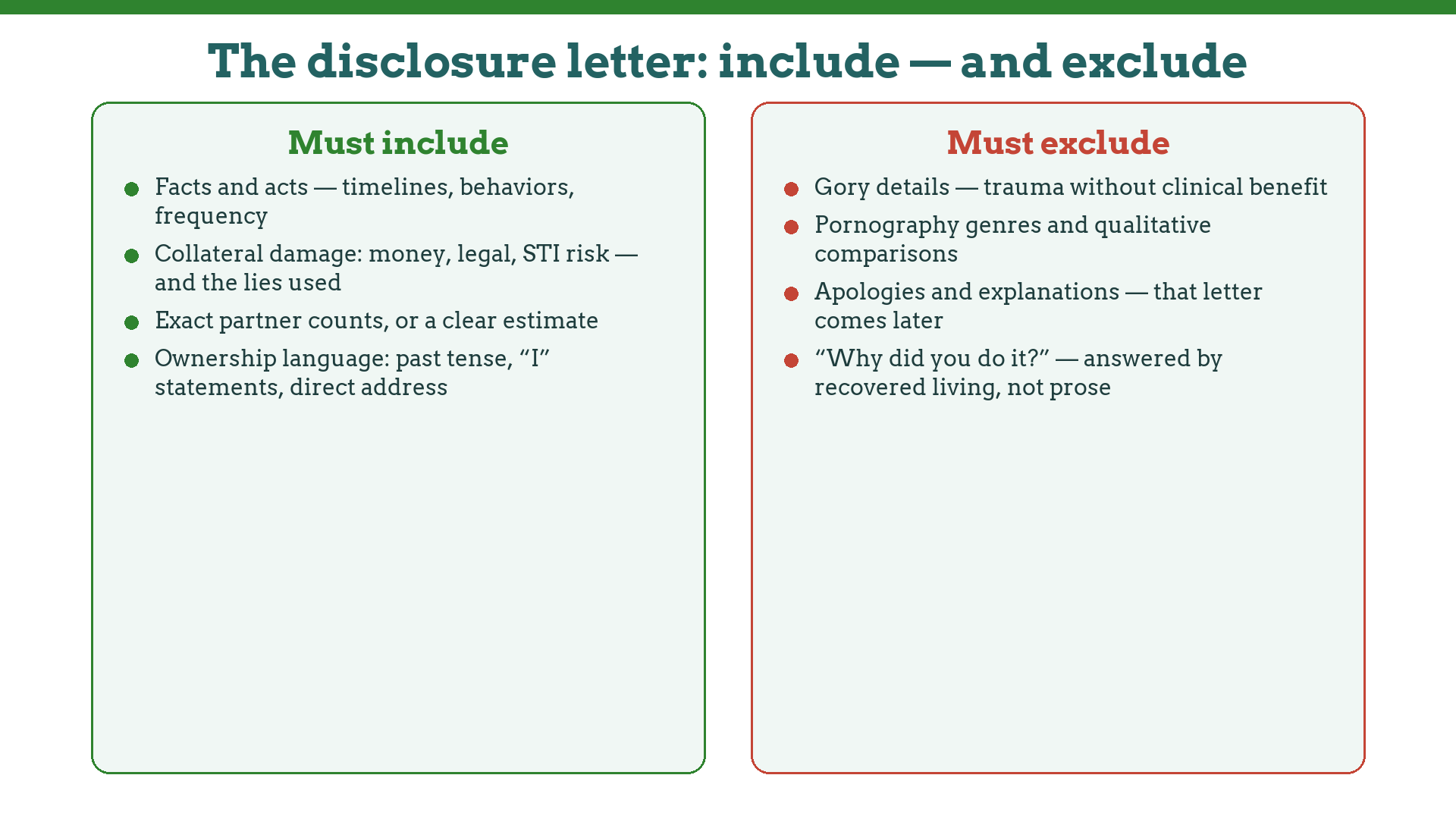
What the letter must include:
- Facts and acts. Chronological timelines, specific behaviors, locations, frequency. Where memory fails, the betrayer says “to the best of my recollection” and gives a high-side estimate.
- Collateral damage. Money spent, illegal activity, STI risk, professional exposure — and the specific lies and gaslighting used to cover it all up.
- Exact partner counts, or a clear estimate where an exact number is incalculable.
- Identities only when they matter. Acting-out partners are named only if the betrayed partner already knows them personally; otherwise they are referred to by gender.
What the letter must exclude:
- Gory details. Specific pornography genres, anatomical description, qualitative comparisons. These cause profound trauma and carry no clinical benefit.
- Story and meaning. “Why did you do it?” cannot be answered in a letter. It is answered by consistent recovered living over months and years.
The drafting rules enforce ownership: past tense, not conditional (“I left work early,” never “I would leave work early”); “I” statements; clinical, anatomically correct language; direct address (“I lied to you,” not “I lied to my wife”); and an explicit acknowledgment of the non-sexual betrayals — verbal abuse, financial hoarding, and every other behavior recruited to protect the addiction. Where deception has been profound, the treatment team may require the betrayer to pass a polygraph regarding the letter’s completeness before it is read.
This is the difference Scripture draws between godly grief that produces repentance and worldly grief that only mourns getting caught (2 Corinthians 7:10). A disclosure letter written to manage the betrayer’s image will fail. One written to set the record straight — whatever it costs — is confession in the biblical sense, and it is the only kind that helps.
The betrayed partner’s agency

The betrayed partner is not a passive recipient of this process; they help design it. Working with their own individual therapist — ideally one trained in partner betrayal trauma — they complete a pre-disclosure preparation worksheet specifying exactly what level of detail they want to hear (specific dates versus ranges; entire life history versus the relationship years only); they compile and filter clarifying questions, screening out traumatizing detail and unanswerable “why” questions; and they prepare through psychoeducation, with books like Mending a Shattered Heart (Carnes), Disclosing Secrets (Corley & Schneider), and Facing Heartbreak (Carnes, Lee & Rodriguez). If you are the betrayed partner: you set the depth. Nothing is read to you that you did not agree to hear.
The impact letter: a structured lament

Once truth is on the table, the betrayed partner writes and reads the Emotional Impact Letter — the full scope of the devastation, expressed without interruption or defense, across every domain it actually touched: physical and medical (sleep loss, weight change, STI exposure, panic attacks), emotional and spiritual (the lost sense of reality, depression, shaken faith), relational (parenting, isolation from friends and family), and financial and professional.
Christians sometimes fear this step is unspiritual — as if naming the damage were bitterness. The Psalms say otherwise: roughly a third of the Psalter is lament, truth about pain addressed to the one who needs to hear it. And the clinical research agrees that structured, written emotional disclosure carries measurable psychological benefit (Frattaroli, 2006). We’ve written more about this step in The hope of an impact letter in betrayal trauma.
The amends letter: the beginning of repentance, not the end

The final structured letter belongs to the betrayer again: the Emotional Restitution (Amends) Letter — the place for profound remorse, empathy, and apology. Its one rule: no new disclosures and no graphic detail. Its goal: to explicitly reference the pain named in the partner’s impact letter, demonstrating that the collateral damage has actually been understood — the way Zacchaeus’s repentance was measured in restitution, not sentiment (Luke 19:8).
Expectations need shepherding here. The letter may not be everything the betrayed partner hoped — or it may be the first time the addict takes true ownership. Either way, the partner’s feelings are valid, and space is given to process them safely. And a word about forgiveness, because someone has probably already pressured you with it: in both Scripture and the research literature, forgiveness in marriage is a process, not a demanded moment (Fincham, Hall & Beach, 2006); infidelity treatment models sequence it deliberately and never coerce it (Fife, Weeks & Stellberg-Filbert, 2011); and forgiveness interventions measurably reduce depression and anxiety in the forgiver (Wade et al., 2014) — it is a gift God works in you, in His timing, distinct from reconciliation and never a hall pass for the one who caused the harm.
After the letters

Disclosure establishes a baseline of truth. What gets built on it is a function of what happens next: consistent recovery behavior, rebuilt safety, and — where both spouses choose it — couples work. Research-informed affair-recovery models exist precisely for this road (Gordon et al., 2004), and the evidence says integrating your faith into that work helps rather than hinders: religiously and spiritually integrated psychotherapy performs at least as well as standard approaches (Smith, Bartz & Richards, 2007), with added benefit for spiritual well-being (Captari et al., 2018).
If you’re earlier in this journey, start with our overview pages: betrayal trauma counseling for the partner, sex addiction recovery and porn addiction recovery for the one who betrayed, couples counseling for the marriage, and our most-read article, FAQ about therapeutic disclosure.
Formal disclosure at Restored Life

We facilitate formal therapeutic disclosure in person in Glendale, Arizona (17230 N 59th Ave, inside Faith Bible Church — serving Glendale, Peoria, and the north Phoenix Valley) and by telehealth across Arizona and Washington. Our clinical team is supervised by a CSAT (Certified Sex Addiction Therapist), and our in-house model coordinates the therapists a disclosure needs — the betrayed partner’s individual work, the betrayer’s recovery work, and the couples work — as one team with one plan. We accept most major insurance plans and offer a sliding scale with published price ranges.
“He heals the brokenhearted and binds up their wounds” (Psalm 147:3). The truth will hurt before it heals. You don’t have to walk into it alone.
Save and share
Pin or share these — someone you love may need them today.

References
- Captari, L. E., Hook, J. N., Hoyt, W., Davis, D. E., McElroy-Heltzel, S. E., & Worthington, E. L., Jr. (2018). Integrating clients’ religion and spirituality within psychotherapy: A comprehensive meta-analysis. Journal of Clinical Psychology, 74(11), 1938–1951. https://doi.org/10.1002/jclp.22681
- Corley, M. D., & Schneider, J. P. (2002). Disclosing secrets: Guidelines for therapists working with sex addicts and co-addicts. Sexual Addiction & Compulsivity, 9(1), 43–67. https://doi.org/10.1080/107201602317346638
- Fife, S. T., Weeks, G. R., & Stellberg-Filbert, J. (2011). Facilitating forgiveness in the treatment of infidelity: An interpersonal model. Journal of Family Therapy, 35(4), 343–367. https://doi.org/10.1111/j.1467-6427.2011.00561.x
- Fincham, F. D., Hall, J. H., & Beach, S. R. H. (2006). Forgiveness in marriage: Current status and future directions. Family Relations, 55(4), 415–427. https://doi.org/10.1111/j.1741-3729.2005.callf.x-i1
- Frattaroli, J. (2006). Experimental disclosure and its moderators: A meta-analysis. Psychological Bulletin, 132(6), 823–865. https://doi.org/10.1037/0033-2909.132.6.823
- Gordon, K. C., Baucom, D. H., & Snyder, D. K. (2004). An integrative intervention for promoting recovery from extramarital affairs. Journal of Marital and Family Therapy, 30(2), 213–231. https://doi.org/10.1111/j.1752-0606.2004.tb01235.x
- Schneider, J. P., Corley, M. D., & Irons, R. R. (1998). Surviving disclosure of infidelity: Results of an international survey of 164 recovering sex addicts and partners. Sexual Addiction & Compulsivity, 5(3), 189–217. https://doi.org/10.1080/10720169808400162
- Slepian, M. L., Chun, J. S., & Mason, M. F. (2017). The experience of secrecy. Journal of Personality and Social Psychology, 113(1), 1–33. https://doi.org/10.1037/pspa0000085
- Smith, T. B., Bartz, J., & Richards, P. S. (2007). Outcomes of religious and spiritual adaptations to psychotherapy: A meta-analytic review. Psychotherapy Research, 17(6), 643–655. https://doi.org/10.1080/10503300701250347
- Steffens, B. A., & Rennie, R. L. (2006). The traumatic nature of disclosure for wives of sexual addicts. Sexual Addiction & Compulsivity, 13(2–3), 247–267. https://doi.org/10.1080/10720160600870802
- Wade, N. G., Hoyt, W. T., Kidwell, J. E. M., & Worthington, E. L., Jr. (2014). Efficacy of psychotherapeutic interventions to promote forgiveness: A meta-analysis. Journal of Consulting and Clinical Psychology, 82(1), 154–170. https://doi.org/10.1037/a0035268
Method note: sources were identified via OpenAlex literature search and screened for retractions and editorial notices via Scite before citation. Scripture quotations are from the ESV. This page describes Restored Life Counseling’s general clinical stances and best practices for formal therapeutic disclosure; it is educational, not a substitute for individualized clinical guidance. Prepared with AI assistance and reviewed by Restored Life Counseling’s clinical staff.